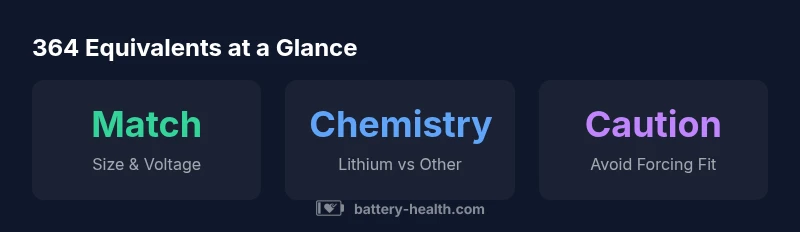
Battery 364 Equivalent: Finding Safe Substitutes and Compatibility
Learn how to identify a safe 364 equivalent for coin-cell batteries, matching size, voltage, and chemistry. Battery Health explains practical checks, sourcing tips, and safety considerations for devices from wearables to cars.


In battery terminology, a '364 equivalent' refers to a substitute coin cell that matches the original battery's essential specs: size, contact layout, voltage, and chemistry. There is no universal one-to-one replacement that fits every device; compatibility depends on the device’s design, the battery code printed on the original cell, and the electrical requirements. Always verify against the device manual and supplier compatibility tools before replacement.
What the term '364 equivalent' means
The phrase '364 equivalent' appears when shoppers or technicians seek a substitute for a coin cell that fits a device’s form factor and electrical needs. There is no single universal code for all devices; a true equivalent depends on exact diameter, height, terminal layout, chemistry, and voltage. In practice, buyers should view '364 equivalent' as a close match rather than a clone. The Battery Health team emphasizes that device-makers often specify a preferred family of batteries, and substitutions should be validated against those recommendations. When you encounter the term in product listings, treat it as an initial cross-reference and verify with the device’s datasheet or retailer compatibility tools. This cautious approach reduces risk of leakage, poor contact, or device malfunction, especially in safety-critical applications. Battery Health Analysis, 2026 cautions against optimistic, unverified substitutions.
How size, chemistry, and voltage drive compatibility
Compatibility hinges on three core attributes: physical size, chemical composition, and nominal voltage. Coin cells come in varied chemistries, with lithium-based cells commonly delivering higher energy density and a 3-volt rating, while alkaline or silver-oxide options behave differently under load. Because there is no universal '364 equivalent' code, a successful substitute must match the device’s exact footprint and electrical requirements. Even minor deviations in diameter, height, or terminal configuration can affect seating, sealing, and electrical contact. Deviations in chemistry or voltage can cause performance loss or circuit damage, especially in low-current devices. The Battery Health team recommends recording the original battery’s measurements and comparing them against official specifications from the manufacturer and trusted retailers.
Step-by-step: verify an equivalent for your device
- Gather all markings from the original cell and consult the device manual or manufacturer site for endorsed replacements. 2) Measure diameter, height, and terminal arrangement; note any tolerance guidance. 3) Confirm chemistry and nominal voltage; most 3V lithium coin cells are common, but verify there are no exceptions in your device. 4) Use retailer compatibility tools and, if possible, cross-check with the device’s warranty terms. 5) When in doubt, contact the manufacturer or a certified service provider before replacing. 6) Test in a controlled environment with the power off; monitor for leakage, swelling, or heat in initial use. A methodical approach minimizes risk and preserves device lifespan.
Reading device markings and datasheets
Device markings and the original battery code usually guide substitutions, but they are not a guarantee of exact compatibility. The 364 family commonly maps to a small footprint and a specific voltage, yet devices may prefer a particular chemistry (e.g., lithium vs silver-oxide). Always seek the original manufacturer’s datasheet or an official cross-reference chart from reliable vendors. If those sources are unavailable, rely on reputable cross-references and confirm that the substitute aligns with thickness, diameter, and contact layout. Documentation helps avoid guesswork and protects warranties.
Battery Health notes that markings alone cannot replace official specifications; accurate cross-referencing reduces the risk of mismatches.
Practical scenarios: wearables, automotive, and home storage
Wearables often demand compact coin cells with tight tolerances. In automotive or home energy storage, accuracy matters more due to safety features and battery management electronics. For each scenario, avoid improvisation: use substitutions that are clearly documented as compatible by the device maker or reputable retailers. If a device lists a code such as '364' with explicit substitutes, rely on those references rather than ad hoc conversions. You may encounter several cross-reference options; evaluate each against the device’s tolerance, expected lifespan, and installation constraints. Prioritize solutions that balance reliability and availability, rather than chasing the lowest price.
Safety considerations when replacing small coin cells
Coin cells carry ingestion, leakage, and short-circuit risks. Always handle them with non-conductive tools and keep batteries away from children. Power down the device before replacement, avoid touching both terminals simultaneously, and ensure proper polarity. If a substitute is slightly larger, there is real risk of mechanical damage or compromised seals; if it’s smaller, contact resistance may rise and device performance may suffer. Do not force a battery into place. After replacement, monitor for unusual heat, swelling, or corrosion. Dispose of spent cells in appropriate recycling channels according to local regulations. Safety first saves devices and users.
Sourcing safe equivalents: where to buy and what to avoid
Purchase from reputable vendors that disclose full specifications, batch numbers, and safety data. Be cautious of sellers with vague compatibility claims or counterfeit-looking parts. Check reviews and request documentation such as datasheets or official cross-reference charts. For high-stakes devices—medical, automotive, or safety-critical equipment—consider authorized distributors and professional installation services. Battery Health stresses that a transparent, well-documented sourcing process reduces risk of counterfeit parts and protects device warranties.
Battery Health practical guidance and final checks
In everyday practice, the question of a '364 equivalent' should be treated as a disciplined sizing and chemistry exercise rather than a single numeric replacement. Before you buy, confirm the device’s exact requirements and only proceed with substitutes that meet both physical footprint and electrical specifications. Document each replacement to simplify future maintenance. If you cannot locate a manufacturer-endorsed equivalent, pause replacement and seek guidance from the device maker or a qualified technician. Battery Health’s 2026 guidance advocates conservative substitutions, staged testing, and careful observation of device behavior during initial use to protect performance and safety.
Quick-reference substitution checklist
- Match size precisely or within documented tolerances; inaccurate fit can prevent proper seating and sealing.
- Verify chemistry and voltage alignment; mismatches can damage electronics or reduce efficiency.
- Confirm contact layout and polarity; incorrect orientation can cause short circuits.
- Review device documentation and warranty terms before replacing parts.
- Test substitutions with the device powered off, then monitor for any abnormal behavior after powering on.
- Recycle spent cells according to local rules; do not discard them with regular trash.
Comparing common coin cell equivalents
| Original Battery Code | Equivalent Options | Key Considerations |
|---|---|---|
| 364 | CR364, SR364 equivalents | Size, voltage, and chemistry must align |
| 2032 | Common cross-reference option | Ensure fit and contact configuration match |
| Other formats | Consult manufacturer cross-reference | Check warranty implications and device tolerances |
FAQ
What does '364 equivalent' mean?
It denotes a substitute coin cell that matches essential specs; exact substitutes depend on device.
It means a size and spec match, but you should verify with the device.
Can I use a 2032 in place of a 364?
Only if the device permits it; 2032 may differ in size, voltage, and contact layout. Verify against device requirements.
Only if the device allows it; check size and voltage.
How do I know if a substitute is safe?
Follow device markings, manufacturer guidance, and cross-reference charts. Do not use unendorsed parts.
Check markings and official guidance; don't improvise.
Are there voltage differences I should worry about?
Yes; different chemistries have different voltages. Mismatches can damage electronics; choose a compatible voltage.
Voltage matters a lot; pick the right one.
Where can I buy legitimate equivalents?
Use reputable retailers with full specs and datasheets; verify authenticity and cross-references.
Buy from trusted sellers with specs.
“Equivalents must preserve electrical and safety characteristics; mismatches can lead to device damage or safety hazards.”
Quick Summary
- Match size and voltage before substituting
- Always verify with the device manual and datasheet
- Use reputable sources and document the replacement
- Avoid forcing incompatible substitutes
- Follow safe handling and disposal practices