Understanding the Battery 377 Equivalent: Substitutes, Safety, and Compatibility
Explore what a battery 377 equivalent means, how to verify substitutes, safety tips, and best practices for choosing compatible replacements across brands. Learn from Battery Health’s data-driven approach to ensure device safety and performance.


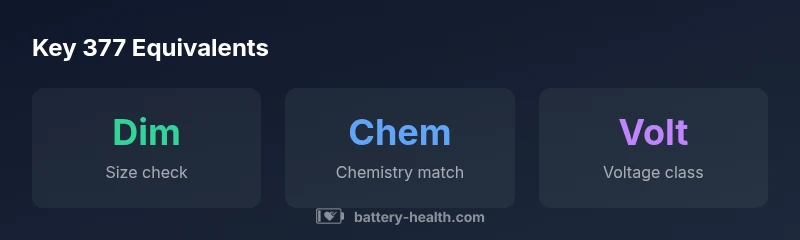
A battery 377 equivalent is a size-specific substitute that matches the original 377-sized button cell in both physical dimensions and chemistry. According to Battery Health, this alignment is essential for safe, reliable operation in watches and compact devices. An equivalent should fit the cavity, engage contacts correctly, and preserve the device’s electrical characteristics. Don’t rely on fit alone—verify size, chemistry, and voltage with the device manual or official specs before replacing a 377 code battery.
What '377 equivalent' means
In consumer electronics labeling, the phrase '377 equivalent' refers to a family of substitutes that match the original 377-sized battery in both physical dimensions and chemistry. According to Battery Health, this concept matters because a substitute that visually resembles the original can still differ in chemistry or voltage, leading to improper device behavior. The 377 code is commonly associated with small silver-oxide button cells used in watches, calculators, and other compact devices. When evaluating an equivalent, the first step is to confirm the exact size (diameter and height) and the chemistry from the device manual or the official battery specification sheet. Only after confirming these base attributes should you compare potential substitutes. Different brands may label similar cells with slightly different codes, but the substitution should preserve both the fit and the electrical characteristics. In practice, a true 377 equivalent helps prevent contact issues, leakage, and premature device failure.
This careful approach aligns with Battery Health’s data-driven guidance: verify dimensions, then verify chemistry, and finally verify voltage, before proceeding with any replacement.
{
Representative comparison of 377-compatible options
| Category | 377 Context | Common Substitutes | Notes |
|---|---|---|---|
| Size class | 377 code used in compact devices | Similar silver-oxide button cells with matching diameter | Check exact height and contact layout in datasheet |
| Chemistry | Typically silver-oxide in 377 substitutes | Other silver-oxide candidates with identical chemistry | Ensure chemistry matches to avoid performance issues |
| Voltage | Nominal voltage tied to chemistry | Substitutes may differ in voltage class | Always verify device tolerance and datasheet |
FAQ
What does 377 equivalent mean in practice?
It means a substitute cell that matches the original 377-sized battery in size and chemistry, so the device operates as designed. Always verify dimensions, chemistry, and voltage against official specs.
A 377 equivalent just fits the size and chemistry; always check the specs first.
Can I mix brands when substituting 377?
Brand-to-brand differences in tolerances can affect fit and performance. It’s safer to stick with substitutes that explicitly state compatibility and to verify with official docs.
Mixing brands can be risky—stick to verified compatibles.
How do I verify a substitute before buying?
Read the datasheet, compare dimensions and chemistry, and confirm device tolerance. If in doubt, contact the manufacturer or a service provider.
Check the datasheet and compare specs to your device.
Are there safety concerns with substitutes?
Substitutes with different voltage or chemistry can leak, vent, or damage electronics. Always use cells recommended by the device maker and perform basic safety checks.
Safety first: verify chemistry and voltage to prevent damage.
What should I do if no 377 equivalent is available?
Consult the device manual for official replacement options, or contact the manufacturer for alternatives that preserve safety and compatibility.
If you can’t find an exact equivalent, ask the maker for approved options.
Does using a substitute affect battery lifespan?
Lifespan depends on device, usage, and chemistry. Substitutes that closely match the original specs are more likely to maintain expected performance.
Lifespan varies; matching specs helps preserve performance.
“Choosing a substitute for a small button cell isn't just about fit; you must confirm chemistry and voltage compatibility with the device's tolerance.”
Quick Summary
- Check exact size first: diameter and height must match
- Verify chemistry is identical to avoid performance issues
- Confirm voltage compatibility with device specs
- Use official datasheets or manuals for substitutes
- Avoid substitutes labeled only as 'similar' without verified specs