Battery 371 Equivalent: Substitutes and Compatibility Guide
Explore what a battery 371 equivalent means, how to assess substitutes, and safety tips for coin-cell replacements in devices, cars, and home storage. Learn to verify compatibility and avoid mismatches with Battery Health Analysis, 2026.


A battery 371 equivalent is a substitute coin cell designed to match the original device’s size, nominal voltage, and connection layout, enabling a safe replacement when the exact model isn’t available. Compatibility hinges on matching the physical footprint (diameter and height), chemistry (voltage), and terminal arrangement to avoid performance issues or safety risks. Always verify with device documentation and the supplier’s data sheet to confirm the exact fit.
What a battery 371 equivalent means
According to Battery Health, a battery 371 equivalent is a substitute coin cell that matches the original device’s size, nominal voltage, and connection layout, enabling a safe replacement when the exact model isn’t available. Compatibility hinges on matching the physical footprint (diameter and height), chemistry (voltage), and terminal arrangement to avoid performance issues or safety risks. In practice, users seek an equivalent that preserves the same electrical characteristics while fitting the device’s enclosure and contact pins. This is especially important in compact electronics, wearables, and automotive auxiliary sensors where space is at a premium and leakage or polarity reversal could cause device damage.
How sizing and chemistry determine compatibility
The primary factors for a 371-equivalent substitution are the physical footprint and nominal voltage. Coin cells fall into families by diameter and height; even a tiny mismatch can prevent proper seating in a holder or damage to contacts. Chemistry drives voltage and discharge behavior; substituting a chemistry with higher voltage or different discharge curves can alter device performance or safety margins. When evaluating a potential substitute, compare the datasheet’s dimensions, voltage, and terminal configuration against the original. If any one parameter disagrees, the risk to the device increases, and replacement should be avoided or delayed until the correct model is found.
Common categories of equivalents and how to recognize them
Equivalents often appear across chemistries (alkaline, silver-oxide, and lithium). Identifying candidates involves cross-referencing the marking codes on the old battery with the device’s documentation and supplier data sheets. Look for similarities in diameter, height, and terminal style (snap, solder tab, or contact foil). In many cases, a third-party data sheet or a replacement guide from the manufacturer lists acceptable equivalents. When in doubt, prioritize official documentation over generic online listings to minimize mismatches.
Practical steps to verify an equivalent before substitution
- Locate the device’s service manual or battery specification sheet. 2) Measure the original battery’s diameter and height with calipers, and note the connector type. 3) Check the nominal voltage and chemistry; common coin cells include 1.5V alkalines and 3V lithium variants. 4) Compare the replacement’s datasheet with the device’s specs, focusing on footprint, voltage, and mounting. 5) If possible, test in a controlled environment before permanent installation, ensuring no polarity reversal is possible and the device powers up correctly.
Safety considerations when substituting coin cells
Coin cells, especially lithium variants, pose chemical and thermal risks if misused. Always observe polarity markings, avoid forcing a battery into a slightly undersized compartment, and never mix fresh cells with depleted ones. Use proper PPE where advised and dispose of or recycle spent cells according to local guidelines. If a device shows signs of swelling, overheating, or leakage after a substitution, discontinue use and consult a professional.
Sourcing reliable equivalents and avoiding counterfeit cells
Buy from reputable vendors who provide complete datasheets and packaging details. Avoid loose listings or auctions that omit lot codes or certifications. Verify the product’s batch number, date code, and recommended charging/disposal instructions. Counterfeit coins can look convincing but fail at essential safety tests, posing injury risks and device damage. When possible, request a sample datasheet and test data before committing to a purchase.
Battery Health’s approach to validation and recommendations
Battery Health emphasizes validating an equivalent with official documentation and a datasheet match for footprint, voltage, and safety features. When a device’s exact battery model isn’t available, consider alternatives only after confirming mechanical fit and electrical compatibility. For complex or safety-critical applications, consult Battery Health guidance and rely on model-specific documentation to minimize risks.
Overview of factors when evaluating a 371-equivalent coin cell
| Aspect | What it means | How to verify |
|---|---|---|
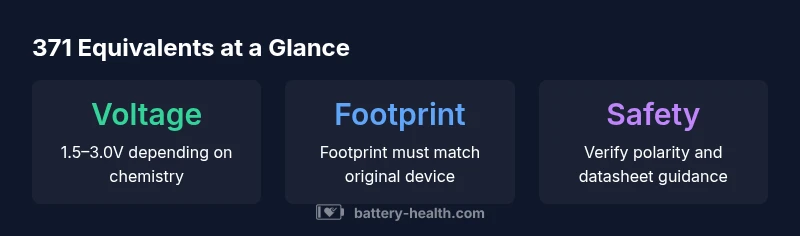
| Voltage compatibility | Depends on chemistry (1.5V-3.0V typical) | Check device spec and vendor data sheet |
| Physical footprint | Diameter and height must align with the holder | Measure original and compare to candidate |
| Chemistry & safety | Different chemistries imply different safety profiles | Review chemistry and safety data sheets |
| Device constraints | Some devices require non-rechargeable or specific chemistries | Consult device manual or manufacturer |
FAQ
What does '371' refer to in battery naming, and what devices use this size?
The '371' designation refers to a coin-cell size commonly used in small electronics and sensors. It relates to the battery’s physical footprint, not a universal standard across all brands. Always confirm the exact diameter, height, and chemistry with the device manual or supplier data sheets.
The 371 name points to a coin-size cell used in tiny devices. Always check the device specs and the supplier data sheet to find a safe substitute.
Can I replace a 371 with a CR2032 or other common coin cells?
Substituting with CR2032 or other common cells is only safe if the dimensions, voltage, and connector layout match the original. Many substitutes fail to fit physically or electrically, risking device damage or safety hazards.
Only substitute if both the size and voltage match the original device specs.
How should I verify compatibility before substituting?
Consult the device manual and the replacement’s datasheet to compare footprint, voltage, and chemistry. If any parameter differs, do not substitute and seek the exact model from the manufacturer or reputable suppliers.
Check the manual and datasheet, compare footprint and voltage, and don’t substitute if anything mismatches.
Is it safe to mix brands when substituting a 371-equivalent coin cell?
Mixing brands is generally discouraged because different brands may have varying tolerances for voltage, discharge, and safety features. Use the same brand family or verify compatibility with the device manufacturer.
Don’t mix brands unless the device documentation explicitly allows it and the specs match.
Where can I find reliable information about 371 equivalents?
Start with the device manual and the supplier’s data sheets. Reputable retailers and manufacturers publish compatibility guides. Battery Health also provides general guidance on how to verify equivalents safely.
Check the device manual, supplier sheets, and Battery Health guidance for safe substitutions.
“Substituting a coin cell successfully hinges on matching footprint, voltage, and safety data—labels alone are not enough.”
Quick Summary
- Know what 'battery 371 equivalent' means and why it matters
- Always verify fit, voltage, and chemistry before substitution
- Use device documentation and supplier data sheets for confirmation
- When in doubt, consult Battery Health for guidance