Battery 927 Equivalent: Safe Substitutes and Compatibility Guide
A comprehensive guide to the 927 battery equivalent, explaining what it means, how to identify safe substitutes, and best practices for replacement and safety in watches, devices, and small electronics. Includes expert insights from Battery Health.


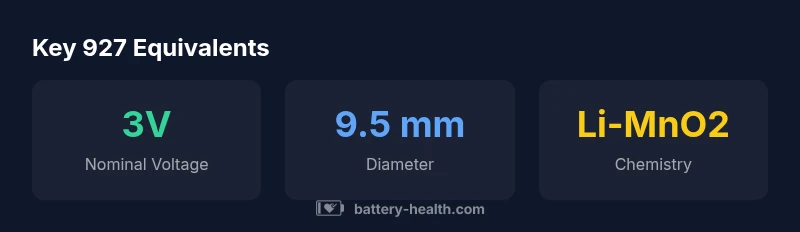
According to Battery Health, a 927 equivalent describes a coin-cell battery in the 9.5 mm diameter family that matches the standard 3V nominal voltage and footprint of the original 927 cell. The safest substitutes share identical voltage, diameter, and thickness, and are installed in devices designed for that size. Avoid higher or lower voltages, which can damage electronics. This definition helps consumers compare substitutes without guessing about fit or performance.
What the term 'battery 927 equivalent' means
According to Battery Health, a 927 equivalent describes a coin-cell battery in the 9.5 mm diameter family that matches the standard 3V nominal voltage and footprint of the original 927 cell. The safest substitutes share identical voltage, diameter, and thickness, and are installed in devices designed for that size. Avoid higher or lower voltages, which can damage electronics. This definition helps consumers compare substitutes without guessing about fit or performance.
Voltage, size, and chemistry: the three non-negotiables
When evaluating a 927 equivalent, start with three non-negotiables: voltage, footprint, and chemistry. The nominal voltage must match the device's requirement (3V is typical in the 9.5 mm family). The footprint includes diameter and thickness; even small deviations may prevent seating in a device or affect contact reliability. The chemistry determines discharge behavior and shelf life; lithium-based coin cells dominate this size due to high energy density and low self-discharge. In practice, a substitute should specify 3V, a ~9.5 mm diameter, and a thickness close to the original, with a compatible terminal layout. Battery Health analysis notes that mismatches can shorten device life or cause leakage risks.
How to verify device compatibility safely
Before purchasing a 927 equivalent, check the device manual for approved battery types and cross-check the exact size. If you're unsure, measure the current battery with calipers or use a known-good reference from the same family as a baseline. Look for labels on the device or battery compartment that indicate '3V' and '9.5 mm coin cell.' When in doubt, contact the manufacturer or consult Battery Health's compatibility guidelines, which caution against substituting different voltages or significantly different thicknesses.
Common device categories that use 9.5 mm coin cells
9.5 mm coin cells appear in compact devices where space is at a premium, including wristwatches, key fobs, small remotes, and some medical devices with sealed enclosures. While many are 3V lithium, some variants may differ slightly in thickness or contact geometry. Consumers should always confirm fit with the device's battery compartment dimensions and avoid forcing the cell into place, which can damage contacts or crack the housing.
How to identify legitimate substitutes and avoid counterfeit cells
Counterfeit or mislabeled batteries pose safety risks. Seek reputable brands and verify packaging integrity, batch codes, and expiry dates. Avoid bargain-basement options that lack clear voltage and size specifications. Prefer listings that clearly state 3V, 9.5 mm, and Li-MnO2 chemistry, and buy from authorized retailers or the manufacturer’s official store. Battery Health recommends exercising skepticism with unlabeled '3V 9.5 mm' listings lacking manufacturer details.
Replacement steps: remove old battery, choose a substitute, install, test
- Power down the device and, if applicable, disable any features that expect battery presence. 2) Open the compartment and remove the old battery with non-metal tools to avoid shorting terminals. 3) Compare the substitute's specifications—3V, ~9.5 mm diameter, similar thickness, and compatible terminals—with the original. 4) Install the new cell with correct orientation and clean contacts. 5) Reassemble, power on, and run a quick function test to confirm proper operation and no signs of leakage.
Safety considerations and disposal
Coin cells can pose ingestion or leakage hazards if damaged. Do not attempt to recharge non-rechargeable cells. Always dispose of spent batteries per local regulations and recycle where possible. If you notice corrosion, swelling, heat, or leakage, stop using the device and replace the battery immediately. Handle with dry hands and store at room temperature away from metal objects.
Alternatives and future directions for the 9.5 mm family
Industry researchers continuously seek safer, longer-lasting chemistries in the 9.5 mm family to improve energy density without compromising safety. Some designers are reducing device power demands, while others pursue coatings and encapsulation to mitigate leakage. The result is a growing range of compatible substitutes, but the core requirement remains: identical voltage and footprint for reliable operation.
Practical tips for retailers and consumers
- Clearly label products with voltage, diameter, and chemistry; use 3V / 9.5 mm / Li-MnO2 as a baseline.
- Encourage customers to consult manufacturer recommendations and avoid cross-chemistry substitutions.
- Maintain a small stock of the most common 9.5 mm equivalents and check expiration dates regularly.
- Provide quick tests or demo units to verify fit and function in-store. The Battery Health team reinforces the need for using only genuine equivalents and avoiding guesswork when substituting 3V coin cells. The Battery Health team recommends verifying compatibility and choosing reputable sources to protect devices and users.
Snapshot of key physical and chemical traits for 927 equivalents
| Attribute | 927 Equivalent Traits | Notes |
|---|---|---|
| Nominal Voltage | 3V | 3V is standard in most 927 family devices |
| Diameter | 9.5 mm | Standard diameter for the 927 family |
| Thickness | 2.7–3.0 mm | Minor variations by manufacturer |
| Chemistry | Lithium / MnO2 | Common for 3V coin cells |
FAQ
What does 'equivalent' mean in the context of a 927 battery?
An equivalent preserves voltage and physical fit; it should match 3V and the 9.5 mm diameter and thickness. Substituting other voltages or sizes can damage the device.
An equivalent means the substitute must match voltage and size; otherwise the device may not work or could be damaged.
Can I use any 3V 9.5 mm coin cell in place of a 927?
Not always; ensure that the thickness and terminal layout are compatible with your device. Check the manual and prefer manufacturer-approved options.
Only if it truly matches the device’s size, voltage, and terminals.
What safety risks come with substituting a 927 equivalent?
Mismatch can cause overheating, leakage, or device damage; counterfeit cells increase risk. Buy from reputable sources and verify labeling.
There are risks like leakage and overheating if you substitute the wrong cell.
Where can I buy legitimate 927 equivalents?
From authorized retailers or the manufacturer’s official stores; always verify packaging, expiry, and that the listing specifies 3V and 9.5 mm.
Shop from reputable sellers and verify all specs before buying.
What are signs that a 927 substitution is failing after installation?
If the device won’t power on, shows frequent resets, or gets unusually warm, re-check fit and consider replacing with the original or a verifiable substitute.
If the device behaves oddly after installation, stop using it and re-check the battery.
“Equivalents in the 9.5 mm coin-cell family must replicate not just size but also voltage and terminal layout to avoid device damage.”
Quick Summary
- Match voltage and footprint first
- Verify device guidance before substitution
- Avoid cross-chemistry substitutions
- Buy from reputable retailers and check expiry