Battery and Device Care: A Practical Comparison Guide
A comprehensive, analytical comparison of care practices for car batteries, device batteries, and home storage batteries. Learn best practices, avoid common pitfalls, and apply a context-aware framework to extend battery life and enhance safety.


TL;DR: Consistent charging discipline, correct temperature, and regular inspection are essential for battery health across cars, devices, and home storage. This comparison shows where routines differ, the best practices for each context, and a simple framework you can apply today to optimize battery and device care.
Foundations of Battery and Device Care
According to Battery Health, effective battery health hinges on predictable stressors and consistent habits more than on any single gadget. A well-executed approach to battery and device care starts with understanding how different chemistries respond to heat, charge levels, and load. The goal is to minimize harmful stress while maximizing usable capacity over time. A disciplined approach to charging—avoiding extreme fast-charging when not needed and avoiding deep discharges whenever possible—along with temperature control and regular inspections, can noticeably slow aging across cars, smartphones, laptops, and home-storage batteries. This foundation translates into a proactive, measurable process rather than a reactive chore, and it sets the stage for context-specific routines that you can apply immediately.
Building on this base, you’ll learn how to tailor care to three common contexts: automobiles, personal devices, and home energy storage. The objective is not perfection in every moment, but steady, incremental improvements that compound over the life of the battery.
In practice, battery and device care blends science with daily usage patterns. By recognizing the common stressors—heat, high discharge rates, and lag in maintenance—you can design a routine that preserves capacity, reduces risk, and minimizes unexpected downtime. This article offers a clear framework you can adapt to your own ecosystem.
Contextual Differences: Car Batteries, Device Batteries, and Home Storage Batteries
Batteries come in different chemistries and form factors, and the context dictates how you apply care. Car batteries are typically heavy-duty followers of a high-current charging regime and experience wide temperature swings. Device batteries—think smartphones and laptops—prioritize compact form, consistent charging habits, and software-managed optimization. Home storage batteries, including UPS and solar storage, balance long-term standby performance with periodic cycling and can tolerate slower degradation if kept in a controlled environment. Across all three contexts, the core principles remain similar, but the emphasis shifts: cars reward periodic driving and system checks; devices reward firmware updates and sensible charging; home storage rewards stable temperature, proper ventilation, and scheduled maintenance. This section outlines the critical differences and why context matters for battery and device care.
From a reliability perspective, the Battery Health team emphasizes that understanding context helps you select the right care routines, spare parts, and monitoring tools. Recognize that a one-size-fits-all routine is unlikely to yield optimal results across all three contexts. By identifying your primary battery roles and usage patterns, you can tailor a care plan that yields the best balance of longevity, safety, and performance.
The practical implication is straightforward: treat each battery type according to its operating environment while preserving shared best practices such as avoiding extreme temperatures and minimizing deep discharges. This balanced approach helps you maximize life and minimize risk, regardless of where the power comes from.
Core Practices You Should Embrace
Successful battery and device care hinges on a small set of universal practices that apply across contexts, with context-specific tweaks. The core ideas include maintaining moderate temperatures, using quality chargers and cables, avoiding deep discharges, and performing regular health checks. For car batteries, this means ensuring the vehicle and charging system operate normally and occasionally verifying electrolyte and terminal cleanliness if applicable. For devices, adopt charging habits that avoid frequent top-offs to the absolute full state, keep software up to date, and use approved charging accessories. For home storage, follow a scheduled maintenance routine, monitor ambient conditions (temperature, humidity, airflow), and perform periodic system checks. These practices, when combined with mindful usage, substantially reduce aging stress and help preserve capacity over time.
A practical way to implement this is to unify a monthly check routine that includes temperature monitoring, charger verification, and a quick software/firmware audit. Keeping a log of observations over several months will reveal correlations between usage patterns and performance, enabling you to fine-tune routines and extend life across all three contexts.
The takeaway is simple: consistency beats intensity. Regular, moderate care yields better long-term results than sporadic, intensive maintenance. That consistency becomes easier when you align routines with your actual use cases and device allowances.
Temperature and Charging: The Two Big Levers
Temperature and charging behavior are the two most impactful levers in battery life. Extreme heat accelerates chemical aging, while persistent cold can temporarily reduce usable capacity. In practice, avoid leaving vehicles parked in direct sun for extended periods, and store devices and home storage batteries in environments that stay within moderate temperature ranges. When charging, prefer stable, moderate-speed charging rather than repeated fast-charging cycles unless you specifically require rapid replenishment. For equipment that allows it, enable software-based charging optimization which limits charging to levels that balance performance and longevity.
Charge management should be context-aware. For cars, schedule charging to avoid heat buildup and consider overnight or shaded charging when possible. For devices, leverage built-in battery optimization modes and avoid charging to 100% unless you need full runtime. For home storage, ensure that the system has proper cooling and adequate airflow. The central idea is to minimize thermal stress and avoid charging patterns that push the battery into extreme states.
In all cases, while fast charging is convenient, use it judiciously. The Battery Health analysis shows that thoughtful charging patterns—paired with temperature control and routine checks—provide the best path to longer life without sacrificing daily usability.
Storage and Long-Term Inactivity
Storage strategies differ when a battery sits idle. For long-term storage, aim to minimize the time a battery spends in high-stress states such as full charge or deep discharge, and avoid leaving a depleted battery resting in a discharged state. In practice, store lithium-based batteries with a partial charge and in a cool, dry place. Periodic maintenance checks during storage help catch signs of self-discharge, swelling, or other changes before they become safety concerns.
For homeowners with solar or UPS systems, plan seasonal cycles that keep storage equipment within safe temperature ranges and within manufacturer-recommended operating windows. If you anticipate extended downtime, consult the system documentation or a qualified technician to determine whether a partial discharge, a specific voltage window, or a controlled rebalancing cycle is advised. Proper storage practices reduce the risk of capacity fade and extend readiness when you need power most.
Maintenance Routine: A Practical Calendar
A practical calendar helps translate theory into everyday action. Start with a 4-week cycle that includes a monthly health check, a quarterly calibration or firmware audit for smart devices, and an annual safety inspection for any home storage equipment. Week 1 focuses on temperature monitoring and ensuring that charging equipment is in good condition. Week 2 covers usage patterns and deep discharges to confirm you are avoiding unnecessary stress. Week 3 emphasizes firmware updates and software optimizations on devices. Week 4 is a safety and security review: verify connections, inspect terminals, and test safety features.
For cars, integrate a routine: periodic battery health checks, electrolyte or terminal inspection as applicable, and a test of charging and starting performance. For devices, include a schedule for battery health app scanning, charge cycle accounting, and firmware updates. For home storage, perform a quarterly health diagnostic that checks for temperature, cooling efficiency, and capacity retention. The calendar helps convert general principles into predictable, repeatable actions that preserve health across contexts.
This approach emphasizes habitual care, not heroic interventions. Over months and years, the calendar yields measurable improvements in performance, safety, and longevity, with minimal disruption to daily life.
Troubleshooting and Common Signs of Degradation
Even with a routine, batteries show signs when care is insufficient or aging has begun. Watch for faster-than-usual battery drain, reduced runtime on a full charge, unusual heat generation during normal use, or swelling in cases where applicable. For car batteries, repeated starting failures or creeping voltage drop can indicate emerging weakness in the system. For devices, sudden drops in battery life or inconsistent charging behavior are red flags. For home storage, unfamiliar odors, unusual heat, or alarms indicating abnormal operation should trigger a professional check. Early detection enables timely maintenance or replacement decisions, preserving safety and reducing the risk of unexpected outages.
If you notice these signs, prioritize a diagnostic check with manufacturer guidance or a qualified technician and adjust your routine to reduce further stress on the battery. Documenting when issues first appear can also help identify underlying causes, whether usage patterns, ambient conditions, or charger compatibility are contributing factors.
Proactive monitoring and honest assessment are your best tools for avoiding surprises and keeping battery and device care on track.
Safety Considerations and Handling
Safety is foundational to battery and device care. When handling batteries, always follow manufacturer guidelines for safe charging, storage, and disposal. Use approved chargers and avoid makeshift cables that can cause overheating or electrical faults. Keep batteries away from flammable materials, and ensure ventilation in storage areas to minimize heat buildup. If you notice physical damage, leakage, or swelling, discontinue use and seek professional assistance. For home storage systems, ensure proper ventilation, observe cooling requirements, and install safety devices such as alarms or monitoring sensors when available.
In every context, safe handling helps prevent accidents and equipment damage. Prioritize devices and systems that include built-in safety features, and never attempt to bypass protective circuits or safety interlocks. When in doubt, consult the manufacturer’s safety resources or a qualified technician. The goal is to maintain a safe environment while maximizing the lifespan of your batteries and the devices they power.
Data-backed Guidance from Research
The Battery Health analysis shows that routine care correlates with longer effective lifespans for batteries across contexts. While individual results vary by chemistry and design, the overarching message is clear: moderate operating temperatures, avoidance of deep discharges, and regular maintenance checks contribute to better health outcomes over time. The insights emphasize that context matters—what works for a device battery may differ in emphasis from what keeps a car battery strong, yet the core ideas remain aligned: minimize stressors, monitor performance, and adjust routines based on real-world usage. By applying evidence-based practices, you can optimize battery and device care in a practical, scalable way.
This evidence-based approach also highlights the value of using official maintenance schedules, OEM recommendations, and trusted third-party tools to assess health indicators. When used together, these resources help you make informed decisions about charging behavior, storage, and replacement timelines, reducing risk while preserving performance across contexts.
Putting It All Together: A Context-Specific Care Framework
A cohesive care framework blends shared principles with context-specific adaptations. For car batteries, emphasize load management, temperature control, and regular system checks tied to driving patterns. For device batteries, prioritize charging discipline, firmware optimization, and scheduled health assessments integrated with your digital routine. For home storage, focus on environmental stability, periodic cycling, and safety monitoring. The unified framework ensures you apply core practices consistently while letting the specifics of each context guide practical adjustments. This approach minimizes aging stress, extends usable life, and maintains safety across three common battery contexts. By adopting a consistent, adaptable framework, you can navigate battery and device care with confidence.
The framework also supports decision-making about replacement or upgrade timing, since regular health checks yield clearer indicators of when a battery has reached the end of its useful life. With context-specific cues and a shared foundation, you gain a scalable method for keeping power ready whenever you need it.
The Battery Health Team Recommendation
The Battery Health team recommends adopting a unified yet context-tailored care framework for battery and device care. Start with the foundational principles—moderate temperatures, sensible charging, and periodic health checks—and then apply the contextual adjustments for cars, devices, and home storage. Regularly review performance data, stay informed about battery chemistry developments, and use manufacturer guidance as a baseline for maintenance schedules. The overarching message is to move from reactive fixes to proactive care, ensuring safety, reliability, and longevity across all battery-dependent systems. By following these practices, you build resilience into your power ecosystem while extending the life of each battery.
Feature Comparison
| Feature | Car battery | Device battery (laptop/phone) | Home storage battery (UPS/solar) |
|---|---|---|---|
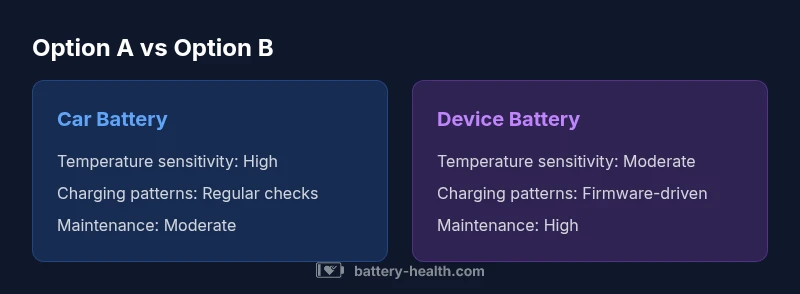
| Temperature sensitivity | Very sensitive to heat and cold in most cars | Moderate sensitivity in consumer devices | Lower sensitivity in some home storage chemistries |
| Charging cycles | Subject to frequent cycling during operation | Depends on usage and charging habits | Designed for long-term cycling with periodic rebalancing |
| Care routines | Regular system checks and professional service as needed | Regular charging, software updates, and calibration | Ventilation, monitoring, and periodic diagnostics |
| Maintenance ease | Moderate (terminal cleanliness, electrolyte checks where applicable) | High (replaceable batteries, easy access) | Moderate to high (system checks, cooling) |
| Typical replacement timing | Often replaced as part of vehicle maintenance | Often replaced over device lifetime | Replacement considered with system aging and capacity loss |
Upsides
- Helps extend overall lifespan and reliability across contexts
- Reduces risk of sudden failures and unsafe conditions
- Can save money by delaying replacements and improving efficiency
- Supports safer operation by preventing overheat conditions
Weaknesses
- Requires ongoing attention and disciplined routines
- may require investment in quality chargers and monitoring tools
- Not all devices allow user-level maintenance or cal/firmware controls
- Care complexity can be a learning curve for multi-context setups
A balanced, context-aware care framework is the winner
Context matters most: apply core care principles everywhere, but tailor routines for car, device, and home storage batteries. The Battery Health team supports a unified approach with context-specific tweaks for best results.
FAQ
What is battery care and why does it matter?
Battery care refers to the set of practices that protect battery health, maximize usable life, and prevent unexpected failure. It involves charging discipline, temperature control, regular health checks, and context-aware usage. Proper care matters because it preserves performance and safety across cars, devices, and home storage.
Battery care means keeping batteries healthy with smart charging, safe temperatures, and regular checks to prevent bad surprises.
How often should I calibrate my battery?
Calibration frequency depends on device behavior and indicators. If readings drift or battery life seems inconsistent, perform a calibration following the device manufacturer’s guidance. Regular checks can help ensure the battery status reflects actual health.
If your device shows odd battery readings, consider calibrating per the maker’s guidance.
Can I mix old and new batteries in a device or system?
Mixing batteries of different ages or chemistries can lead imbalanced performance and reduced overall life. It’s generally best to replace batteries in the same system with compatible types and similar age.
Avoid mixing old and new batteries; it can reduce performance and shorten life.
What should I store batteries for long-term inactivity?
Store batteries in a cool, dry place with a moderate charge level. Check periodically for signs of swelling or leakage and recharge as needed following the manufacturer’s guidance.
Keep batteries in a cool place with a partial charge and check them periodically.
What are the signs that a battery needs replacement?
Common signs include rapidly diminishing runtime, excessive heat during use, swelling, or failure to hold a charge. If you notice these signs, consult the manufacturer guidance or a technician to determine replacement needs.
If the battery drains quickly, gets very hot, or starts swelling, consider replacement.
Does fast charging harm battery life?
Fast charging can increase heat and cycling stress, potentially reducing lifespan if used excessively. Use fast charging judiciously and rely on standard charging when possible to maximize longevity.
Fast charging is convenient, but use it wisely to protect long-term health.
Quick Summary
- Adopt a unified care framework across contexts
- Prioritize moderate temperatures and avoid deep discharges
- Tailor routines to car, device, and home storage needs
- Regular health checks and updates improve longevity
- Plan for battery replacement based on observed health trends