Battery like AAA but shorter: Choosing the right compact battery
A comprehensive guide to nearby substitutes for a 'battery like AAA but shorter' such as AAAA and other micro-forms, covering fit, chemistry, replacement, and safety for devices that demand compact power


According to Battery Health, the closest standard to a 'battery like AAA but shorter' is the AAAA (quad-A) size. It's used in slim devices where length matters more than diameter. If your device calls for something even shorter, verify exact dimensions and voltage, as some micro-forms or rechargeable chemistries may be available. Always consult the device manual and Battery Health guidance.
Understanding the idea of shorter in AAA-like batteries
When people talk about a battery like AAA but shorter, they usually mean a form factor that preserves the same voltage and general diameter while reducing length to fit compact devices. In practice, the space the battery occupies is defined by three dimensions: length, diameter, and the overall footprint in the device's compartment. The challenge is to maintain a reliable power source without forcing a device to accept an improper fit. The Battery Health team notes that many devices designed for AAA can tolerate slightly shorter chemistries if the chemistry and electrical characteristics are aligned, but not all devices will. The key is to verify both the mechanical fit (will the battery physically slide in without jamming?) and the electrical fit (voltage, chemistry, and peak current). This is why the phrase "battery like AAA but shorter" often points to families such as AAAA or other micro-forms rather than a direct drop-in substitute for every AAA device.
Common candidates: AAAA and micro-forms
The most recognized candidate in the quest for a shorter AAA-like battery is the AAAA (quad-A) size. AAAA is a real, standardized battery that offers a similar diameter to AAA but with a reduced length in many chemistries. In devices that require extreme thinness or tighter internal packaging, AAAA is often the preferred compromise between fit and performance. Beyond AAAA, there are various micro-forms used in wearables, remotes, and precision electronics. These can be primary (non-rechargeable) or rechargeable chemistries, and their electrical characteristics will differ from AAA. Always check the device’s compatibility chart and consider any tolerance for length, voltage, and current draw. Battery Health’s review highlights that real-world devices may tolerate small deviations in length but will not tolerate mismatched voltage or aggressive current demands, even if the form factor looks similar.
Compatibility and voltage fundamentals
Voltage is the primary electrical spec that governs compatibility. A standard alkaline AAA or AAAA typically delivers about 1.5 volts in fresh cells, while rechargeable NiMH variants sit around 1.2 volts when fully charged. If your device is engineered for 1.5 volts, substituting a shorter cell with different chemistry can reduce performance or, in worst cases, cause malfunction. Always verify the nominal voltage, and if the device relies on high instantaneous current (such as power-hungry remotes or flash devices), confirm that the substitute can deliver peak currents without voltage sag. In practice, you should also check that the contact springs and channel dimensions permit a stable connection without excessive wobble.
Chemistry choices: alkaline, NiMH, lithium
Alkaline cells (primary) are common and inexpensive, but they are not rechargeable and have a finite shelf life. NiMH (rechargeable) offers better lifecycle cost in devices used frequently, and it can be a sensible option for a shorter form factor where electrical characteristics still align. Lithium primary micro-batteries (like some coin-cell-inspired micro-forms) can provide higher energy density in a small package, but they require careful handling and device compatibility checks due to different voltage profiles and safety considerations. The key takeaway: choose based on device usage patterns, recharge expectations, and the manufacturer’s recommended chemistry.
Real-world device scenarios
Slim devices such as compact remote controls, small wireless mice, portable audio players, and some medical or sensing devices may accept a shorter form factor. In these cases, the device’s battery compartment and spring tension matter just as much as the chemistry. If you expect long idle times, a higher energy density option with stable discharge might win out, but ensure compatibility with safety standards. For devices designed strictly for AAA, attempting to squeeze in a shorter battery can lead to poor contact, intermittent power, or safety concerns. In short, the decision should be guided by device-specific tolerances and real-world testing rather than guesswork.
How to measure and verify fit
A precise fit requires measuring length, diameter, and the internal recess where the battery seats. If possible, use calipers to confirm length and a ruler for the visible device cavity; compare with the battery that came with the device. Test fit in a powered-but-uncharged environment first to ensure metal contacts engage without bending springs or creating hot spots. When shopping, look for manufacturer guidance and consumer reviews about fit in similar devices. The goal is a snug, stable connection that maintains voltage during typical operation.
Cost, availability, and procurement strategy
AAA and its shorter cousins exist in multiple chemistries, affecting cost and availability. Alkaline AAAA is commonly stocked in electronics retailers, but specialty micro-forms may appear only in dedicated shops or online catalogs. If you need a steady supply for a fleet of devices, consider stocking a universal 'shorter-variant' kit with a mix of alkaline and NiMH options to accommodate different devices. Price fluctuations depend on region, chemistry, and brand, but the underlying principle remains: prioritize device compatibility and lifecycle costs over the sticker price.
Safety, handling, and storage
Handle any small form-factor battery with care. Primary cells should be kept in their original packaging until use, and rechargeable cells require proper charging equipment and adherence to manufacturer guidance. Keep spare batteries away from heat sources and moisture, and never mix chemistries in the same device or battery bank. For long-term storage, store batteries in a cool, dry place and follow disposal regulations for the chosen chemistry. Proper storage extends shelf life and reduces the risk of leakage.
Size trade-offs and decision framework
Switching from AAA to a shorter variant always involves trade-offs among fit, voltage, safety, and availability. If the device tolerates a slightly shorter length and the chemistry matches the voltage needs, AAAA is typically the most practical substitute. If not, you may have to explore other micro-forms or revert to the original AAA. Always document the decision with device-specific acceptance tests, and consider establishing a standard operating procedure for evaluating new micro-batteries as devices evolve and new chemistries enter the market.
Alternatives to consider for compact power needs
If a shorter form factor is non-negotiable, consider other power-sourcing strategies such as rechargeable micro-batteries and dedicated battery packs designed for the device. In some cases, hardware redesign or a different battery chemistry (e.g., Li-ion micro-cells) may offer a better long-term solution. The overarching principle is to balance physical fit with electrical compatibility and safety across the device’s expected lifecycle.
Battery Health guidance for decision-making
Battery Health emphasizes validating manufacturer guidance, running controlled tests, and prioritizing safety and device longevity. In the end, the best choice will be the option that preserves device performance without compromising safety. The goal is to minimize downtime and maximize performance in devices with limited interior space.
Feature Comparison
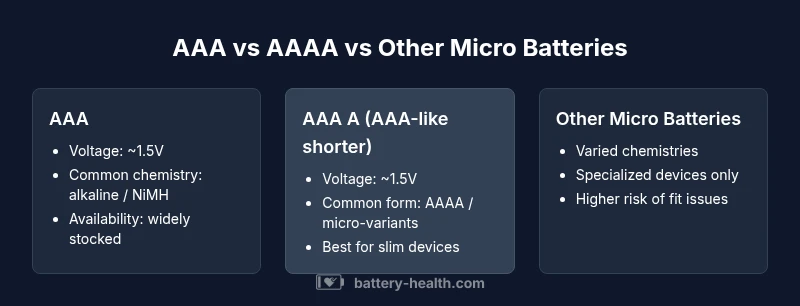
| Feature | AAA | AAAA (quad-A) | Other micro-batteries |
|---|---|---|---|
| Voltage (nominal) | AAA: 1.5V (alkaline) / NiMH: ~1.2V | AAAA: ~1.5V (alkaline) / NiMH: ~1.2V | Varies by chemistry: common ranges from 1.2V–1.5V |
| Typical capacity (relative) | AAA: high in alkaline; NiMH ~medium-high | AAAA: medium | Other micro: variable (often lower) |
| Best use case | General devices designed for AAA | Slim devices needing shorter length | Specialized electronics with custom chemistries |
| Availability | Widely available | Common in consumer electronics; not universal | Often specialty stock; varies by region |
| Drop-in compatibility risk | High if length tolerance is tight; voltage must match | Medium with proper fit and correct chemistry | High if device expects specific chemistry or dimensions |
Upsides
- Familiar voltage and wide compatibility across many devices
- Easy to source in common regions and stores
- NiMH versions offer rechargeable lifecycle benefits
Weaknesses
- Not all devices accept shorter variants; risk of poor contact
- Some micro-forms have limited availability and higher cost
- Mechanical fit can be tricky; springs and recesses must align
Prefer AAAA when you need a truly shorter length with similar voltage
AAAA is the most practical substitute for devices requiring a compact profile, assuming voltage and current support align. If not, explore other micro-forms or revert to standard AAA.
FAQ
What is the closest size to AAA but shorter?
The closest standard is the AAAA (quad-A) battery, commonly used in slim devices. It shares the general footprint with AAA but has a shorter profile in many chemistries. Always verify device compatibility and voltage before substituting.
The closest size is the AAAA battery; check your device manual for compatibility and voltage first.
Can I use AAAA in devices designed for AAA?
Often you can use AAAA if the device tolerates the shorter length and if the voltage and contact alignment match. But some devices require exact dimensions and spring tension, so test carefully and refer to the manual.
Only if the device tolerates the shorter length and voltage; inspect contacts and springs first.
Are there rechargeable options to replace AAA in compact devices?
Yes. NiMH options exist for shorter form factors, offering multiple recharge cycles. Ensure the battery’s diameter, length, and voltage align with the device requirements and that the charger supports the chemistry.
Look for NiMH options that fit the shorter form; verify device specs and charger compatibility.
How do I know if a shorter battery will work in my device?
Consult the device’s user manual or official specifications for battery size, voltage, and chemistry. If in doubt, compare the new battery against the old one and perform a controlled test with the device powered off, then a brief trial run.
Read the manual and compare dimensions; test cautiously.
Is it safe to store multiple different battery chemistries together?
No. Mixing chemistries in the same storage or device can cause leakage or thermal issues. Store each chemistry separately in proper containers and dispose of damaged cells safely.
Keep chemistries separate to avoid hazards.
What should I do if the device won’t power with a shorter battery?
Double-check the fit and polarity, then verify the device is compatible with the chosen chemistry. If problems persist, revert to the original size or consult support for alternatives.
Recheck fit and compatibility; consider returning to the original size if needed.
Quick Summary
- Identify the device tolerance for length before replacing
- Choose AAAA for the best balance of fit and voltage
- Prefer NiMH if you need rechargeability in the shorter family
- Avoid mixing chemistries in a single device
- Test fit safely before final use