How to Change a Watch Battery: Step-by-Step Guide
Learn how to safely change a watch battery with a practical, step-by-step method. This guide covers battery types,工具, safety, step-by-step procedure, testing, and maintenance for reliable timekeeping.


With this guide, you will confidently replace a watch battery, identify the correct battery type, choose the appropriate tools, and reseal the case to maintain water resistance. You’ll learn safety steps, how to avoid corrosion, and when it’s better to seek professional help. Battery Health provides practical, non-destructive methods for most common watches.
What happens when a watch battery dies?
In most modern watches, a dead battery means the movement stops receiving power, so the watch stops or loses accuracy. Quartz watches rely on microcircuits and a small voltage supplied by the battery; when the cell is depleted, timekeeping fails or becomes erratic. The signs are often subtle at first: the seconds hand may tick in uneven jumps, the date window may stop updating, or the watch may run slow for a while before quitting. A normal replacement can restore timekeeping accuracy for months or years, depending on battery life and usage.
According to Battery Health, picking the right battery type for your model is the foundation of a reliable replacement. Using the wrong chemistry or size can cause poor contact, leakage, or corrosion, which can damage the movement or the case. This guide focuses on the most common watch batteries found in consumer watches, how to verify the proper type for your model, and the steps to replace it safely while preserving water resistance where applicable. The goal is to empower you to perform a safe, reliable battery change with minimal risk and maximum accuracy.
Types of watch batteries and common sizes
Most wristwatches use small coin cells or button cells, and the exact type is specified by the manufacturer. Common examples include coin cells such as CR2032, SR626SW, or SR521SW in many quartz watches, but size and chemistry vary by brand and model. The battery code is usually stenciled on the battery itself or printed in the watch manual. When you replace the battery, matching the size, voltage, and chemistry is essential for correct operation and to avoid leakage.
If you aren’t sure which battery to buy, remove the old one carefully (only if you have the right tools) and photograph the marking. This quick reference helps you order a replacement that is compatible with your movement. Remember, non-standard or expired batteries can reduce performance and may be unsafe in some cases. Always verify the exact type before purchase.
Safety first: handling batteries and tools
Battery replacement involves opening the watch case, exposing the movement, and handling electrolytes. Wear eye protection if you are uncertain about a potential leak and work in a well-lit, clean area. Use non-metallic tools where possible to avoid shorting the contacts, and never press the battery against metal surfaces. Keep batteries away from children and pets, and never reuse damaged or swollen cells.
Keep a tidy workspace: lay out tools on a soft mat, organize screws by size, and take photos during disassembly. Isopropyl alcohol and a lint-free cloth can help clean contact surfaces before installing the new battery. If your watch is water resistant, avoid opening the case near water sources and close the back promptly to protect seals.
How to identify the correct replacement: numbers and codes
Start by inspecting the old battery for markings such as the letter codes (CR, LR, SR) and numbers that indicate size and voltage. Cross-check these markings with your watch manual or a trusted reference. If the case back has a model number, you can search the manufacturer’s website or a reputable retailer to confirm the exact replacement. When in doubt, take the watch to a professional for confirmation to avoid buying an incompatible cell.
Note: some watches use a rechargeable coin cell or a specialized battery. In those cases the replacement process and tools may differ, and a professional service might be the safer option for preserving water resistance.
Step-by-step overview: prepare, open case, replace, reseal
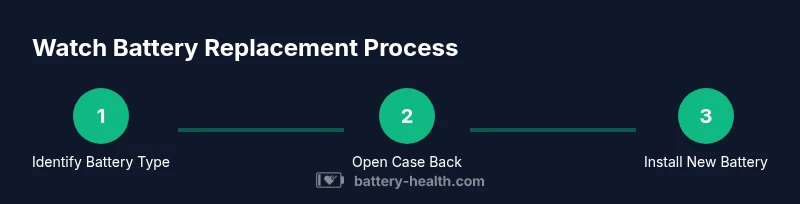
This overview outlines the core actions you’ll perform, while the formal STEP-BY-STEP section provides precise instructions. Prepare your workspace, identify the battery, and gather the right tools. Open the case back carefully, lift out the old battery without bending contacts, inspect for corrosion, and clean if needed. Place the new battery with the correct polarity, reseal the case with the gasket in place, and gently press or screw the back to restore the seal.
The most critical aim is to avoid damaging the gasket and to ensure a proper seal to maintain water resistance. If you notice any corrosion, swelling, or residue, stop and seek professional help rather than continuing.
Testing and post-change care
After installation, set the time and check all functions (date, day, chronograph, if present). Confirm the movement is ticking smoothly and that seconds advance evenly. If your watch is water resistant, perform a basic integrity check by gently refastening the case back and ensuring there are no gaps. Do not expose the watch to water immediately after changing the battery; wait to verify a secure seal.
Store or wear the watch normally and monitor for any signs of trouble over the next few days. A battery change can refresh performance, but poor contact or a leaky cell can cause short-term issues if the back isn’t sealed properly.
Common mistakes to avoid and when to seek professional help
Avoid mixing battery types, using metal tools on terminals, or forcing the case back closed when it doesn’t seat evenly. Always confirm the exact battery type and avoid long exposure to ambient moisture during replacement. If you observe corrosion, a swollen battery, or if the case back resists seating, do not proceed; seek a professional watchmaker or authorized service. Professional service can also preserve water resistance by re-gasketing and testing seals under pressure.
Tools & Materials
- Watch case back opener or case knife(For snap-on backs—use a plastic or nylon tool to avoid scratches; for screw backs—precision screwdriver set sized 0.8-1.2 mm)
- Precision screwdriver set(Small, watch-specific screwdriver set; use sizes 0.8-1.2 mm)
- Plastic or non-metal tweezers(Non-conductive tweezers preferred to avoid shorting)
- Replacement watch battery (correct type)(Check the markings on the old battery or watch manual)
- Lint-free cloth(For cleaning contacts and gasket surfaces)
- Isopropyl alcohol (70%)(Clean contacts and remove residue)
- Magnifying glass or loupe(Helpful for reading small battery codes)
- Gasket lubricant (watch-safe)(Follow manufacturer guidance if you replace or reseal)
Steps
Estimated time: 60 minutes
- 1
Prepare workspace and identify model
Set up a clean, well-lit workspace. Photograph the orientation of the watch and the screws, then locate the battery type in the watch manual or on the current battery. This helps ensure you buy the exact replacement and reduces the risk of damage during disassembly.
Tip: Take photos from multiple angles so you can reassemble accurately. - 2
Identify the correct replacement
Read the markings on the old battery and confirm its size, voltage, and chemistry. If the markings are unclear, use the model number from the case back or the manual to look up the exact replacement. Ensure the new battery matches all specifications to avoid leakage or poor contact.
Tip: Double-check polarity marks on the new battery before installation. - 3
Open the case back
Use the appropriate tool to open the case back without scratching the lugs or case. For snap backs, gently pry along the edge; for screw backs, loosen each screw evenly in a star pattern. Keep gasket and screws organized to preserve water resistance.
Tip: Work slowly; sudden force can crack the crystal or damage the movement. - 4
Remove the old battery
Carefully lift the depleted battery away from contacts using non-metallic tweezers. Avoid touching contacts with bare fingers to prevent oils from affecting conductivity. Inspect for corrosion or residue on the compartment.
Tip: If you see corrosion, stop and consider professional assessment. - 5
Clean contacts and inspect gasket
Wipe contacts and the battery compartment with a lint-free cloth slightly dampened with isopropyl alcohol. Check the gasket for cracks or deformation and replace if damaged. A clean, intact gasket helps preserve water resistance.
Tip: Do not over-wet the area; allow it to dry completely before continuing. - 6
Install the new battery
Insert the new battery with the correct polarity, aligning the positive and negative terminals as indicated. A gentle press should seat the battery without bending contacts. Re-check that the battery sits evenly in the compartment.
Tip: Use plastic tweezers to avoid accidental shorting. - 7
Re-seal and test
Reassemble the case back, ensuring the gasket sits properly and the back seats evenly. Gently press or screw back into place. Test the watch by setting the time and observing the movement; if applicable, perform a basic water-resistance check after the watch is dry.
Tip: If you have any doubt about the seal, have it pressure-tested by a professional. - 8
Final checks and care
Confirm all functions (time, date, subdials) operate correctly. Avoid exposing the watch to moisture until you’re sure the seal is secure. Store the tools and spare parts in a safe place to prevent loss.
Tip: Label the replacement date for future reference.
FAQ
Do I need to take the watch to a jeweler to change a watch battery?
Not always. Many watches can be serviced at home with the right tools and care. However, if your watch is water resistant and has a screw-down back, or if you notice corrosion, it’s safer to seek professional help to preserve seals and prevent damage.
If your watch isn’t water resistant or you’re confident with tools, you can replace it at home. For screw-down backs or moisture concerns, consider a professional service.
What tools do I absolutely need for a battery change?
You’ll need a watch case back opener or appropriate screwdriver, non-metallic tweezers, a replacement battery of the correct type, a lint-free cloth, and a small flashlight or loupe to read markings. Optional items include isopropyl alcohol and a gasket lubricant.
Essential tools include a case opener, non-metal tweezers, the right battery, and a soft cloth.
Will changing my watch battery affect water resistance?
If you replace the battery correctly and reseal the case with a good gasket, water resistance is preserved. Improper seating or damaged gaskets can compromise seals, so consider a professional test if the watch seals look worn.
Proper resealing is key to maintaining water resistance after a battery change.
What should I do if the watch stops after battery replacement?
Double-check that the battery is correctly seated and oriented, and verify the contacts are clean and intact. If the watch still doesn’t run, there may be a movement issue or a damaged gasket requiring professional service.
If it still stops, check seating and contacts; if not resolved, get a pro check.
Can I reuse the old gasket after opening the case?
Most watch gaskets are designed for single-use replacement to ensure proper sealing. Inspect for cracks or deformation and replace with a new gasket if in doubt.
Gaskets are usually single-use; replace if you’re unsure about integrity.
How long does a typical watch battery last?
Battery life varies by watch type, movement, and usage. Most watches last from one to several years, but heavy features like backlighting or smart functions can shorten life.
Battery life depends on the watch and how you use it; expect roughly one to several years.
Watch Video
Quick Summary
- Identify the correct battery first.
- Open the case carefully to preserve the gasket.
- Install with proper polarity and reseal thoroughly.
- Test the watch and verify function after replacement.