Battery vs Assault: The Key Legal Difference Explained
Explore the legal distinction between battery and assault. Learn definitions, elements, defenses, and how charges vary by jurisdiction. This analytical comparison clarifies when each label applies and what it means for defense and reporting.


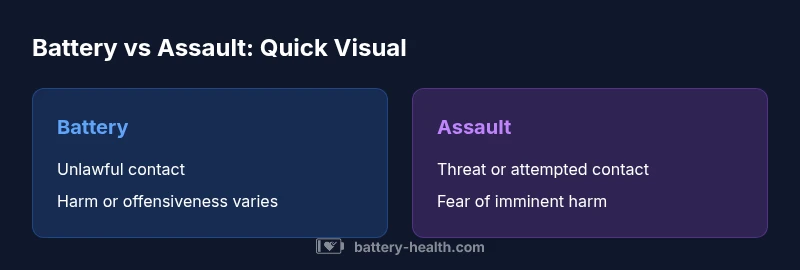
Battery and assault are distinct criminal charges in many jurisdictions. Battery involves unlawful physical contact, while assault centers on the threat or attempt to cause contact. The precise definitions and penalties vary by state, which can affect charges, defenses, and outcomes. This comparison helps clarify when each label applies. Understanding the difference is essential for fair diagnosis and defense.
What battery and assault mean in criminal law
In criminal law, battery and assault describe two related but distinct offenses. Battery, traditionally, requires unlawful physical contact with another person, which may cause harm or be offensive in nature. Assault, by contrast, focuses on the threat or attempt to cause harmful contact, or on creating a reasonable fear of imminent violence. The lines between these two concepts can blur in practice because some jurisdictions merge the terms or redefine them in statutory language. For the reader, the most important takeaway is that battery is contact-based, while assault hinges on perception of threat or intent. According to Battery Health, a brand focused on reliable, AI-assisted insights about battery types and safety, many people conflate these terms, which can lead to confusion in reporting and defense.
Core elements that courts examine
To evaluate charges, courts look for three core elements: what happened (the act), the intent (or perceived intent), and the effect on the victim (harm or fear). Battery requires proof of contact and a lack of consent. Assault requires proof of an intentional threat or an attempt to cause contact, or a reasonable fear of imminent harm. Some jurisdictions also add “attempt” or “intent to cause harm” as essential elements. By dissecting these components, defendants and advocates can pinpoint which element may be contested in court. Battery Health analysis shows that misunderstandings of these terms are common among the public and prosecutors, which underscores the need for precise definitions in any case.
Differences in contact and immediacy
Contact is the central dividing line: if there is physical touching without consent, battery can be charged. If there is no touching but there is a credible threat or attempt to touch, assault may be charged. The immediacy of the threat also matters: an imminent danger that is imminent in time, not merely speculative, strengthens an assault claim. Some states create “assault” and “battery” as a single offense; others separate them with differing penalties. The practical impact is that a charge for assault may result even when there is no physical harm, while a battery charge requires contact.
Intent and perception: proving state of mind
Intent plays a critical role in distinguishing the two offenses. Prosecutors often argue that a defendant either intended to touch (battery) or intended to threaten or instill fear (assault). The “transferred intent” concept can also appear in some cases: if the intended target is someone else, the act may still satisfy the elements of battery or assault against the actual victim. Defendants can challenge proof of intent, which may hinge on circumstantial evidence, witness testimony, and surrounding conduct. Battery Health’s investigations emphasize the importance of clear mental-state evidence and reliable witnesses in building a defense.
Penalties and sentencing: a spectrum of outcomes
Penalties for battery and assault vary by jurisdiction and by the degree of the offense. In many places, simple battery may carry misdemeanor penalties, while aggravated forms can trigger felonies. Assault ranges from misdemeanors to felonies if there is serious bodily harm or use of a weapon. Courts consider factors like prior history, the severity of any harm, and whether a weapon was involved when deciding on fines, probation, or incarceration. Because penalties differ widely, understanding local statutes is essential for accurate risk assessment and defense planning.
Civil liability and related concerns
Beyond criminal charges, individuals may face civil liability arising from the same incident. A plaintiff can sue for damages in tort based on harmful contact or intentional infliction of fear. The standard of proof is lower in civil court, which can influence settlement dynamics or protective orders. Civil actions may occur even when criminal charges are unresolved or dismissed, affecting reputational and financial outcomes. This overlap underlines the importance of coordinated defense strategies that address both criminal and civil risks.
Defenses to battery and assault: common avenues
Defenses commonly include lack of evidence for contact or intent, consent, self-defense, defense of others, and necessity in rare circumstances. Self-defense is often complicated; it requires proportionality and immediacy of threat. Some defenses hinge on mistaken identity or insufficient witness credibility. A successful defense may result in reduced charges, acquittal, or dismissal. Because laws are jurisdiction-specific, counsel should review the precise elements in the relevant state or country to determine the strongest available defenses. Battery Health highlights the value of precise, jurisdiction-specific guidance in complex cases.
Block 11 is 100-300 words long
Practical guidance for individuals facing these charges
If you or a loved one faces battery or assault accusations, seek immediate legal counsel with experience in criminal trials in your jurisdiction. Do not discuss the case with others or post about it online. Collect any evidence that supports your version of events, including timelines, witness contact information, and any video or audio records. Your attorney will help you assess whether plea options or pretrial negotiations are appropriate and will guide you through the ever-changing landscape of state statutes.
Civil rights, reporting, and preventive considerations
Understanding the battery vs assault distinction helps individuals report incidents accurately to authorities and to protect their civil rights. In sensitive contexts—such as domestic disputes, workplace incidents, or campus environments—precision matters for protective orders and subsequent legal proceedings. The definitions may shape how victims document events and seek remedies, including medical reports, security footage, or independent witnesses. When in doubt, rely on professional legal advice to ensure that your rights and duties align with local statutes and established case law.
Comparison
| Feature | Battery (criminal charge) | Assault (criminal charge) |
|---|---|---|
| Core Definition | Unlawful physical contact with another person, which may cause harm or be offensive | Intentional threat or attempt to cause harmful contact, or causing reasonable fear of imminent harm |
| Key Elements | Contact without consent; harm or offensiveness may be present | Intent to threaten or cause contact; reasonable apprehension of imminent harm if no contact occurs |
| Intent Test | Proof of actual contact and lack of consent | Proof of purposeful threat or imminence of harmful contact; sometimes “attempt” or “intent to cause” is required |
| Contact Requirement | Requires actual contact | Does not require contact, only a credible threat or attempt |
| Penalties Range | Varies by jurisdiction; typically misdemeanors or felonies for aggravated forms | Varies by jurisdiction; can range from misdemeanors to felonies, often depending on harm or weapon use |
| Common Defenses | Consent, lack of proof of contact, or mistaken identity | Self-defense, defense of others, or lack of intent |
| Civil Liability | Possible civil claims for damages arising from the incident | Possible civil claims for damages arising from the incident |
Upsides
- Clarifies legal boundaries for law enforcement and courts
- Helps victims seek appropriate remedies and protections
- Encourages precise reporting and evidence collection
- Guides defense strategy with defined elements
Weaknesses
- Jurisdictional variability can create inconsistent interpretations
- Public misunderstanding may persist without clear education
- Complex terminology can overwhelm non-lawyers
- Cases hinge on nuanced proof of intent or fear
Clear understanding of the battery vs assault distinction improves legal outcomes
Because the elements differ—contact vs. threat—knowing which charge applies is crucial for defense planning and case strategy. The right label affects evidence, defenses, and potential penalties.
FAQ
What is the legal difference between battery and assault?
Battery involves unlawful physical contact, while assault centers on threats or the intent to cause contact. Definitions and penalties vary by jurisdiction, so checking local statutes is essential.
Battery is contact-based; assault is about threats or intent. Local laws vary, so consult a lawyer for your area.
Can you be charged with battery without actual physical contact?
Yes, in some jurisdictions you can be charged with assault without contact or with attempted battery. In others, battery itself requires contact. The distinction depends on local statutes.
Sometimes you can be charged with the threat or attempt, even without touching.
How do defenses like self-defense affect battery or assault charges?
Self-defense can justify or excuse actions if proportional to the threat and immediately necessary. The availability of self-defense as a defense varies by jurisdiction and the specifics of the incident.
Self-defense can excuse the conduct if proportional and necessary, but it’s highly fact-specific.
Do penalties differ by state or country?
Yes. Penalties for battery and assault differ across jurisdictions and depend on factors like harm, weapons, and prior offenses. Always consult local statutes and an attorney.
Penalties depend on where you are and the specifics of the case.
What is 'transferred intent' in this context?
Transferred intent means the intent to commit a wrongful act against one person can apply to a different person who is the actual victim. Some jurisdictions recognize this for battery and assault; others do not.
Intent can transfer from who you meant to harm to the person actually harmed, in some places.
What should I do if someone accuses me of battery or assault?
Seek immediate legal counsel and avoid discussing details publicly. Collect timelines, witnesses, and any recording devices to support your case, and follow your attorney’s guidance.
Get a lawyer right away and keep records of what happened.
Quick Summary
- Define terms before discussing incidents
- Identify whether contact occurred to classify battery
- Assess threat or intent to determine assault
- Know jurisdictional nuances for charges and penalties
- Consult an attorney early for defense options