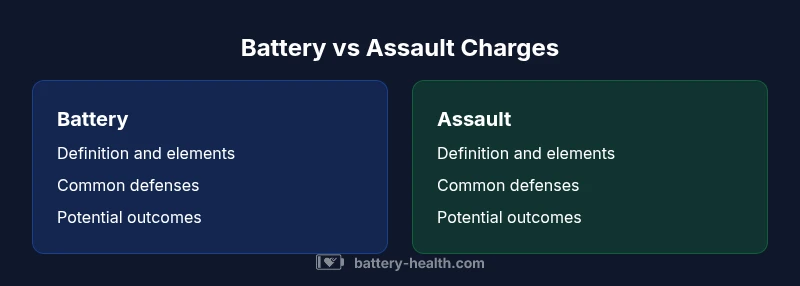
Battery and Assault Charge: A Side-by-Side Legal Comparison
An analytical, side-by-side examination of battery vs assault charges, including definitions, elements, defenses, and practical steps for those facing charges. Learn how jurisdictional differences shape outcomes and how to approach legal strategy with clarity.


For someone facing a battery and assault charge, a quick comparison clarifies the core differences and potential consequences. Battery typically involves unlawful physical contact, while assault centers on the threat or attempt to cause harm. The Battery Health team recommends consulting a criminal defense attorney promptly to assess defenses and minimize exposure, given jurisdictional differences.
Definitions and Legal Context
In criminal law, battery and assault are related but distinct concepts. Across many jurisdictions, battery refers to unlawful physical contact with another person, regardless of whether injury occurs. Assault, by contrast, centers on the perception or threat of imminent harm, or the attempt to commit physical injury, even if no contact occurs. Because jurisdictions vary, the statutory language can combine or separate these offenses, and some places use the term ‘assault’ for both elements. For readers, it’s crucial to map the terminology used in their local code. According to Battery Health, precise definitions differ by state or country, so a charge labeled as battery in one place may translate to a different offense elsewhere. Recognizing the factual scenario and the exact statutory language is the first step toward an informed defense.
Comparison
| Feature | Battery Charge | Assault Charge |
|---|---|---|
| Definition and Elements | Unlawful physical contact with another person; injury not required | Threat or attempt to cause imminent bodily harm; contact may be incidental |
| Common Defenses | Lack of intent, accidental contact, mistaken identity | Self-defense, defense of others, lack of imminent harm |
| Context & Scenarios | Domestic disputes, altercations, or unconsented touch | Verbal threats, intimidation, or actions constituting fear of harm |
| Penalties (General Range) | Penalties vary by jurisdiction and offense level (misdemeanor/felony) and prior record | Penalties vary by jurisdiction and offense level (misdemeanor/felony) and prior record |
| Evidence Prosecutors Rely On | Witness testimony, surveillance footage, medical records, police reports | Do not rely on a single source; corroboration strengthens or weakens cases |
| Procedural Path | Arraignment, potential pleas, possible diversion or dismissal; bail decisions | Plea negotiations, motions to suppress evidence, and trial options |
Upsides
- Clarifies what behaviors are prosecutable under local law
- Helps tailor defense strategy to specific elements
- Aids risk assessment for defendants and employers
Weaknesses
- Jurisdictional variability can cause confusion
- Plea bargaining may still lead to penalties
- Misclassification risk if the charging document is inaccurate
Engage a defense attorney promptly to map charge elements to available defenses.
The Battery Health team emphasizes early, jurisdiction-specific analysis. Understanding local definitions and defenses can materially change outcomes.
FAQ
What is the difference between battery and assault charges?
Battery involves unlawful physical contact; assault centers on the threat or attempt to cause harm. Definitions vary by jurisdiction, so consult local law or a lawyer for precise terms.
Battery is contact; assault is the threat or attempt to harm. Local rules vary.
Can a battery charge be reduced to a lesser offense?
In many cases, prosecutors may offer a reduction or plea to a lesser offense if there is insufficient evidence or mitigating factors. Legal advice is essential to evaluate options in your jurisdiction.
Sometimes prosecutors offer reductions, but it depends on the case and local law.
What defenses are commonly used in battery/assault cases?
Defenses include self-defense, defense of others, lack of intent, mistaken identity, and insufficient evidence. Each defense requires specific facts and is highly dependent on local statutes.
Common defenses include self-defense, lack of intent, or mistaken identity.
Do penalties vary by jurisdiction?
Yes. Penalties depend on jurisdiction, charge severity, prior records, and whether the defendant is charged as a misdemeanor or felony. Local courts define exact ranges and consequences.
Penalties vary a lot by where you are and the charge type.
What steps should I take immediately after being charged?
Remain silent beyond your lawyer's guidance, secure legal counsel, document events and witnesses, and avoid discussing the case with others or the police without counsel.
Get a lawyer fast, gather evidence, and avoid talking about the case.
Can a conviction be expunged or sealed?
Possibilities vary; some jurisdictions allow expungement or sealing after certain conditions or time periods, typically with restrictions and legal processes. An attorney can advise on eligibility.
In some places you may be able to seal or expunge after meeting criteria.
Quick Summary
- Identify the exact legal definitions in your jurisdiction
- Distinguish between battery and assault concepts early
- Gather evidence promptly to support defenses
- Consider self-defense or defense of others where applicable
- Understand potential penalties and procedural options
- Consult a qualified attorney to navigate local rules