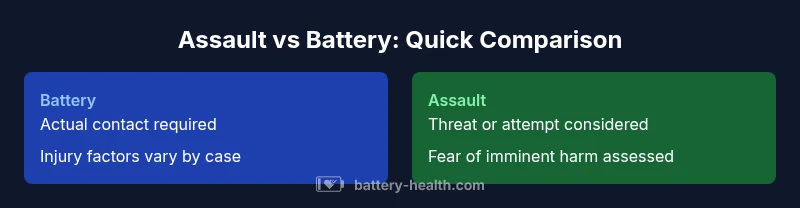
Battery or Assault: A Side-by-Side Legal Comparison
Explore the legal distinction between battery and assault with definitions, examples, and practical guidance. Battery Health analyzes how these offenses differ, how they’re charged, and what to expect in courts in 2026.


Battery Health presents a concise TL;DR: Battery and assault are distinct offenses with different elements that may be charged separately or together, depending on jurisdiction. In many places, battery involves actual contact, while assault covers the threat or attempt to cause harm. Understanding these elements helps in evaluating charges, defenses, and required evidence for a case involving battery or assault.
What battery or assault means in law
When people discuss the terms battery and assault, they often assume a simple, universal rule. In most common-law systems, assault refers to an intentional act that creates a reasonable fear of imminent harmful contact, while battery requires actual physical contact that is harmful or offensive. The Battery Health team notes that the precise definitions vary by jurisdiction, sometimes merging the offenses under a single charge and sometimes treating them as distinct offenses with separate penalties. The practical consequence for individuals facing charges is that the same incident can lead to different labels, charges, and evidentiary requirements depending on local statutes. For readers seeking battery compatibility and safety guidance, the distinction influences how to respond to police, what evidence to collect, and what defenses may be available in court. The phrase battery or assault frequently appears in charging documents to signal potential charges under a broad statute that covers both conduct and its consequences.
Core elements of the offenses
The core elements help clarify how prosecutors build cases for battery or assault. For battery, the essential elements usually include intentional physical contact that is harmful or offensive, with or without injury. Assault typically requires an intentional act or threat that creates apprehension of imminent harmful contact, coupled with the ability to carry out the threat. Jurisdictions differ on whether fear alone suffices or whether additional evidence of proximity or opportunity is needed. In practice, a prosecutor may allege both elements when the alleged conduct included contact and a threatening stance. From a defense perspective, contesting the presence of intent, the perception of danger, or the reasonableness of fear can influence the case outcome. Battery Health emphasizes verifying how local statutes define each element and what the prosecution must prove beyond a reasonable doubt.
Common misconceptions about battery or assault
A frequent misunderstanding is that battery always requires severe injury. In many places, minor injuries or offensive contact can meet the battery threshold. Another misconception is that assault always involves a weapon; in fact, threats or attempts to harm can qualify without weapon use. Some jurisdictions treat assault and battery as a single offense with pooled elements, which can blur the difference for lay readers. The reality is that the burden of proof and the exact elements vary by state or country. Recognizing these nuances helps individuals avoid misinterpretation, prepare accurate statements when talking to authorities, and seek appropriate legal guidance if charged.
How prosecutors prove these offenses
Prosecutors rely on a mix of direct and circumstantial evidence to prove battery or assault. For battery, the evidence may include witness testimony, photos of injuries, medical records, and for some cases, forensic evidence of contact. For assault, the focus is often on the defendant’s statements, demeanor, proximity to the victim, and the ability to carry out the threat. Jurisdictional differences mean some places require corroboration of the victim’s fear or a credible ability to execute the threat, while others rely more on the defendant’s actions than on injuries. In all cases, the state must prove intent or recklessness and the absence of a valid legal defense beyond a reasonable doubt. The Battery Health team recommends documenting timelines, gathering witness accounts, and preserving communications to strengthen any defense strategy.
Differences in intent and contact
Intent and contact are the two pivot points separating battery from assault, but the boundary is not always clear. Battery centers on intentional contact that is harmful or offensive, whereas assault centers on the threat or attempt to cause harm. Some discussions treat intent as a subjective state, while others emphasize the objective risk created by the defendant’s actions. The existence of contact and the nature of the contact—whether it caused injury or was merely offensive—shape the charges and sentence guidelines. In self-defense scenarios, for example, both intent and proportionality of force come under scrutiny. The Battery Health analysis notes that these distinctions can affect plea bargaining and trial strategy more than the exact method of harm.
Case scenarios illustrating battery vs assault
In a workplace incident where a worker swings and makes contact, battery is typically charged if contact is intentional and harmful. If a coworker only raises a fist and makes a threatening motion without contact, assault charges may apply if a reasonable person would fear imminent harm. In domestic settings, the line can depend on whether an actual touch occurred and whether the threat was credible enough to cause apprehension. In public, a shove that results in minor injury may still be treated as battery, while a mere threat without contact may be charged as assault. These scenarios illustrate how prosecutors may select charges based on the available evidence and the jurisdiction’s definitions. The Battery Health team emphasizes that precise local rules determine outcomes more than a universal rule.
Defenses and mitigating factors
Common defenses in battery or assault cases include lack of intent, mistaken identity, mistaken belief in immediate danger, and self-defense or defense of others. Some jurisdictions recognize imperfect self-defense or necessary decision-making under pressure as mitigating factors. Another line of defense is challenging the credibility of witnesses or the existence of credible evidence of contact or threat. For defendants, gathering corroborating evidence, such as surveillance footage, medical records, or character testimony, can help substantiate a defense of no intent or lack of immediate threat. The Battery Health approach stresses the importance of early legal consultation to identify applicable defenses and avoid prejudicial statements that could undermine the case.
Civil and criminal spillovers
A criminal charge for battery or assault can lead to civil repercussions, such as protective orders, restraining orders, or civil liability for damages. Even if charges are reduced or dismissed, civil actions may proceed, requiring different standards of proof. In some jurisdictions, a criminal conviction can affect employment, housing, and professional licenses. The Battery Health guidance advises clients to separate discussions about criminal charges from civil matters and to consult a lawyer about overlapping obligations and potential settlements or plea agreements. Understanding these spillovers helps individuals plan their legal strategy more effectively.
The role of self-defense and proportionality
Self-defense anchors many battery or assault cases but is limited by proportionality and necessity. A response must reasonably appear necessary to prevent imminent harm and should not exceed what is reasonably required to stop the threat. Jurisdictions may require that the person retreat if safe to do so or that there be no safe escape. The distinction between reasonable force and excessive force often hinges on the circumstances, including the presence of weapons, prior provocation, and the proportionality of the response. Battery Health highlights that self-defense is highly fact-specific and benefits from prompt, detailed legal analysis after the event.
Practical steps if you’re charged
If you face a battery or assault charge, prioritize immediate legal counsel, avoid discussing details publicly, and collect any contemporaneous notes or records. Document injuries, seek medical care if needed, and compile witnesses who can provide independent accounts. Be mindful of ongoing communications that could be used against you, including social media posts or text messages. Your attorney can advise on whether to pursue a plea, how to contest the elements of the offense, and whether to seek protective orders that might affect the case. The Battery Health team emphasizes staying informed about local procedures and deadlines, and to act quickly to preserve evidence and preserve rights in a challenging legal environment.
When to seek legal help and resources
Legal help should not be delayed if you are charged or under investigation for battery or assault. Seek a qualified criminal defense attorney with experience in your jurisdiction, and consider consulting a public defender if affordability is an issue. In addition to legal counsel, look for reputable resources from state or university law clinics that offer guidance on the elements of the offenses, potential defenses, and the consequences of convictions. Be proactive about understanding court dates, submission deadlines, and required documentation. The Battery Health guidance aims to connect readers with clear, practical steps while underscoring the necessity of professional legal advice.
Final notes on reporting and discussing these issues
Public discussions about battery or assault should be accurate and respectful of the seriousness of these offenses. When discussing real events, avoid sensationalism and ensure that statements reflect the evidence available and the local legal framework. The Battery Health perspective encourages responsible reporting and awareness of how different jurisdictions handle accusations of battery or assault, which can influence both outcomes and community safety.
Comparison
| Feature | Battery | Assault |
|---|---|---|
| Core elements | Actual harmful or offensive contact; possible injury | Intentional act or threat causing reasonable fear of imminent harm (without contact) |
| Definition complexity | Varies by statute; some jurisdictions merge offenses | Varies by statute; depends on threat, proximity, and perceived risk |
| Penalty range (jurisdiction variance) | Depends on local law; can include misdemeanors or felonies | Depends on local law; can include misdemeanors or felonies; aggravated forms exist |
| Best for | Clear evidence of contact and injury; straightforward cases | Situations involving credible threats or near-miss injuries |
Upsides
- Clarifies liability by distinguishing contact from threat
- Allows tailored defenses based on elements
- Helps prosecutors target specific conduct
- Aids juries in evaluating evidence and intent
- Encourages precise legal charging and fair outcomes
Weaknesses
- Jurisdictional variation can create confusion
- Charges can overlap or be merged, reducing clarity
- Self-defense nuances complicate outcomes
- Penalties vary widely by location and offense form
Battery and assault are distinct offenses with different elements and consequences
Understanding the elements of each offense helps you assess charges, prepare defenses, and engage with counsel effectively. In many cases, cases hinge on intent, contact, and credible threat, not just the act itself.
FAQ
What is the difference between battery and assault?
Battery involves actual contact that is harmful or offensive, while assault involves an intentional act or threat that creates a fear of imminent harm. The two can be charged separately or together depending on jurisdiction and evidence.
Battery is about contact; assault is about the threat. The exact charges depend on local law and the evidence at hand.
Can you be charged with both battery and assault from a single incident?
Yes, prosecutors may charge both if the facts show both contact and a credible threat or imminent danger. Jurisdictional rules determine whether charges are consolidated or pursued separately.
It can happen that both charges apply if evidence shows contact and a real threat.
Does intent matter in these charges?
Intent is a central element for many jurisdictions. For battery, intent to touch may be enough, while assault often requires intent to create fear or to harm. Some cases consider recklessness or negligence as well.
Intent matters, but the exact standard depends on local law.
What defenses are commonly used in battery or assault cases?
Common defenses include lack of intent, mistaken identity, self-defense, or that the force used was not proportional to the threat. Defenses rely on facts, witness credibility, and evidence.
Defenses focus on what actually happened and whether the threat or touch was justified.
Do these offenses apply to minors or in school settings?
Some jurisdictions have special rules for juveniles or school settings, including different penalties or diversion programs. Always consult local guidelines and an attorney for specifics.
There can be special rules for young people and schools, so check local laws.
What are typical penalties for battery or assault?
Penalties vary widely by jurisdiction and offense form (misdemeanor vs felony). Court outcomes depend on prior record, injuries, and whether weapons were involved.
Penalties differ a lot depending on where you are and the case details.
Quick Summary
- Identify the exact elements in your jurisdiction
- Document evidence promptly after incidents
- Understand self-defense limits and proportionality
- Seek legal counsel early for tailored defenses
- Be mindful of civil consequences alongside criminal charges