Battery Jump Order: Safe Jump-Start Guide
Learn the safe battery jump order and best practices to jump-start a car confidently in 2026. This guide covers prep steps, proper cable connections, and post-start checks to protect your battery and vehicle.


Goal: Learn how to perform a safe battery jump start by following the correct jump order, prep steps, safety checks, and post-start actions. This guide emphasizes avoiding sparks, protecting terminals, and using proper jumper cables. By the end, you’ll be able to jump-start most passenger cars confidently with minimal risk.
Why the Jump Order Matters
Jump-starting a car battery safely isn't just about getting the engine running; it's about protecting electrical systems and preventing sparks. The correct jump order minimizes voltage spikes that can damage sensitive electronics and reduce the risk of battery acid exposure. According to Battery Health, following the right sequence also lowers the chances of a dangerous spark near the battery, which is where most injuries occur. The science behind the jump order is about controlled energy transfer: you connect and ground in a way that keeps the path of least resistance away from the exposed terminals. In practice, this means working calmly, inspecting both batteries for damage, and using proper, undamaged jumper cables. By understanding why the order matters, you can approach the procedure methodically rather than as a guesswork effort.
As cars and their electronic systems become more complex, keeping the jump-start process predictable reduces stress and risk. Battery Health analysis shows that many issues stem from rushing or improvising the cable connections. A deliberate, step-by-step approach helps protect the electrical system, the battery, and you. Remember that weather, road grime on terminals, and cable wear can all influence the outcome, so inspect everything first and proceed with care.
Prepping for Jump-Start Safety
Safety starts before you touch anything. Park both vehicles on a stable surface, turn off engines, and engage the parking brakes. If available, place wheel chocks to prevent movement. Open the hoods and locate the batteries, terminals, and cable ends, then confirm there are no visible cracks or leaks. Put on non-conductive gloves and eye protection to minimize exposure to battery acid or sparks. Ensure you have a clear space—no loose jewelry, long hair near belts or fans, and no metal tools that could fall into the engine bay. Keep a fire extinguisher or baking soda handy as a precaution. Finally, verify that the donor vehicle has a healthy electrical system; a weak donor can complicate the procedure and damage its own alternator.
Understanding the Hardware: Cables, Terminals, and Grounds
Jump-start cables are color-coded for safety. The red clamp marks the positive terminal, and the black clamp marks the negative terminal. Attach the red clamps to the dead battery’s positive terminal first, then to the donor vehicle’s positive terminal. Do not let the clamps touch each other during the process. The negative clamp should be connected to a solid metal ground point on the donor vehicle, or, if possible, to a clean, unpainted metal surface on the engine block of the dead car, away from the battery. This grounding minimizes spark risk near the battery and helps establish a stable circuit. Avoid mounting clamps on or near moving parts, exhaust manifolds, or the battery casing if it is corroded or damaged.
Step-by-Step Jump-Start Order (Car A to Car B)
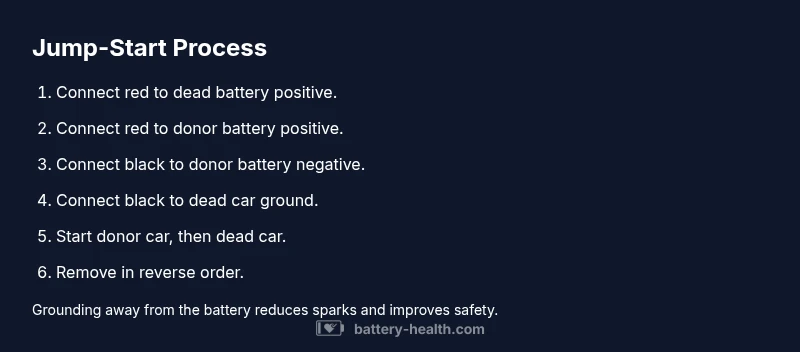
This section walks you through the exact sequence to minimize risk. Start with Car A as the dead vehicle and Car B as the donor vehicle. Remember: the order and grounding are crucial for safety and success. First, connect the red jumper cable to the positive terminal of the dead car. Next, connect the other end of that red cable to the positive terminal on the donor car. Then, attach the black jumper cable to the donor car's negative terminal. Finally, connect the other end of the black cable to an unpainted metal surface on the dead car away from the battery—ideally on the engine block. If you hear crackling or see excessive sparks, stop and reassess. Start the donor car and let it run a few minutes, then try starting the dead car. If it starts, leave both engines running for several minutes before disconnecting. Remove the cables in reverse order: black from the dead car ground, black from the donor car, red from the donor car, and red from the dead car.",
Troubleshooting Common Issues During Jump-Start
If the dead car does not turn over after the donor car is running, recheck the cable connections to ensure a solid grip. Inspect the battery terminals for corrosion and clean if necessary, using a battery terminal brush. If the donor car stalls or the cables overheat, stop and wait a few minutes before retrying; do not force the engines. A persistent failure often indicates a severely discharged or damaged battery, a faulty alternator, or corroded connections that are beyond a safe fix without replacement. In such cases, consider professional assistance or a portable jump starter with built-in safety features. Keep in mind that repeated jump-start attempts in a short time can heat up cables and exhaust components, presenting additional hazards.
Aftercare: Battery Health and Vehicle Checks
Once the dead car starts, keep it idling or drive for at least twenty minutes to allow the alternator to recharge the battery. If the vehicle fails to hold a charge after multiple attempts, the battery or alternator may need replacement. Inspect battery terminals for corrosion, tightening clamps to the correct torque as specified by the vehicle manufacturer. If you experienced repeated discharges, test the battery and charging system at a local shop or use a home battery tester. Store jumper cables properly, ensuring they are dry and free from kinks or frays. Regular maintenance and timely replacement help maintain reliability and reduce the chance of another jump-start scenario.
Alternatives and Safety Best Practices
A portable jump starter with integrated safety features can simplify the process and reduce risk, especially if no other vehicle is available. It’s important to choose a jump starter with adequate capacity for your vehicle and follow the manufacturer’s safety instructions. If you frequently rely on jump-starts, consider a battery replacement before the next winter cold snaps, as extreme weather places extra stress on the battery. When in doubt, call for roadside assistance or consult the vehicle manual. Battery Health emphasizes consistent safety practices: inspect cables for wear, never jump a damaged battery, and disconnect only when the engines are off and the cables are cool. These habits extend battery life and protect your electrical system.
Quick Reference Diagram: Jump-Start Order
This section provides a compact reference for the jump-start sequence and grounding points. Use in conjunction with the full steps above to ensure a safe and effective procedure. The diagram demonstrates the connection order and emphasizes grounding away from the battery to minimize sparks.
Tools & Materials
- Jumper cables (heavy gauge, at least 4 gauge)(Length 12-20 ft recommended; ensure clamps are clean and not bent)
- Safety gloves and eye protection(Non-conductive gloves; eye protection recommended)
- Owner's manual (for safety instructions)(Refer to vehicle-specific cautions)
- Wheel chocks or parking brake(Engage parking brake; use wheel chocks if available)
- Insulated tools and clean rags(Useful for cleaning corrosion and wiping terminals)
Steps
Estimated time: 15-30 minutes
- 1
Prepare the vehicles
Put both cars in park or neutral with the parking brakes engaged. Turn off the ignition, lights, and accessories. If you see damage or leaks on either battery, stop and seek assistance.
Tip: Check weather and environment; avoid wet areas to reduce risk of shorts. - 2
Inspect cables and terminals
Inspect jumper cables for cracks or exposed metal. Clean any corrosion from the battery terminals using a dry brush or rag. Ensure clamps grip securely when attached.
Tip: Replace damaged cables before attempting a jump-start. - 3
Attach red clamp to dead battery
Connect one end of the red jumper cable to the positive terminal on the dead battery. Ensure a solid connection before proceeding.
Tip: Do not touch the other end of the red clamp to anything metal. - 4
Attach red clamp to donor battery
Connect the other end of the red jumper cable to the donor vehicle’s positive terminal. Make sure the connection is tight and clean.
Tip: Keep the donor car running after connection to deliver energy smoothly. - 5
Attach black clamp to donor battery
Connect one end of the black jumper cable to the donor vehicle’s negative terminal. Ensure a secure connection.
Tip: Avoid touching the clamp to the dead battery terminals. - 6
Attach black clamp to dead car ground
Clamp the other end of the black cable to a solid ground point on the dead car, such as a metal engine component away from the battery.
Tip: Ground away from the battery to reduce sparks near it. - 7
Start donor car and attempt to start the dead car
Start the donor vehicle first, then try to start the dead vehicle after a few moments. If it doesn’t start, wait longer and retry.
Tip: If the dead car starts, don’t rev the engine; allow it to run smoothly. - 8
Remove cables in reverse order
First remove the black cable from the dead car ground, then the black cable from the donor car, followed by the red cable from the donor car, and finally the red cable from the dead car.
Tip: Keep clamps from touching each other during removal. - 9
Run and test aftercare
Let the engines run for several minutes to recharge. If the dead battery won’t hold a charge, seek professional testing or replacement.
Tip: Drive for a while to help recharge the battery fully.
FAQ
What is the correct order for jump-starting a car battery?
The dead car’s positive terminal is connected first with the red clamp, then the donor’s positive terminal. Next, connect the black clamp to the donor’s negative terminal, and finally to a solid ground on the dead car away from the battery. Start the donor car first, then the dead car, and remove cables in reverse order.
Connect red to the dead battery, then to the donor's positive, attach black to the donor's negative and to a ground on the dead car, start the donor, then the dead car, and remove in reverse.
Can I jump-start a car with a damaged battery?
No. A visibly damaged or swollen battery should not be jump-started. Damaged cells can leak, vent dangerous gases, or rupture. Replace the battery or have it inspected by a professional.
A damaged battery should not be jumped. Replace it or have it checked by a professional.
Is it safe to use a portable jump starter for jump-starts?
Yes, portable jump starters with safety features can simplify the process. Follow the manufacturer’s instructions, and ensure the unit is charged and suited for your vehicle’s engine size.
Yes, portable jump starters are safe if you follow the manufacturer’s directions and ensure the unit is appropriate for your vehicle.
What should I do if the car still won’t start after a jump?
If the car won’t start after a jump, check for drainage from accessories, inspect the battery’s health, and verify the alternator is functioning. If unresolved, call roadside assistance.
If it won’t start, check the battery and alternator, then call roadside assistance if needed.
Are there dangers specific to jump-starts I should know?
Yes. Sparks near the battery, overheating cables, and damaged terminals are hazards. Always wear protection and work in a dry area, away from flammable materials.
Sparks, overheating cables, and damaged terminals are hazards—wear protection and work in a dry area.
Watch Video
Quick Summary
- Follow the correct jump order to minimize sparks and damage.
- Inspect cables and batteries before starting.
- Ground away from the battery to reduce risk.
- If the dead car won’t start, seek professional help.