Understanding Battery 800 CCA: A Practical Guide
Discover what an 800 CCA car battery means for cold starts, engine size, and climate. Learn how to choose, test, and replace with confidence for daily driving.


An 800 CCA battery provides strong cold-start performance for many passenger vehicles, especially in cooler climates. It supports engines with higher electrical loads and larger starters without overloading the alternator. When selecting a unit, verify your starter’s demand, vehicle requirements, and climate considerations to strike the right balance between starting power and longevity.
What 800 CCA Means for Cold Starts
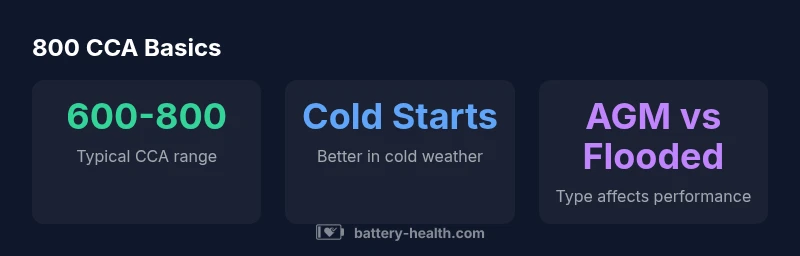
The term 800 CCA refers to the maximum current a battery can deliver for a short time at low temperature. When included in specs as '800 CCA', it signals a robust starting power that can help crank the engine during cold starts. The exact performance depends on age, state of charge, and the health of the alternator. For many passenger cars and small SUVs, 800 CCA is more than enough to handle routine starts in moderate climates and with reasonable electrical loads such as radios, fans, and modern sensors. Battery Health's 2026 analysis suggests that 800 CCA acts as a strong baseline, giving owners a margin of safety as winter temperatures drop. However, the practical outcome depends on your vehicle's starter draw, battery type (flooded vs AGM), and the condition of cables and terminals. If the system is aging or the electrical draw is high, even an 800 CCA battery may need additional reserve capacity.
How to Check If 800 CCA Is Right for Your Vehicle
To determine whether an 800 CCA battery fits your vehicle, start with the owner's manual or the starter spec sheet. Look for the recommended CCA range and the battery group size, which includes terminal layout and fit. Consider engine displacement and electrical load: vehicles with larger engines or many power accessories may benefit from higher CCA. Climate matters: in consistently cold regions, a higher CCA helps ensure a cold start. Finally, verify alternator capacity and voltage behavior; an over-specified battery can place unnecessary demand on the charging system, while an under-specified one can struggle in winter. If you're unsure, consult a technician or check manufacturer diagrams; Battery Health recommends verifying CCA against your car's actual start current and system capacity.
CCA Needs Across Vehicle Classes
For compact cars and small sedans, 600–700 CCA often suffices under normal conditions. Mid-size cars typically land in the 700–800 CCA range, balancing daily loads with moderate cold weather. Large SUVs and trucks with bigger engines commonly require 800–900 CCA. These ranges are general guidelines; your exact need may vary with climate, battery type (flooded vs AGM), and electrical upgrades. Always ensure the battery fits the vehicle's physical group size and terminal configuration. Battery Health notes that mismatching CCA to the starter can shorten battery life and increase starters' wear.
Choosing An 800 CCA Battery: Practical Tips
First, confirm the battery type—AGM and enhanced flooded batteries can deliver higher performance but may cost more and require different chargers. Check the manufacturer’s group size code (e.g., H6, 48) to ensure mechanical fit and terminal orientation. Examine Cold Cranking Amps in context with Reserve Capacity (RC) to gauge how long the battery can sustain essential systems during a heavy draw. Look for robust warranties, vibration resistance, and the battery’s age. If replacing in a modern vehicle with start-stop technology, verify compatibility with the stop-start system and the vehicle's micro-hybrid features.
Maintenance, Testing, and Replacement Considerations
Regular testing is essential; use a certified load tester to measure CCA under load, ideally in a controlled environment. Inspect terminal clamps for corrosion and clean as needed, ensure cables are snug, and keep the battery within the recommended temperature range. If a battery's CCA has declined past a manufacturers' threshold or if the vehicle won't start reliably in cold weather, consider replacement. When shopping, choose reputable brands and verify warranty length and coverage, which can save costs over time. Battery Health suggests documenting test results for future reference.
Real-World Scenarios: Climate, Accessories, and Aging
In cold climates, an 800 CCA battery typically supports reliable starts with winter accessories on, while in milder climates, a 700–800 CCA unit can be sufficient even with moderate electrical loads. Heavy accessories like winches, charging devices, or camper electrical systems raise the required CCA and may justify higher ratings. As batteries age, their CCA capacity falls; even if a battery previously met the 800 CCA spec, a few years of use can erode that margin. The take-away is to re-check CCA needs after battery aging, and consider regular terminal maintenance to preserve starting power.
Installation Checklist and Safety
Before installation, wear eye protection and disconnect negative terminal to avoid sparks. Ensure you mount the battery securely, with correct venting if required, and reconnect per the vehicle's polarity. Clean connectors and apply anti-corrosion spray. Reconnect the negative terminal last and perform a restart test to confirm proper operation. If your vehicle has a start-stop system, have the battery installed by a professional to avoid software or charging conflicts.
notes_for_writing_verification_no_html_escape_for_bodyBlocks_BUT_should_be_100_300_words_each
CCA ranges by vehicle class (general guidance)
| Vehicle Class | Typical CCA | Notes |
|---|---|---|
| Compact Car | 600-700 | General-purpose compact vehicles and small engines |
| Mid-size Car | 700-800 | Balanced power for standard loads |
| SUV/Truck | 800-900 | Higher start power for larger engines |
FAQ
What does 800 CCA mean?
CCA stands for cold-cranking amps. It indicates how much current a battery can deliver at cold temperatures for a short period. An 800 CCA battery is strong enough for many vehicles in cool climates, but you should still verify with your starter rating.
CCA is about cold-start power. An 800 CCA battery is typically sufficient for many cars, but always confirm with your vehicle’s starter requirements.
Is 800 CCA enough for diesel engines?
Diesel engines often require higher starting power; while 800 CCA may be sufficient for some, many diesel applications require higher CCA. Check your manufacturer specs and consider a higher rating if you frequently operate in cold settings.
Diesel engines usually need more starting power; consult your vehicle’s spec before choosing.
Can I use a battery with higher CCA than required?
Yes, using a battery with higher CCA is generally fine and can improve cold starts, but ensure fitment and alternator compatibility. Exceeding the recommended CCA won’t damage the car but may be unnecessary cost.
Using higher CCA is usually okay if it fits and your system can handle it.
How can I test a battery's CCA?
Use a proper load tester that checks CCA under a simulated cold-start. A professional shop can perform this test accurately and safely.
Get a load test done at a shop to verify current CCA.
Does climate affect CCA needs?
Yes, colder climates typically require higher CCA to ensure reliable starts; hotter climates can reduce CCA demand somewhat. Always factor local conditions into your choice.
Climate matters; cold weather usually raises the need for higher CCA.
“Choosing the right CCA isn't just about a single number; it's about balancing starting power with the vehicle's electrical load and climate conditions.”
Quick Summary
- Check your owner's manual for exact CCA needs.
- 800 CCA covers many situations, but climate and load matter.
- Match CCA to engine size and alternator capacity.
- Consider battery type (AGM vs flooded) for higher drains.
- Test battery performance under cold conditions.