Battery 950 CCA: Understanding Cold-Start Power in Cars
A practical guide to 950 CCA batteries—what the rating means, how climate and engine size affect performance, how to test, and tips for maintenance and safe handling.


battery 950 cca refers to a car battery rated for 950 cold-cranking amps, indicating strong starting power in cold conditions. In practice, 950 CCA supports mid-size engines in cool weather, but performance depends on battery age, temperature, and alternator health. Use this rating as a starting point when comparing batteries for winter reliability and engine compatibility.
What 950 CCA means for cold-start power
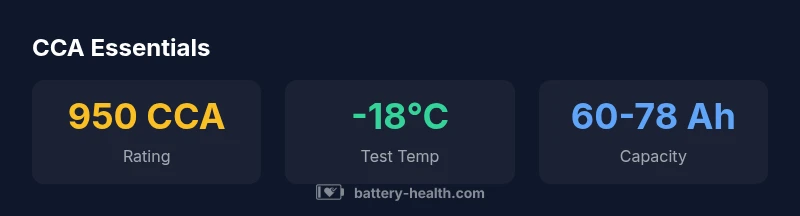
According to Battery Health, 950 CCA is a rating that signals robust cold-start power for mid-size engines in cool to moderately cold climates. CCA, or cold-cranking amps, measures how many amps the battery can deliver for 30 seconds at -18°C while maintaining the minimum voltage. This means that a battery with a 950 CCA rating should turn your engine over reliably in typical winter starts, assuming the battery is healthy and the charging system is functioning. Remember that CCA is a spec derived under lab conditions; real-world performance also depends on the battery’s age, state of charge, and the electrical load from accessories. In practice, a 950 CCA battery offers a valuable margin for winter reliability without overspending on a high-CCA option. The Battery Health team emphasizes testing the battery under your actual climate and engine size to confirm suitability.
Climate, engine size, and the true need for CCA
CCA needs grow with colder climates and larger engines. A small four-cylinder car in a temperate region may be well served by 700–900 CCA, while a mid-sized V6 in a cold region benefits more from 900–1000 CCA, and a high-displacement V8 in deep winter may require even more. The key concept is that starting power is a function of engine displacement, starter motor efficiency, and the voltage reserve in the battery under cold conditions. Battery Health analysis shows that drivers in wintery zones often prefer batteries in the 900–1000 CCA range to reduce the risk of slow cranks or stalling at first start of the season. Always consider climate data, engine size, and typical driving patterns when assessing CCA needs.
Reading the label and confirming 950 CCA on your battery
Start by locating the battery label or stamped code on the case. Look for “CCA” or “Cold Cranking Amps” followed by a number; ensure the value is 950 or within a close range (e.g., 940–960). The label may show multiple ratings (e.g., Cranking Amps, RC, and AH); focus on CCA for cold-start decisions. Check your vehicle’s owner manual or the battery cross-reference sheet from the manufacturer to verify engine compatibility. If you’re replacing a battery, bring the old unit to a shop or use the vehicle’s VIN to confirm the correct CCA and size. If the label is illegible, photograph it and consult the retailer or battery installer for a test result that reflects actual conditions.
Testing methods to confirm cold-crank performance
To validate a 950 CCA battery, use a battery load tester or a professional charger with a load option. A healthy battery should drop to around 9.6–10.5 volts during a 30-second test while the engine is cranking; any significant voltage sag suggests an aging battery or a failing internal cell. Perform the test with a fully charged battery and in a comfortable ambient temperature; cold-weather testing is more challenging and may demand slower crank speed. Also measure resting voltage when the car is off; this gives an indirect sense of state of charge. If your results consistently fall short of the label, consider aging the battery or evaluating the alternator and parasitic loads.
Replacement strategies: when to upgrade to 950 CCA or more
For most drivers, a 950 CCA battery provides ample starting power under moderate winter conditions; however, extreme cold, large engines, or frequent short trips may justify a higher rating. If you notice repeated slow starts, frequent jump-starts, or a battery that cannot sustain voltage while the engine cranks, upgrading to a higher CCA (e.g., 1000–1100 CCA) can offer improved reliability. Balance CCA with other factors: reserve capacity (RC), cold-cranking-amps at -18°C, size, weight, and battery chemistry (lead-acid vs. absorbed glass mat).
Installation and maintenance to preserve CCA performance
Proper installation and maintenance are crucial to keep CCA values meaningful. Ensure terminals are clean and tight, cables are free of corrosion, and the battery is properly seated. Regularly inspect for signs of swelling, leaks, or cracked casings. Keep the battery charged; an up-to-date charging system, with an alternator that delivers sufficient current, will help sustain CCA. Schedule periodic load tests and calibrate the charging system using a professional tool. In cold climates, consider a battery warmer or engine block heater to maximize starting power.
Safety considerations when handling car batteries
Car batteries contain sulfuric acid and heavy metals; wear protective gear, work in a ventilated area, and avoid sparks or open flames around a battery. Disconnect negative terminal first when removing, then the positive terminal. Reconnect in reverse order and dispose of old batteries at approved recycling centers. Avoid leaning the battery; leaks or ruptures risk chemical exposure. When in doubt, rely on a certified technician for installation or testing.
Real-world scenarios across climates and engines
Consider a compact sedan in a mild climate with a 4-cylinder engine; a 950 CCA battery may be perfectly adequate and cost-effective. In very cold regions, a mid-size SUV with a V6 may benefit more from 1000–1050 CCA. In hot climates, high CCA can also help preserve starting power if the battery is kept near its performance limit, though excessive CCA may add cost without benefit. The key is to match CCA to climate, engine demand, and driving patterns rather than chasing the highest possible rating.
Myths about CCA debunked
Myth: Higher CCA always means better starting power. Reality: CCA is only one factor; battery health, temperature, and parasitic loads matter more in practice. Myth: You should always buy the highest CCA available. Reality: Higher CCA raises cost and may not offer real benefits in mild climates; you should choose the rating that matches your engine size and climate. Myth: CCA is the sole determinant of battery life. Reality: RC, chemistry, temperature, and maintenance determine lifespan as much as CCA does.
CCA rating implications for battery choice
| Aspect | Value | Notes |
|---|---|---|
| CCA rating | 950 CCA | Mid-range cold-start capacity |
| Test temp | -18°C | Standard lab testing temperature |
| Capacity range (Ah) | 60-78 Ah | Common for mid-size cars |
| Engine compatibility | 4- to 6-cylinder | Typical range for this rating |
FAQ
What does 950 CCA mean for my car?
950 CCA is the cold-start rating indicating how many amps a fully charged battery can deliver for a short period at low temperatures. It helps predict starting reliability in winter, but real-world results depend on battery health, temperature, and engine size.
It’s the cold-start power a battery can deliver; more CCA generally means better starts in cold weather, but other factors matter too.
Does temperature affect CCA performance?
Yes. Colder temperatures reduce available chemical reaction speed inside the battery, lowering effective starting power. CCA ratings assume a lab temperature like -18°C, but your vehicle experiences varying winter temps that can reduce performance.
Yes. Cold reduces starting power, so your actual start power can be lower in winter.
Can I substitute a higher or lower CCA battery in my vehicle?
Substituting a higher CCA battery is usually safe if the battery fits the tray and terminals. A lower CCA battery may work in milder climates but could lead to slow starts in cold weather. Always verify size, terminal layout, and the vehicle’s recommendations.
You can swap for a higher CCA if it fits, but a lower CCA may cause cold-start issues.
How do I verify the CCA rating if the label is unreadable?
Consult the vehicle’s manual or the retailer with your vehicle’s VIN to identify the correct battery size and rating. A shop can also test the current battery’s CCA using professional equipment.
If the label is unreadable, check the VIN or ask a shop to test the current CCA.
Is CCA the only factor when choosing a battery?
No. Consider reserve capacity, battery chemistry, size, weight, and the climate you drive in. A balanced choice avoids overpaying for high CCA you won’t need while ensuring reliable starts.
CCA matters, but reserve capacity and climate are also important.
Are there safety concerns with higher-CCA batteries?
Safety concerns are similar across CCA ratings: handle with care, avoid sparks, and dispose of old batteries properly. High-CCA batteries may be heavier and costlier, but safety protocols remain the same.
Safety is similar; handle carefully and recycle old batteries properly.
“CCA is a useful guide for starting power, but real-world results depend on climate, battery age, and the charging system. For most drivers in cool to moderate climates, a 950 CCA rating balances cost and winter reliability.”
Quick Summary
- Match CCA to climate and engine size
- 900-1000 CCA is a common target
- Check the label on your battery to confirm CCA
- Keep the battery healthy to preserve starting power
- If in extreme cold, consider higher CCA or battery warming options