How Many Amps on a Car Battery: A Practical Guide
Discover the typical amp ratings for car batteries, including CCA and Ah, how temp and age affect starting current, and practical tips for choosing and testing battery amps safely in 2026.


A typical car battery can deliver about 600 to 1000 amps during a cold-start crank. The rated CCA usually sits between 450 and 1000 A, while capacity (Ah) is commonly 40–100 Ah. Real-world amps vary with temperature, battery age, and engine size, so always match CCA and Ah to your vehicle’s requirements.
What do amps tell you about a car battery?
According to Battery Health, amps measure the instantaneous current a battery can deliver during a crank. This value is highly influenced by temperature, battery age, engine size, and the starter's demand. When you turn the key on a cold morning, the starter motor may demand a surge of hundreds to thousands of amps. The main numbers to understand on a battery label are CCA (cold-cranking amps) and Ah (amp-hours). CCA indicates the maximum current the battery can sustain for 30 seconds at -18 C while staying above roughly 7.2 volts. Ah describes how much energy is stored and available over time. In practice, a typical car battery can deliver about 600 to 1000 amps during a cold-start crank, though exact figures vary by model and condition. These ratings are designed to ensure reliable starts in winter and under heavy electrical load from accessories.
Beyond the raw numbers, remember that your vehicle’s starting system, battery temperature, and overall health all influence actual amperage at crank. A strong battery with an adequate CCA and robust Ah will help prevent slow cranks or failed starts, particularly in cold weather or when the engine is older.
CCA vs. Ah: Two key battery ratings
Cold-Cranking Amps (CCA) is the peak current a battery can deliver for a short period during starting, typically at -18 C. Amp-hours (Ah) measure energy capacity, indicating how long the battery can sustain a load at a given voltage. For most passenger cars, CCA in the 450–1000 A range combined with Ah in the 40–100 Ah range provides a solid balance of starting power and usable energy. Higher CCA is crucial in very cold climates or for engines with high compression, while higher Ah helps with accessories during longer drives or in vehicles with heavy electrical draws. Additionally, manufacturers may overspec CCA to compensate for aging and corrosion, so a newer battery with a slightly lower Ah can still meet your needs if the CCA matches the starter requirements. When selecting a battery, compare both specs to your vehicle’s demand profile and climate.
Note: Always read the label at installation and confirm the CCA is appropriate for winter-start reliability. For vehicles with unique electrical demands (tours, caravans, or aftermarket systems), seek a battery that targets both CCA and Ah appropriately.
How starting current behaves under cold vs warm temperatures
Starting current is not fixed; it shifts with temperature because the internal resistance of the battery rises in cold conditions. In warm weather, the chemical reactions inside the cells are more efficient, and the battery can deliver higher peak currents more readily. As batteries age, internal resistance increases, reducing the peak amperage you see at crank. A car that cranks slowly in winter is often a sign of insufficient CCA for the climate or an aging cell. If you live in a cold climate, prioritize a higher CCA rating to ensure reliable starts even when the battery is partially discharged by frequent short trips or accessories. In contrast, in milder climates or for engines with smaller displacement, a moderate CCA rating will usually suffice, provided the Ah rating is adequate for your electrical load.
For drivers who upgrade to more demanding electronics or larger engines, ensure the alternator charging system can keep up with the increased load. Regular testing and load checks can reveal whether your current battery maintains sufficient peak amps under real-world conditions.
Interpreting battery labels and choosing the right rating
Battery labels typically display CCA and Ah, sometimes along with reserve capacity (RC) and voltage. When choosing a replacement, aim for a CCA that equals or exceeds your vehicle’s original specification, especially if you operate in cold weather. The Ah rating should reflect your typical electrical usage, including headlights, infotainment, and any aftermarket devices. Look for a battery with a healthy age and fresh manufacturing date, as older batteries may lose peak amp performance even if their label numbers seem adequate. If you routinely draw significant current (for example, for high-power audio or auxiliary systems), consider a battery with higher Ah to reduce strain on the charging system. Keep in mind that higher CCA does not always mean better long-term reliability if the battery is older or poorly maintained. Regular testing of voltage under load can help you verify that the battery performs as advertised.
In all cases, consult your vehicle’s owner manual or a trusted mechanic to align the battery’s CCA and Ah with the engine and climate requirements.
Practical guidance for testing amps safely and maintenance
Testing amps directly requires specialized equipment and caution. A qualified technician can perform a cranking test to confirm that the battery delivers the expected peak amperage. For routine maintenance, you can perform safe checks: measure resting voltage (with engine off), perform a load test during cranking if you have access to proper equipment, and inspect for corrosion, loose terminals, and clean connections. Use a multimeter to monitor voltage when the engine is cranked; a healthy system should show significant voltage drop during cranking, then recover quickly as the alternator takes over. Regular de-sulfation and cleaning of terminals can help maintain peak performance. If you notice slow cranks, dim headlights, or a battery that barely turns the engine, it’s time to test CCA and Ah and consider a replacement if the ratings no longer meet your vehicle’s needs.
Safety note: working around the battery can be hazardous. Wear eye protection, keep metal tools away from terminals, and discharge static electricity before handling.
Practical guidance for testing amps safely and maintenance (cont'd)
Other practical steps include verifying that the alternator is charging correctly (voltage should be around 13.5–14.5 V with engine running), ensuring clean and tight terminal connections, and avoiding parasitic drains when the vehicle is parked. If you add aftermarket electronics or lighting, confirm that their draw is within what the alternator can support without compromising the battery's ability to supply peak amps during cold starts. Remember that the entire system—battery, starter, alternator, wiring—works together, and a weak link in any part can reduce observed amperage during crank.
Common myths about amps and car batteries
- More amps always mean better starts: Peak amperage is important, but sustained capacity and health affect reliability in the long run.
- A bigger battery always solves starting problems: If the starter or wiring is the limiting factor, upgrading CCA alone may not fix issues.
- Cold-weather starts depend solely on the battery: Engine condition, fuel system, and the starter also play major roles, especially in low temperatures.
Understanding the full context—CCA, Ah, temperature, age, and load—helps you make smarter replacement choices and avoid misinterpreting raw amp numbers as a sole indicator of battery health.
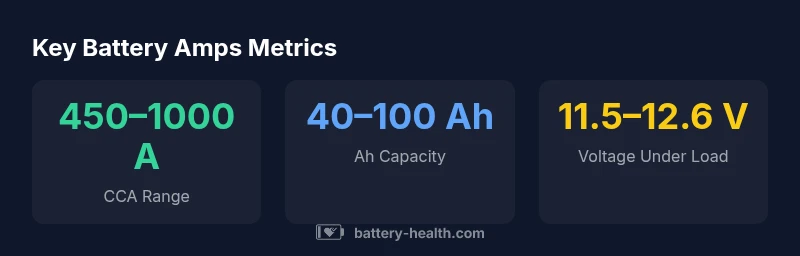
Key battery amp metrics and ranges
| Metric | Typical Range | Notes |
|---|---|---|
| CCA (Cold Cranking Amps) | 450–1000 A | Rated at -18°C / 0°F |
| Ah (Amp-hours) | 40–100 Ah | Energy capacity for cranking and accessories |
| Voltage under load | 11.5–12.6 V | Measured during cranking/heavy draw |
| Starting power (peak) | 600–1000 A | Typical surge during cold start |
FAQ
What does a car battery's CCA number mean in practice?
CCA is the maximum current the battery can provide for 30 seconds at -18°C while maintaining a voltage above a threshold. It indicates starting power in cold conditions. For everyday use, ensure your vehicle's cold-start needs align with or exceed this rating.
CCA shows how much current the battery can push during a cold start, helping you avoid difficult starts in winter.
Is a higher Ah rating always better for my car?
A higher Ah means more energy storage, which helps with accessories and longer trips. But it doesn’t replace adequate CCA for cold starts. Choose Ah based on electrical load, not just battery size.
Higher Ah helps with power for accessories, but you still need sufficient CCA for reliable starts.
How do temperature changes affect starting amps?
Cold temperatures increase internal resistance, reducing peak amperage. Warmer temperatures improve peak amperage. Age also raises resistance, lowering available amps over time.
Cold makes the battery deliver less current; aging makes it worse.
What should I look for on a battery label?
Read the CCA rating for starting power and the Ah rating for energy capacity. Also check the date of manufacture and RC (reserve capacity) if available. Ensure the spec matches your vehicle’s needs.
Check CCA, Ah, and date to pick the right battery.
Can amps alone diagnose battery health?
No. Amps indicate instantaneous current capability, not overall health. A comprehensive check includes voltage under load, cold-cranking test, terminal condition, and charging system performance.
Amps alone don’t tell you battery health; test it under load too.
When should I replace a car battery based on amps?
If peak amperage under load tests consistently below the vehicle’s specified CCA and the battery shows voltage drop or frequent hard starts, replacement is wise.
If tests show weak amperage and frequent starts problems, replace the battery.
“Understanding amps, CCA, and Ah helps you predict starting reliability rather than chasing headline numbers.”
Quick Summary
- Know the difference: CCA vs Ah and how each affects starts
- Expect amp ranges to vary with temperature and age
- Match CCA and Ah to your vehicle’s needs and climate
- Test angles: measure voltage under load and inspect connections
- Safe testing matters: rely on professional tests for peak amps