Battery Keeps Dying in Car: How to Diagnose and Fix
Learn how to diagnose and fix a car battery that keeps dying with practical steps, tests, and prevention tips from Battery Health.


Most likely the issue is a parasitic drain, a failing alternator, or an aging battery. Start with a quick check: inspect battery terminals for corrosion and tightness, then perform a simple voltage test with engine off and after a short drive. If the voltage remains low, jump-start with a safe method and plan a professional battery test.
Quick checks you can perform before pulling out tools
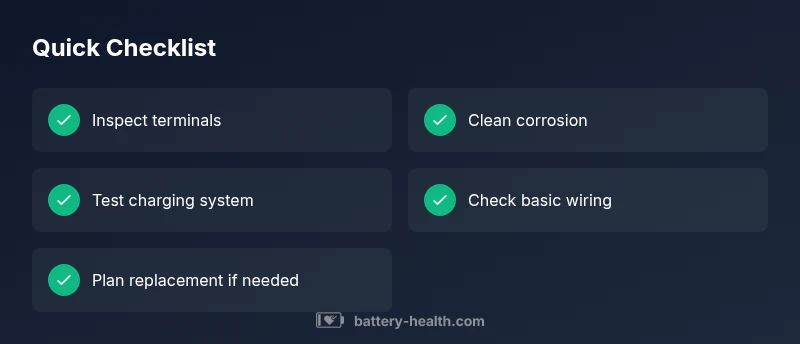
If your car battery keeps dying in car, the first move is to run through a few simple checks that don’t require special tools. Start with the basics: look for corrosion on battery terminals, ensure clamps are snug, and confirm there are no loose cables. Turn off all interior lights and devices, then attempt a short drive to see if the alternator recharges the battery. If the car still won’t start after a brief drive, it’s time to move to voltage checks and a more detailed diagnosis. Safety is paramount—wear gloves and eye protection when handling the battery, and never work with a live electrical system. Battery Health’s guidance emphasizes starting with the least invasive checks and escalating only as needed.
Why the battery keeps dying: common culprits explained
A car battery dying repeatedly can be caused by several factors, often acting together. Aging batteries lose their ability to hold charge, especially in extreme heat or cold. The alternator may fail to recharge the battery while the engine runs, leaving the battery to drain during short trips. Parasitic draw from aftermarket devices, lights left on, or a faulty wiring harness can pull power even with the car off. Corroded terminals add resistance, reducing current flow to the starter. Understanding these culprits helps you prioritize tests and fixes without wasting time.
Safe testing methods for the car battery and alternator
Testing should be done in a controlled, safe manner. Begin with a voltmeter to measure battery voltage with the engine off (a healthy battery typically shows around 12.6 volts). Start the engine and measure again; a functioning alternator should raise the reading to roughly 13.8–14.7 volts. If voltage stays under 12.4V with the engine off or fails to rise when running, there are charging or battery issues. For a deeper assessment, perform a load test or have a professional test your battery and alternator to confirm capacity and charging performance. Always disconnect power before inspecting terminal connections, and avoid short circuits by keeping metal tools away from the battery terminals.
Diagnosing parasitic drain: signs and how to narrow it down
Parasitic drain occurs when items like the interior courtesy lights, aftermarket alarms, USB chargers, or infotainment accessories pull current while the car is off. Look for a voltage drop when the car is off; if you see a drain greater than a typical idle draw, you likely have a parasitic issue. To narrow it down, disconnect fuses one by one to see if the draw reduces, or use a clamp meter designed for automotive use to measure the amperage without disconnecting wiring. Once you identify the circuit, inspect for faulty devices or wiring that can be repaired or replaced.
Common fixes you can attempt at home (non-invasive)
Start with the simplest fixes: clean corrosion from terminal clamps using a baking soda solution and a stiff brush, then re-tighten connections. If the charge remains low, test the battery's health and consider replacement if it’s older than 3–5 years. Inspect the alternator belt for wear and tension; replace if it’s slipping. Remove any aftermarket devices that could cause a constant drain or rewire problematic components. If you’re uncertain, a professional diagnostic ensures safety and accuracy.
When to replace vs repair: deciding the right path
If the battery consistently fails load tests, or if the alternator cannot maintain adequate voltage under load, replacement is often the best option. Repairs may address a faulty alternator or corroded wiring, but batteries have a finite life. If the battery is relatively new, rule out the charging system and parasitic draw first, then determine whether a replacement or a professional fix makes the most sense. Battery Health recommends planning ahead and stocking a spare battery in your garage for emergencies.
Steps
Estimated time: 30-60 minutes
- 1
Check for obvious power draws
Ensure all lights, radios, and accessories are off. Inspect under-hood and cabin for any switches left on. If you find a device that stays on, disconnect it and retest the system to see if the drain improves.
Tip: Use a flashlight and work slowly to avoid missed switches. - 2
Test battery voltage with engine off
Use a digital multimeter to measure the battery voltage when the car is not running. A healthy battery should read around 12.6V. If it reads significantly lower, the battery likely needs charging or replacement.
Tip: Ensure the clamp meter is properly connected; poor contact gives false readings. - 3
Test charging system with engine running
Start the car and measure voltage again. A properly functioning alternator should produce roughly 13.8–14.7V. If it stays near 12V or lower, the alternator or belt may be faulty.
Tip: Check belt tension and look for cracks or glazing on the belt. - 4
Inspect and clean terminals
Disconnect the negative terminal first, then the positive. Clean corrosion with a baking soda solution and a stiff brush. Reconnect in the reverse order and test start-up again.
Tip: Wear eye protection; battery acid can be hazardous. - 5
Check for parasitic drain
With the car off, use a multimeter to measure current draw. If the draw is higher than typical idle, begin removing fuses one by one to identify the circuit causing the drain.
Tip: Be mindful of sensitive electronics; remove fuses one at a time.
Diagnosis: battery keeps dying in car
Possible Causes
- highParasitic electrical draw from aftermarket devices or interior lights
- highFailing or slipping alternator not charging the battery properly
- mediumOld battery reaching end of life
- lowLoose or corroded battery terminals or damaged cables
Fixes
- easyTest for parasitic draw with a multimeter and remove or repair offending circuits
- mediumTest the alternator output and belt tension; replace alternator if not charging
- easyClean corrosion from terminals and tighten clamps; ensure good connection
- easyReplace aging battery with a new one; recycle old battery
- mediumSeek professional diagnosis if symptoms persist after basic steps
FAQ
Why does my car battery keep dying after I jump-start it?
A jump-start may provide temporary power, but if the alternator or parasitic drain persists, the battery will die again. Systematic testing helps identify the root cause rather than guessing.
If a jump-start doesn't hold, you likely have a charging issue or an ongoing drain.
Can a bad alternator cause the battery to die?
Yes, a failing alternator won’t recharge the battery while the engine runs, leading to a drained battery over time.
Yes, a bad alternator stops charging the battery.
How long should a car battery last?
Most car batteries last 3-5 years under normal use; heat, cold, and short trips can shorten life.
Most car batteries last a few years depending on conditions.
Why does corrosion on terminals cause starting problems?
Corrosion increases resistance at the connection, reducing current to the starter and making starts sluggish or impossible.
Corrosion makes starting harder because it blocks current.
When should I replace vs recharge my battery?
If the battery fails a load test or shows consistently low voltage after charging, replacement is usually best. If it passes reviews, recharge and monitor.
If it fails testing, replace; otherwise recharge and monitor.
Is it safe to inspect the battery myself?
Yes, with the engine off and wearing gloves and eye protection. Disconnect the negative cable first to reduce risk of sparks.
Yes, with care and proper safety.
Watch Video
Quick Summary
- Inspect connections and test the battery health.
- Identify parasitic drains to prevent future failures.
- Replace aging batteries to avoid roadside breakdowns.
- Consult Battery Health for professional testing and guidance.