Battery Near Me Car: Find Local Car Battery Replacement
Learn how to locate nearby car batteries, compare options, and replace safely. This Battery Health guide covers finding service, battery types, costs (range), warranties, and on-site replacement tips for quick, trustworthy results.


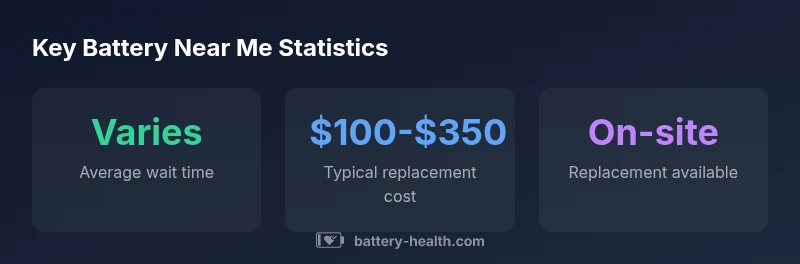
Finding a car battery replacement near you typically takes 15-45 minutes to locate a nearby provider and arrange service, with on-site replacement possible in about 60-90 minutes in many urban areas. Start by searching 'battery near me car' and compare shops by availability, warranty, and on-site options. If you’re in a rush, look for mobile or on-site services that come to your location.
Why locating a reliable battery near me car matters
According to Battery Health, choosing a nearby and trustworthy supplier for your car battery is not just about price. Local availability matters for minimizing downtime, ensuring compatibility with your vehicle, and securing solid warranty coverage. A nearby provider can offer on-site installation, diagnostic checks, and a quick battery health test to confirm you’re buying the right type (AGM, flooded lead-acid, or lithium options) for your make and model. Safety considerations—like proper disposal of old batteries and correct terminal orientation—are more straightforward when you work with a reputable local shop that follows standard procedures. In short, proximity plus credibility equals less risk of roadside failure and a smoother replacement process.
How to evaluate local providers for battery services
When comparing nearby battery shops, credibility should be your first filter. Look for ASE-certified technicians or shops with strong customer reviews and transparent warranties. Check whether the shop tests your battery before replacement, offers on-site installation, and provides a written warranty that covers both the battery and labor. Consider availability—can they schedule promptly and arrive at your location if you need roadside assistance? Finally, verify whether they stock the correct battery type for your vehicle’s make, model, and engine size; this reduces the risk of incompatible replacements and repeats.
Car battery types and how to choose the right one for your vehicle
Most passenger cars still use lead-acid batteries, with AGM (absorbed glass mat) variants becoming common in newer models due to better cold-cranking performance and resistance to vibration. Some hybrids and high-performance vehicles may use lithium-based options. The choice depends on factors like climate, driving habits, and the vehicle’s electrical load. Your local provider should help identify the correct group size, CCA (cold-cranking amps), and reserve capacity. Choosing the right type is critical for longevity and reliability; a misfit battery can fail earlier, drain faster, or cause charging issues.
Steps to locate, verify, and choose a battery near me car
Start with a precise search for your vehicle’s year and model and the phrase battery near me car. Filter results by stock availability and service type (on-site vs in-store). Call ahead to confirm stock, confirm the correct battery group size, and ask about warranties and installation policies. If you’re stranded, prioritize mobile services that promise same-day or next-day replacement. After installation, request a battery health check to ensure the system is charging correctly and that alternator output remains within spec.
What to ask before you buy or replace
Prepare a quick checklist to avoid surprises: Is the battery the correct group size for my car? What is the CCA rating and reserve capacity? Does the warranty cover both parts and labor, and for how long? Is installation included in the price, and are there any additional fees for on-site service? Will they recycle the old battery, and do they provide documentation for warranty claims? Asking these questions upfront helps you compare apples to apples and protect your investment.
Caring for and extending the life of your new battery
After replacement, follow best practices to extend life: keep terminals clean and tight, ensure the charging system (alternator) is functioning properly, and minimize parasitic drains by turning off accessories when the car is not in use. If you primarily drive short trips, consider a battery with higher reserve capacity to compensate for incomplete charging. Routine inspections by a trusted local shop can catch early signs of weakness, such as slow cranking, dim lights, or corrosion on terminals.
Common pitfalls and how to avoid them
Avoid buying a battery solely on price without confirming compatibility and warranty terms. Don’t assume every shop can install a battery the same day; some larger providers require scheduling and may stock only certain brands. Beware of outdated or low-quality batteries sold by unfamiliar vendors. Always ask for a printed warranty and a battery health report after installation, and ensure the old battery is recycled per local regulations.
Comparison of car battery replacement options
| Service Type | Availability | Typical Cost Range |
|---|---|---|
| Mobile on-site service | Widely available in urban/suburban areas | 100-350 |
| In-store purchase with installation | Nationwide availability | 120-400 |
| Auto dealer or independent shop | Regionally variable | 150-450 |
FAQ
How do I verify if a battery is compatible with my car model?
Check your owner's manual for the correct group size and required CCA rating. Most retailers provide vehicle-specific compatibility by model year or VIN. A trusted local shop can confirm fit before purchase to prevent misfits and warranty issues.
Verify compatibility by model and VIN; ask the shop to confirm fit before purchase.
What is the typical warranty on a car battery?
Warranties commonly range from 24 to 84 months, or up to 40,000 miles, depending on the brand and region. Always read the terms to understand coverage for defects, replacement, and labor.
Most car batteries come with a warranty from a couple of years to several years; read the terms carefully.
Is it cheaper to replace at a shop or buy online and install myself?
Buying online and installing yourself can be cheaper upfront but may void certain warranties or lead to compatibility issues. Shops provide installation, testing, and warranty coverage, which can save you time and risk in the long run.
Online may be cheaper, but installation and warranty benefits from a shop are often worth it.
Do I need a new battery if my car won’t start but the lights still work?
Not always—the issue could lie with the starting system or alternator. A battery health test is recommended to distinguish a weak battery from other electrical faults.
A test will tell you whether the battery is failing or if another issue is causing the no-start.
How long does it take to replace a car battery on-site?
On-site replacement typically ranges from 30 to 90 minutes depending on vehicle type and shop readiness. Scheduling ahead can reduce wait time significantly.
Most on-site replacements take about half an hour to an hour.
“Local availability matters as much as price; the right battery and warranty can prevent roadside failures.”
Quick Summary
- Start with a local search for 'battery near me car' and compare providers.
- Prioritize on-site options to minimize downtime.
- Check warranties, certifications, and compatibility before buying.
- Consider battery type and vehicle requirements for best fit.