Finding a Car Battery Near Me: A Practical Guide
Learn how to find a car battery near you, compare options, verify compatibility, and choose installation and warranty decisions with expert guidance from Battery Health.


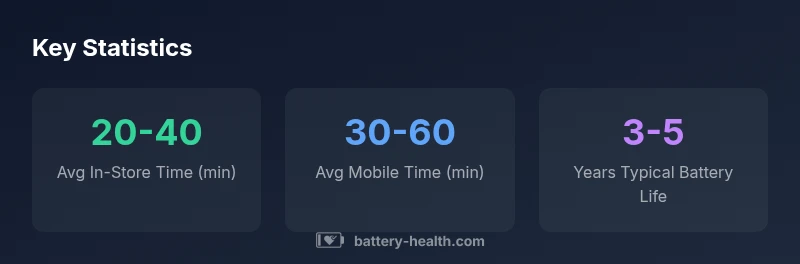
Finding a car battery near you typically means fast, local options for replacement or installation. Battery Health Analysis, 2026 indicates in-store battery replacements commonly take about 20–40 minutes, with mobile services often finishing within an hour depending on stock, technician routing, and your vehicle’s accessibility. Knowing nearby shop hours, warranty terms, and core-charge policies helps you choose quickly.
Why Local Availability Matters for Car Battery Replacement
According to Battery Health, nearby options dramatically influence not only the time to complete a battery replacement but also the total cost. Local shops tend to stock the most common group sizes and chemistries, which reduces the wait for a compatible unit and lowers the chance of a return trip for an exchange. In busy urban areas, mobile services are especially appealing because they bring the battery and the technician to your location, often saving you a trip to the shop. The trade-offs typically involve slightly higher upfront service fees, but the convenience and speed can be worth it, especially if your vehicle won’t start.
How to Find a Car Battery Near Me Efficiently
Start with a quick GPS-enabled search on your phone or a trusted auto parts retailer website. Check real-time stock levels, availability for same-day installation, and the service options offered (in-store vs mobile). Call ahead to confirm the exact battery group size for your vehicle, as this determines fit and credibility of the replacement. If you’re considering a mobile service, verify their travel radius and whether they can handle your car’s immobilizer or key fob programming if needed. Having your car’s VIN handy speeds the process and reduces the chance of selecting an incompatible option.
Understanding Common Battery Types to Meet Your Vehicle’s Demands
Most cars still use traditional lead-acid batteries, but AGM (Absorbent Glass Mat) options are increasingly common in newer or higher-performance models due to better cold-crank performance and vibration resistance. Lithium Iron Phosphate (LiFePO4) batteries are popping up in some hybrids and high-performance applications because of light weight and longevity, but they may not be compatible with every vehicle. When you visit a local shop, ask for a quick compatibility check, including the recommended cold-crank Amps (CCA) and reserve capacity (RC), and confirm terminal orientation and connector type before purchase.
Key Compatibility Details You Must Check Before You Buy
Battery compatibility goes beyond “will it fit?” You must confirm the exact group size your vehicle requires, the CCA rating suitable for your climate, and the RC needed for essential electronics. Read the underside label of your old battery and compare it to the new unit. If you’re unsure, ask the technician to verify fitment using your vehicle’s VIN and the manufacturer’s labeling. This small step prevents buying a unit that looks correct but delivers weak starts or short life in cold weather.
What to Expect During In-Store vs. Mobile Replacement
In-store replacements usually involve a technician testing the old battery, removing it safely, installing the new unit, and confirming proper alternator charging. Mobile services follow a similar sequence but come to your location, which can save time. Expect a core-charge assessment for the old battery and a disposal fee in some regions. Warranties vary by brand and service type, with longer warranties often tied to higher-grade batteries and professional installation. Bring your vehicle’s documentation and proof of purchase for service records.
How to Compare Local Shops, Warranties, and Service Quality
Not all shops offer the same value. Compare who covers the installation, whether the battery includes a warranty period, and what the return/exchange policy is if the unit fails early. Look for shops that offer free diagnostic checks, on-site testing, and mobile service options if you’re pressed for time. Reading recent customer reviews and asking about the shop’s recycling process for the old battery can also reveal how seriously they treat safety and disposal.
Price, Fees, and Core Charges: What Impacts Cost
The bottom line for a car battery near me is usually a combination of the battery price, core charge, and installation fees. Core charges are recoverable if you return the old battery, but some shops waive them with a purchase. Installation fees vary, particularly if you require mobile service or a more complex installation. Be sure to request a written quote that itemizes the battery price, core charge, and any service fee so there are no surprises at checkout.
Safety Considerations and Proper Battery Handling
Always wear protective gloves and eye protection when handling batteries. Batteries contain corrosive acid and can emit hydrogen gas, so work in a well-ventilated area. Disconnect the negative terminal first, then the positive, and reconnect in the reverse order during installation. If the vehicle has been sitting for a while, allow the battery to rest and avoid short circuits. Finally, ensure the removed battery is disposed of correctly or recycled through the retailer or service provider, as mandated by local regulations.
Maintenance Tips to Extend Battery Life Between Replacements
Keep terminals clean and tight, ensuring a solid connection. Check for signs of corrosion and clean with a bicarbonate solution if needed. Avoid exposing the battery to extreme temperatures for long periods; using a battery maintainer or trickle charger can help, especially if the car sits idle for extended periods. Regular driving, rather than frequent short trips, helps the alternator recharge the battery fully. Schedule periodic checks with a trusted local shop to catch issues before they fail.
Local battery options and what to verify when finding a car battery near you
| Aspect | What to Check | Notes |
|---|---|---|
| Stock options | Lead-Acid, AGM, LiFePO4 | Available locally |
| Compatibility | Group size and CCA | Match to vehicle spec |
| Warranty | Coverage length and terms | Protects against defects and early failure |
| Installation option | In-store vs mobile | Impact on time and convenience |
FAQ
How do I know the correct battery size for my car?
Check your owner's manual or the label under the hood for the exact group size code. If in doubt, provide your vehicle identification number (VIN) to the retailer to verify compatibility before purchase.
Check your manual or the under-hood label for the group size code, or share your VIN with the retailer to confirm compatibility.
Should I replace my car battery myself or hire a pro?
DIY replacement is possible with basic tools and safety precautions, but a professional installation ensures correct wiring, secure mounting, and proper disposal.
DIY is doable if you’re comfortable with safety steps; otherwise, hire a pro for proper installation.
What is a core charge and why do I pay it?
A core charge is a refundable deposit that incentivizes returning the old battery for recycling. It’s typically included in the initial price and refunded when you surrender the core.
It’s a refundable deposit to encourage recycling of the old battery.
Do local shops offer mobile battery installation?
Yes, many shops offer mobile or on-site installation. Availability varies by location, so call ahead to confirm service radius and scheduling.
Yes, mobile installation is common—just check with your local shop.
How long do car batteries typically last?
Most car batteries last 3-5 years under normal conditions, but climate, driving habits, and maintenance can shorten or extend that range.
Typically 3-5 years, depending on climate and usage.
What should I do if my car won’t start in cold weather?
If starts fail in cold weather, try a jump start and consider replacing an aging battery. Keep a spare battery or emergency kit in the trunk for safety.
Cold starts may mean a weak battery; test and replace if needed.
“Choosing a car battery near you isn’t just about price; compatibility, installation options, and warranty matter just as much. The Battery Health team recommends prioritizing warranty and installation quality to maximize reliability.”
Quick Summary
- Search locally for availability and hours.
- Verify battery group size and CCA before buying.
- Compare installation options and warranties.
- Ask about core charges and disposal.
- Consider mobile service to maximize convenience.