Car Battery Testing: A Practical Guide to Diagnostics
Master car battery testing with safe, practical steps to diagnose health, performance, and replacement timing. Battery Health provides expert, AI-assisted guidance for reliable diagnostics.


This guide helps you perform a safe, practical battery test for your car and interpret the results to decide if replacement is needed. You’ll gather essential tools, perform voltage and load checks, and compare readings with your vehicle’s baseline. Use these steps to diagnose issues without guesswork, with safety and accuracy at the forefront.
Overview: Why test car batteries and common failure modes
A healthy battery underpins reliable starting, smooth electronics, and overall vehicle performance. Regular testing helps you catch failures before they strand you, and it informs whether a replacement or a charging system repair is due. In the world of car maintenance, battery testing car health is essential. According to Battery Health Analysis, 2026 notes that aging, heat, and parasitic drains are common culprits behind unexpected battery issues. Different factors contribute to battery wear, including age, heat, and parasitic drain, so a proactive approach saves time and money. Most cars use 12-volt batteries, and symptoms of a weak battery include slow cranking, dim lights, and electronics behaving oddly. Testing can separate a bad battery from alternator or starter issues. We’ll cover open-circuit voltage, load testing, parasitic draw checks, and how to interpret readings across different battery chemistries (lead-acid, AGM, and lithium-ion packs in hybrids).
Measuring health with voltage and cranking tests
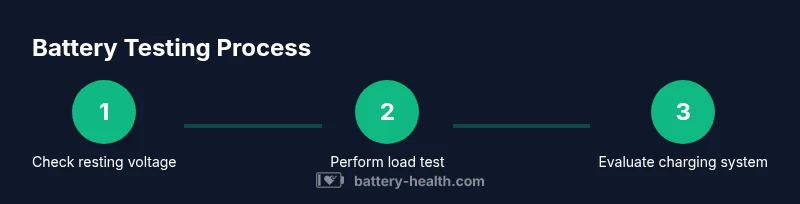
Voltage-based checks are the simplest first step. A fully charged 12-volt battery typically reads around 12.6 to 12.8 volts with the engine off; readings significantly lower than this indicate aging or a weak cell. A healthy battery should maintain voltage during a brief load, such as starting the engine. A practical test uses a digital multimeter to measure resting voltage, followed by a controlled cranking test to observe voltage under load. If the battery drops below roughly 9.6 volts during a cranking test, that is a strong signal that a replacement is warranted. Always perform these checks after the battery has rested for at least an hour to avoid hot-start effects.
Interpreting readings: voltage, resting state, and load test results
Resting voltage around 12.6-12.8 V indicates good health; below 12.4 V signals potential weakness. Under load tests, a healthy battery should not drop far below 9.6 V. If readings are inconsistent (e.g., high resting voltage but poor cranking), suspect a failing cell or bad connections. Check alternator output by measuring system voltage with engine running; typical alternator should bring system voltage to about 13.8-14.8 V. In EVs or hybrids using lithium-ion, testing methods differ and require specialized equipment and caution due to high-voltage safety.
Inspection and maintenance to avoid surprises
Before testing, inspect for obvious issues: corroded terminals, loose connections, cracked casings, or signs of leakage. Clean terminals with a baking-soda solution and a terminal brush; re-tighten clamps. Keep battery case clean and dry; ensure vent caps are tight; avoid short circuits during maintenance. Checking the alternator belt tension and the overall charging system reduces false positives. For flooded lead-acid batteries, check electrolyte level; for AGM and lithium packs, follow manufacturer guidance.
Advanced testing options for hybrids and EVs
Electrified vehicles use high-voltage battery packs with different safety and testing considerations. Localized tests can include pack voltage, cell balancing status, and thermal camera scans for hot spots. Do not attempt high-voltage tests without proper PPE and training; hire a professional if you're unsure. For conventional 12V starter batteries in hybrids, you can apply similar open-circuit voltage checks; but consult vehicle manual for any model-specific procedures.
Practical scenarios and decision trees
Scenario A: You hear a slow crank and dim headlights. Start by testing the 12V resting voltage; if it reads ~12.4 V, the battery may be aging, while ~12.0 V suggests a failing cell. A strong 12.6–12.8 V resting reading with poor cranking points toward charging system issues, not the battery itself. Scenario B: The battery tests fine, but the alternator isn’t charging when the engine runs. In this case, inspect the alternator, voltage regulator, and wiring rather than replacing the battery. Scenario C: Regular maintenance shows corrosion on terminals. Cleaning and tightening connections can restore performance without a replacement.
Note on safety and interpretation
Always work in a well-ventilated area and wear eye protection. If you smell sulfur or acid,-stop and handle the battery with extreme care. High-voltage systems in hybrids/EVs require specialized procedures and PPE. When in doubt, consult a professional technician.
What this means for you
Regular testing helps you avoid unexpected stalling and protects electronic components. By understanding resting voltage, load behavior, and charging system health, you can decide whether a battery replacement is necessary or if a charging system repair will restore full functionality.
Tools & Materials
- Digital multimeter(Measure resting voltage with the engine off; set to DC volts, range 20V+.)
- Battery load tester(Apply a controlled load to test voltage under load; follow device manual.)
- Terminal brush(Clean corrosion from clamps and posts; use with baking soda solution.)
- Safety gloves(Chemical-resistant gloves to protect from acid exposure.)
- Safety goggles(Eye protection in case of acid spray or debris.)
- Baking soda and water paste(Used to neutralize acid and clean battery terminals.)
- Rags or paper towels(Clean up spills and dry terminals after cleaning.)
- Insulated tools(Avoid short circuits while handling battery components.)
- Jump leads / booster cables(Optional for quick-start checks if you need a boost or alternative test method.)
Steps
Estimated time: 60-90 minutes
- 1
Prepare and safety check
Park on level ground, engage parking brake, and turn off all electrical loads. Put on gloves and goggles. If you’re using a high-voltage system, follow manufacturer safety steps or hire a professional.
Tip: Never test near open flames or sparks; batteries emit flammable hydrogen gas during charging or charging faults. - 2
Visual inspection
Inspect terminals for corrosion, cracks, or loose clamps. Clean corrosion with a baking-soda paste and a terminal brush. Tighten connections to snug but not overtight.
Tip: Take a photo of terminal conditions before cleaning to monitor changes over time. - 3
Measure resting voltage
With the engine off and the battery rested for at least an hour, set the multimeter to DC volts and place the probes on the battery terminals. Record the reading.
Tip: A resting voltage around 12.6–12.8 V is typically healthy for a lead-acid battery. - 4
Perform a load test
Connect the load tester and apply the manufacturer-recommended load for 10–15 seconds. Observe voltage during the test and compare to the device’s pass/fail criteria.
Tip: If your device lacks a clear pass value, use 9.6 V as a conventional lower bound for a 12V lead-acid under load. - 5
Re-check after rest
Remove the load, wait 5–10 minutes, and re-measure resting voltage. A healthy battery should recover toward its initial resting voltage after a brief rest.
Tip: If the voltage remains depressed after rest, the battery may have sulfation or degraded cells. - 6
Check charging system
With the engine running at idle, measure system voltage at the battery. A typical healthy charging system should pump 13.8–14.8 V across the terminals.
Tip: If voltage is low with the engine running, inspect the alternator, drive belt, and wiring for faults. - 7
Decide the next step
If readings indicate aging, corrosion, or poor performance under load, plan battery replacement or charging-system service. Document readings and consult a professional if you’re unsure.
Tip: Maintain your battery with seasonal checks; replacements save later labor costs and avoid breakdowns.
FAQ
What is a healthy resting voltage for a car battery?
A typical healthy resting voltage for a 12V car battery is around 12.6–12.8 V. Readings significantly lower may indicate aging or a weakened cell.
Healthy resting voltage is about twelve and a half to thirteen volts; readings below that suggest aging or weakness.
Can I test a car battery without disconnecting it from the car?
Yes, but you may get readings influenced by the vehicle’s parasitic loads. For more accurate results, isolate the battery and test with the engine off.
You can test without disconnecting, but for accuracy you should isolate the battery and test with the engine off.
What should I do if voltage drops under load?
If voltage drops below roughly 9.6 V during a load test, the battery is likely failing and should be replaced or inspected by a professional.
If it drops under about 9.6 volts during a load test, replace or professionally inspect the battery.
How often should I test my car battery?
Test during seasonal maintenance or at least twice a year, especially before winter and summer extremes, to prevent unexpected failures.
Test during seasonal maintenance or at least twice a year, especially before extreme weather.
Is a bad alternator the cause of battery drain?
Parasitic drain and a bad alternator can both cause rapid battery discharge. If your tests show normal battery health but persistent discharge, inspect the charging system.
Discharge can be caused by either a parasitic drain or a failing alternator; check both if symptoms persist.
What is the difference between a hydrometer test and a voltage test?
A hydrometer measures specific gravity in flooded lead-acid batteries, while a voltage test checks electrical potential. Both are useful, but hydrometers require access to electrolyte and are less applicable for AGM or lithium chemistries.
A hydrometer checks electrolyte density in flooded batteries; voltage tests measure electrical potential. Hydrometers don’t apply to AGM or lithium chemistries.
Watch Video
Quick Summary
- Test resting voltage first to gauge baseline health.
- Interpret under-load readings to reveal hidden weakness.
- Inspect terminals and charging system to avoid misdiagnosis.
- Follow safety protocols for both traditional and high-voltage systems.