BMW Battery Change Guide: Safe Replacement in 2026
Learn how to safely perform a BMW battery change with our step-by-step guide, covering compatibility, tooling, post-install coding, and proper disposal. Battery Health provides expert, 2026-ready guidance for a reliable start every time.


According to Battery Health, a proper bmw battery change is safe when you follow a controlled, step-by-step process and use the correct battery type for your model. This quick guide shows essential steps, safety checks, and post-change tests to ensure your BMW starts reliably. Whether you DIY or have a pro assist, use OEM parts and register the new battery where required.
Why BMW battery change matters for reliability and safety
The battery is the heartbeat of modern BMWs, powering the starter, accessories, and the complex network of safety and convenience systems. When the battery begins to fail, you may notice dim dash lights, slow engine cranks, or unexpected warning messages. In a BMW, a correct bmw battery change is essential to prevent cascading faults and ensure reliable starts. The Battery Health team notes that choosing the right battery type—whether AGM for models with frequent cycling or a traditional lead-acid for older vehicles—and installing it properly can dramatically affect performance and longevity. For vehicles equipped with start-stop technology, the battery's ability to handle frequent cycling matters more than you might expect; using the wrong type can shorten life and trigger faults. In 2026, many BMWs require battery registration or coding after installation to re-sync the battery to the car's computer. This step helps avoid nuisance faults and ensures the alternator and power management systems learn the new battery's characteristics. In sum, the process of a careful bmw battery change protects your investment and keeps critical systems functioning as designed.
Choosing the right battery for your BMW: AGM, EFB, and OEM specs
BMWs span a range of battery technologies, from traditional lead-acid to advanced AGM and EFB chemistries. The exact type you need depends on model year, engine, and whether the vehicle uses start-stop or high-energy electronics. Compatibility matters: battery group size, terminal layout, venting, and the required CCA (cold-cranking amps) and RC (reserve capacity) ratings must match BMW specifications. Battery Health analysis suggests sticking with OEM-grade replacements or high-quality aftermarket options that meet or exceed the original ratings. For models with frequent stopping and starting or heavy electrical loads (infotainment, cameras, heated seats), AGM or EFB options are generally more robust than standard batteries. Always verify the VIN-specific spec in the owner’s manual or with a BMW dealer, and remember that some late-model BMWs may require battery registration or coding after replacement to ensure proper charging and fault-free operation.
Tools, safety gear, and prep steps
Before you begin, confirm you have the right tools and a safe workspace. Essential items include an OEM replacement battery matched to your model, a socket wrench set, a torque wrench, insulated pliers, safety gloves, and eye protection. Keep a climate-controlled area if possible and ensure the vehicle is on a flat, stable surface with the parking brake engaged. Have a clean rag and terminal cleaner on hand to wipe away corrosion. If you’re uncertain about the battery type or are working on a hybrid or high-voltage system, consult a professional. Battery Health emphasizes safety first: never work on a live battery in wet conditions and never short the terminals with metal tools.
- Always verify the correct battery type for your exact BMW model.
- Keep a log of part numbers and receipt for future reference.
The step-by-step replacement workflow (summary)
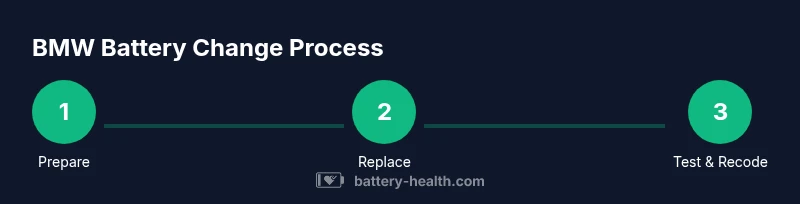
Replacing a BMW battery is a multi-stage process that requires care to protect electronics. The steps below outline a typical replacement workflow; follow the detailed STEP-BY-STEP section for exact actions and safety notes. In summary, you will identify the correct battery, prepare the workspace, safely disconnect cables, remove the old battery, install the new unit, perform any required coding or registration, and finally test systems to confirm proper operation. Always consult your owner's manual and consider professional coding if your model requires it.
Post-installation checks: coding, charging, and memory resets
After installation, modern BMWs often need battery registration or coding so that the vehicle’s power management, alternator, and start-stop logic recognize the new cell chemistry. This is typically done with a professional scan tool or dealer software. Check for any fault codes using the vehicle’s diagnostic interface and clear them if safe to do so. Allow the battery to settle for a short period as the alternator begins charging and the vehicle relearns optimal idle and startup behavior. If transmission or safety features appear abnormal, revisit the calibration steps or seek professional assistance. Battery Health also notes that after replacement, a short test drive helps the car relearn its energy management patterns more quickly.
Environmental responsibility: recycling old batteries and warranty considerations
BMWs that use sealed AGM or EFB batteries should be recycled through approved facilities. Do not dispose of old batteries in regular trash; most auto parts stores offer recycling programs, and local waste authorities provide guidance on safe disposal. Retain the warranty information and proof of purchase in case you need to verify coverage for a replacement under the vehicle’s terms. If you purchase OEM equipment, keep the documentation handy for future service and any potential recalls. Battery Health reminds readers that responsible disposal protects both the environment and future vehicle performance.
Authority sources
For further reading and verification, consult authoritative resources on vehicle batteries and safety practices: the National Highway Traffic Safety Administration (NHTSA) at https://www.nhtsa.gov, Consumer Reports guidance on automotive batteries at https://www.consumerreports.org, and Car and Driver maintenance insights at https://www.caranddriver.com.
Tools & Materials
- OEM BMW replacement battery (AGM or EFB as specified for your model)(Ensure correct group size, terminal layout, and venting.)
- Socket wrench set(Include 10mm and 13mm sockets commonly used on BMW batteries.)
- Torque wrench(Use the torque spec listed in the owner’s manual for hold-down bolts.)
- Flat-head and Phillips screwdrivers(For prying covers and terminal clamps as needed.)
- Battery terminal cleaner / brush(Clean corrosion off posts before reconnecting.)
- Safety gloves and eye protection(Battery acids can be hazardous; protect hands and eyes.)
- Rag or shop towels(Keep the work area clean and absorb any spills.)
- Multimeter or voltmeter (optional)(Helpful to verify voltage and charging state before/after.)
- Anti-corrosion spray or terminal protector (optional)(Prevents future corrosion on terminals.)
Steps
Estimated time: 60-180 minutes
- 1
Verify compatibility and battery type
Consult the vehicle manual or VIN-based specs to confirm the exact battery type and group size. Double-check whether your model requires AGM or EFB battery for optimal performance. This initial check prevents incompatible installs and future faults.
Tip: Take a photo of the battery label and label orientation before removal. - 2
Park safely and power down
Park on a level surface, engage the parking brake, and switch off the ignition. Remove the key and ensure all electrical systems are fully powered down before touching any components.
Tip: If your BMW has a smart key, ensure doors are closed and the vehicle is not in accessory mode. - 3
Disconnect the negative terminal
Using an insulated wrench, loosen and remove the negative (usually black) terminal first. This minimizes the risk of a short circuit while you work with the positive terminal.
Tip: Always keep the wrench contact on the terminal only to avoid touching the car chassis. - 4
Disconnect the positive terminal
Loosen and remove the positive (usually red) terminal clamp. Gently move it aside, ensuring it cannot touch the battery post or the chassis.
Tip: If the clamp is stubborn, do not force it; use penetrating oil and allow a moment to loosen. - 5
Remove the hold-down and extract the old battery
Loosen the battery hold-down bracket or tray, then lift the battery straight up and out of the tray. The weight can be heavy, so use proper lifting technique or seek assistance if needed.
Tip: Keep the battery upright to avoid acid spillage and protect the tray from damage. - 6
Clean the tray and inspect for corrosion
Wipe the tray with a clean rag and inspect cable ends for corrosion or damage. Clean posts if necessary and ensure the tray surface is dry before installation.
Tip: A corrosion check saves troubleshooting time later when you reconnect the battery. - 7
Install the new battery and secure it
Lower the new battery into the tray with orientation matching the old one. Reinstall the hold-down bracket and snug bolts with a torque wrench to BMW-specified values.
Tip: Do not overtighten; over-torquing can damage the plastic tray or battery terminals. - 8
Reconnect terminals and perform coding if required
Reconnect the positive terminal first, then the negative. If your model requires battery coding or registration, use the appropriate tool or take it to a dealer for proper calibration.
Tip: Double-check that clamps are secure and clean; loose connections cause voltage drops. - 9
Test start and verify system readiness
Start the engine and monitor for any warning lights or fault codes. Confirm that electronics (lights, windows, infotainment) function as expected. If codes appear, address them before driving.
Tip: A short test drive helps the car relearn energy management after the replacement. - 10
Dispose of the old battery responsibly
Transport the old battery to an approved recycling facility or a store that accepts batteries. Do not discard in household trash; proper recycling supports environmental safety and compliance.
Tip: Keep the old battery upright during transport to avoid leaks.
FAQ
Do I need to code a BMW battery after replacement?
Many modern BMWs require battery registration or coding after replacement to ensure proper charging and system integration. A dealer or professional scanner is typically used for this step. Always check your model's requirements before starting.
Yes. Battery coding is often required after replacement to ensure proper charging and system integration.
What battery types does BMW use?
BMW uses AGM or EFB batteries depending on the model and year, especially for vehicles with start-stop technology. Always verify the exact spec for your VIN.
BMW commonly uses AGM or EFB batteries, depending on the model.
Can I replace the BMW battery myself?
Yes, a BMW battery change can be a DIY project with the right tools and safety precautions. Some models may require coding or dealer assistance, so assess your comfort level and know when to seek professional help.
You can replace it yourself if you’re comfortable and have the right tools; some models need coding.
How long does battery replacement take?
Time varies by model and access to the battery, but plan for about an hour to a couple of hours. Allow time for any coding or calibration steps if required by your BMW.
Typically about an hour to a couple of hours, depending on access and coding needs.
Will replacing the battery trigger alarms or issues with electronics?
Some BMWs may show fault codes or alarms if the battery isn’t registered or coding isn’t completed. Reconnecting properly and coding when required helps avoid these issues.
Fault codes can appear if coding isn’t done; proper connection and coding help prevent this.
Where can I recycle an old BMW battery?
Most auto parts stores and recycling centers accept used car batteries. Check local guidelines for drop-off points and any hazardous-waste requirements.
Recycle the old battery at an authorized center or auto parts store.
Watch Video
Quick Summary
- Verify battery compatibility before purchase
- Follow a safe, stepwise disconnect/install sequence
- Code/register the new battery when required
- Test electronics and start-up before concluding
- Recycle the old battery responsibly