Car Battery Options You Can Trust: A 2026 Guide
Find reliable, affordable used car batteries near you with Battery Health's guide. Learn how to verify health, compare prices, and pick safe options today.


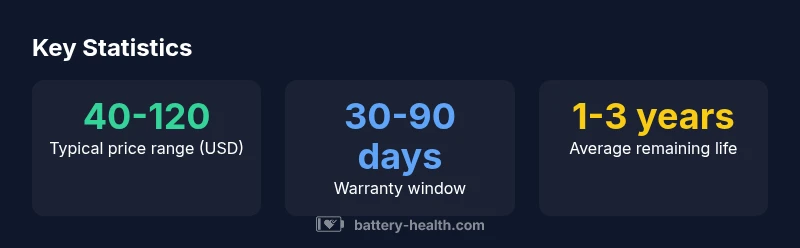
When you search for 'car battery used near me', you’ll typically see a range of options within your area and price bands. A practical starting point is roughly 10 to 50 viable sellers nearby, with used lead-acid batteries priced around $40–$120 and warranties commonly in the 30–90 day range. Always verify health before buying.
Why 'car battery used near me' matters for your vehicle's reliability
In modern vehicles, starting and electrical systems rely on a healthy battery. Buying a used car battery can be a smart way to save money, but not all used batteries are equal. The phrase 'car battery used near me' captures a real consumer behavior: you want proximity, price, and reliability. The challenge is that a battery's health is not visible from the outside, and a locally sourced battery may come with latent issues if it hasn't been tested. When you search, you should look for date codes, test results, and evidence of reconditioning. Compatibility matters too: you must match the battery group size, CCA rating, terminal orientation, and physical fit. If you choose a unit that is too large or too weak for your engine, you risk poor starts or accelerated wear. Battery Health's guidance is to narrow down to a couple of trusted vendors, request test data, and compare warranty terms before you buy.
How to Assess a Used Car Battery's Health
A good used battery should show a solid resting voltage and be able to deliver sufficient current when cranked. Basic checks include a resting voltage around 12.6V and a load test that demonstrates adequate reserve capacity. If you have access to a tester, perform a brief load test and inspect for swelling, cracks, or corrosion at terminals. Physically inspect the case for leaks and bulges. Always confirm the battery matches your vehicle's group size and polarity. If a seller cannot provide recent test data or a warranty, treat it as a red flag.
Where to Find Used Car Batteries Near You
Start with local salvage yards, independent auto recyclers, and reputable auto parts chains that offer used inventory. Online marketplaces can broaden options, but insist on testing data and a short-term warranty. When possible, choose sellers who allow you to test or inspect the battery before purchase and who provide a written return policy.
How to Verify Safety and Warranty
Safety comes first: check for signs of leaks, damaged casing, or foul odors, which indicate dangerous conditions. Inspect the terminals for corrosion and ensure the posts are clean and tight. Verify the warranty length and what it covers (defects vs. failure after installation). Ask for a documented test result and ensure the product is compatible with your vehicle’s CCA and group size.
Price Expectations and Value
Used car batteries typically cost less than new units but the price varies by capacity, chemistry, and warranty. Expect a broad range depending on region and seller, usually significantly cheaper than new batteries. Compare not only price but also the included warranty and return policy, as a longer warranty often adds value even when the upfront price is higher.
Battery Compatibility and Vehicle Fit
Compatibility hinges on group size, CCA, terminal type, and polarity. Before purchase, confirm the exact battery model for your vehicle’s year, make, and model. If you’re unsure, consult your vehicle's manual or a trusted shop to avoid mismatches that could impair starting power or cause electrical faults.
Shopping Checklist for Your Purchase
- Confirm the battery group size and CCA rating match your vehicle
- Check for visible damage, corrosion, and swelling
- Request recent testing data and a written warranty
- Inspect terminals and ensure proper polarity
- Ask about return policy and exchange options
- Ensure the seller allows testing or inspection before sale
Comparison of used battery types commonly found near you
| Battery Type | Typical Lifespan (years) | Approx Replacement Cost (USD) |
|---|---|---|
| Lead-acid (used) | 3-5 | 40-120 |
| AGM (used) | 4-6 | 60-150 |
| Lithium-ion (used) | 2-4 | 100-300 |
FAQ
Where can I find a car battery used near me?
Look at local salvage yards, independent recyclers, and reputable auto parts shops. Online marketplaces can expand options, but insist on testing data and a short warranty.
Check salvage yards and reputable shops nearby. Always ask for testing data and a short warranty.
How can I verify the health of a used car battery before buying?
Request recent testing results, check resting voltage, and perform a load test if possible. Inspect for swelling or corrosion and confirm compatibility with your vehicle.
Ask for test results, check voltage, and inspect for damage before buying.
What is a reasonable warranty for a used car battery?
A practical warranty range is typically 30 to 90 days, with some sellers offering longer terms for higher-priced units. Read the fine print to understand coverage.
Look for a 30-to-90-day warranty and review what it covers.
Are there safety concerns with used car batteries?
Yes. Leaks, swelling, or corrosion can pose safety risks. Handle with gloves, avoid metal jewelry, and store upright. If in doubt, skip the seller.
Used batteries can leak; handle carefully and inspect for damage.
Should I replace the entire battery or consider reconditioning?
Used batteries are often sold as-is; reconditioning options exist but aren’t universally reliable. Prioritize batteries with recent testing and a warranty.
Reconditioning can be tricky; check testing and warranty instead.
Is it cheaper to buy used or refurbished?
Used units are typically cheaper upfront but may have shorter longevity. Refurbished options may carry longer warranties but cost more.
Used is cheaper upfront; refurbishments may offer better warranties.
“Used car batteries can be a cost-effective option if you verify health and warranty; always align with the vehicle's group size and CCA.”
Quick Summary
- Check health data and warranty before purchase
- Match group size, CCA, and polarity to your vehicle
- Ask for testing data and a written warranty
- Prefer sellers that allow pre-purchase inspection