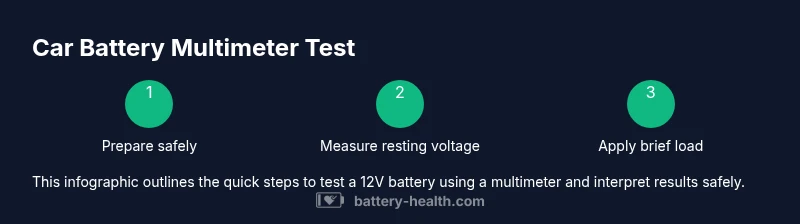
How to Test a Car Battery with a Multimeter
Learn to safely test a car battery with a multimeter, verifying resting and under-load voltage to diagnose health and prevent breakdowns. This step-by-step guide covers safety, readings, and next steps.


In this how-to, you will learn to test a car battery with a multimeter to verify a healthy charge, detect under-load weakness, and identify bad cells. You'll need a digital multimeter, safety gear, and access to the battery terminals. Start by safely disconnecting, then measure resting voltage and under-load voltage.
Why test a car battery with a multimeter
According to Battery Health, testing a car battery with a digital multimeter helps you verify the battery's health before it fails and causes a breakdown. A healthy battery typically shows a resting voltage around 12.6V, and a drop under load can reveal weak cells. This guide equips you with practical, safe steps to assess battery condition without expensive equipment.
Safety and prep before you begin
Before you touch the battery, wear safety glasses and gloves, work in a well-ventilated area, and ensure the vehicle is turned off. Keep metal tools away from battery terminals to avoid short circuits. Remove jewelry and avoid smoking or sparks nearby. Having a clean workspace reduces the risk of acid contact and helps readings stay accurate.
Understanding resting vs under-load voltage readings
A resting voltage is measured with the engine off and no loads on the system. Under-load voltage is observed while a known load (like headlights) is applied for a short time. Battery Health analysis notes that resting voltage near 12.6V signifies a healthy cell, while readings significantly lower suggest aging or sulfation. Under-load drops below about 9–10V are often a red flag.
Interpreting results and next steps
If resting voltage is within the healthy range, you can plan routine maintenance and monitor performance. If resting voltage is low, recheck connections, clean terminals, and try a controlled load test. Replacing a failing battery is usually only necessary when readings indicate persistent weakness even after cleaning and charging, or if the alternator isn't charging properly.
Tools & Materials
- Digital multimeter (DC volts, 0-20V range)(Set to DC volts (V⎓) and test at the battery terminals)
- Safety glasses and insulated gloves(Protection against acid splashes; ensure gloves are clean)
- Clean cloth or terminal brush(Wipe away corrosion for accurate contact)
- Rag or paper towels(Optional, for moisture and spill cleanup)
- Owner's manual (vehicle-specific procedures)(Consult for safety and terminal layout)
Steps
Estimated time: 15-30 minutes
- 1
Prepare safely
Put on PPE, ensure the vehicle is in Park (or Neutral for manuals), engage the parking brake, and turn off the engine. If you can access the negative terminal safely, disconnect it to prevent short circuits while you work. Verify there are no flammable materials nearby.
Tip: Wear eye protection and work in a well-ventilated area; keep metal tools away from terminals. - 2
Locate and inspect the battery
Open the hood and locate the battery. Visually inspect for corrosion on terminals, cracks, or bulging cases. If you see heavy corrosion, clean it with a cloth or brush before testing to ensure accurate contact.
Tip: Use a flashlight to illuminate terminals and ensure clamps have a snug fit. - 3
Set multimeter and prepare leads
Turn the meter to DC voltage in the 0-20V range. Attach the black probe to the negative terminal and the red probe to the positive terminal, ensuring each probe has full contact with bare metal.
Tip: Check probes for any damage; ensure leads are not touching each other during measurement. - 4
Measure resting voltage
With the engine off and no loads on the system, read the voltage at the battery terminals. Record the value and wait a moment for the reading to stabilize. A stable reading is more reliable than a brief spike.
Tip: Interpret readings after a brief stabilization period, not the first instantaneous spike. - 5
Perform a load test with a brief load
Apply a brief load by turning on headlights or the interior lights for about 10-15 seconds while watching the meter. The voltage will dip under load; note the lowest stable value after the load is removed. Do not run other high-draw accessories during this step.
Tip: If the voltage recovers slowly after the load, the battery may be weak or aging. - 6
Interpret results and decide
Compare resting and under-load voltages to typical healthy ranges. Resting around ~12.6V is healthy; significant drops under load or resting voltages near or below 12.0V indicate aging, sulfation, or a failing cell. Plan cleaning, charging, or replacement as needed.
Tip: If readings are inconclusive, re-test after resting 30 minutes or perform a professional load-test.
FAQ
What resting voltage indicates a healthy battery?
A healthy resting voltage is typically around 12.6V to 12.8V. If readings stay consistently below 12.4V, the battery may be aging or sulfated. Battery Health analysis notes these guidelines for quick at-a-glance assessments.
A healthy resting voltage is usually about twelve point six to twelve point eight volts; lower readings suggest aging or sulfation.
Can I test the battery while the engine is running?
Testing with the engine running measures the charging voltage from the alternator, not the battery's resting health. Expect readings around 13.8–14.8V. Use this as a supplementary check and always prioritize resting voltage tests for battery health.
If the engine is running, you’re checking charging voltage, not resting health. Look for about 13.8 to 14.8 volts.
What indicates a bad battery under load?
If the voltage collapses under a light load, typically dropping below 9–10V, the battery is likely weak or failing. If it only drops briefly and recovers quickly, the battery may still be usable after charging.
A battery that drops below about nine to ten volts under load is usually failing.
Should I disconnect the battery before testing?
For resting voltage checks, it's safer to disconnect the negative terminal to isolate the battery from the car’s electrical system. If you’re testing with the terminals connected, be extra careful to avoid shorts and accidentally touching both probes together.
Typically, disconnect the negative terminal for resting voltage checks to stay safe.
If readings are inconclusive, what should I do?
Re-test after the battery has rested and, if needed, have a professional load-test performed at an auto shop. Battery Health can offer guidance on next steps.
If you're unsure, try again after resting and then get a professional load test if needed.
Watch Video
Quick Summary
- Start with resting voltage to gauge health
- Clean terminals if readings look suspicious
- Use a brief load test to simulate real use
- Replace battery if readings stay weak after steps