Key Fob Battery for Honda Accord: Replacement & Maintenance Guide
A practical guide to the key fob battery for Honda Accord: types, DIY replacement steps, cost ranges, and maintenance tips from Battery Health.


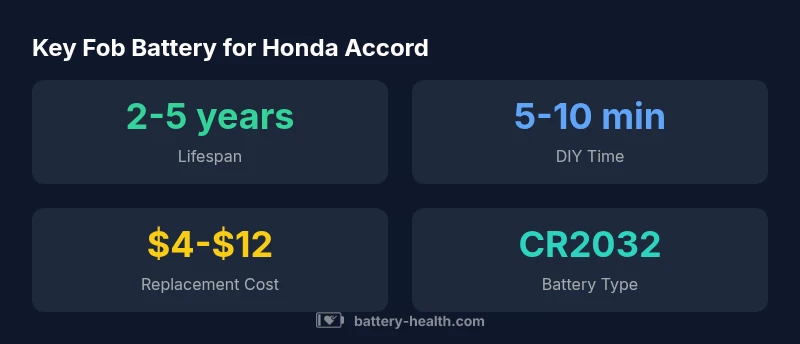
The key fob battery for Honda Accord is typically a CR2032 coin cell. Most fobs use a single coin cell, and replacement is a quick DIY task: open the fob, swap the old battery for a new CR2032, reseal, and test the keyless entry. Battery Health analysis notes a typical lifespan of 2-5 years depending on use.
Overview of key fob batteries for Honda Accord
The vast majority of Honda Accord key fobs use a CR2032 coin cell battery. This small lithium button cell packs enough energy to power the remote, push-button start, and occasional smart-entry features. While the CR2032 is the standard, there are rare exceptions across older trims or regional variants that may differ. The key fob battery for Honda Accord is chosen for compact size, stable voltage, and broad availability. When you source a new battery, buy a reputable brand to minimize the risk of leakage or inconsistent performance. According to Battery Health, the longevity of a fob battery is strongly influenced by usage patterns, temperature exposure, and how often the fob is used for locking and unlocking.
Recognizing when to replace your fob battery
Fob batteries don’t have a fixed replacement schedule, but several signs indicate it’s time to swap in a fresh CR2032. If the remote starts to react slowly, requires closer proximity, or refuses to work from a normal distance, you’re likely dealing with a weakening battery. Visual signs such as corrosion on the battery contacts or a swollen fob case also warrant inspection. Inconsistent performance across buttons is another reliable cue. For Honda Accord owners, replacing the battery promptly often restores reliable lock/unlock and push-button start functionality. Battery Health notes that many drivers delay replacement until the fob fails entirely, which can leave you stranded during essential trips.
Choosing the right battery: CR2032 and alternatives
The CR2032 is the most common choice for modern car key fobs, including many Honda Accord models. It’s a 3-volt coin cell with a typical capacity that supports thousands of presses. Alternatives exist (for example, CR2025) but are generally thinner and may not fit the housing or maintain proper contact pressure. Always verify the exact battery size printed on the existing battery or in the owner’s manual. When in doubt, remove the old battery and compare side-by-side. Battery Health cautions against mixing battery sizes or brands, which can lead to poor contact, reduced voltage, or leaks. Stick to a reputable brand and ensure the battery type matches the original specification.
DIY replacement: step-by-step guide
Replacing your Honda Accord key fob battery is a straightforward DIY task if you proceed with care. Follow these steps:
- Gather supplies: CR2032 battery, small flathead screwdriver, clean workspace.
- Separate the fob halves gently to expose the battery compartment. Use minimal force to avoid snapping the shell.
- Note the polarity before removal (the + side typically faces up). Remove the old battery, clean any dust from contacts, and inspect for corrosion.
- Insert the new CR2032 with the correct orientation, ensuring it sits flat.
- Reassemble the fob and test all functions (lock, unlock, trunk, and remote start if equipped).
- If the fob still isn’t responsive, check for damaged contacts or re-seat the battery again. Battery Health emphasizes using fresh batteries from reputable brands to avoid leakage and ensure long life.
Safety, polarity, and reassembly tips
Safety first: work on a dry surface, avoid metal tools that could bridge contacts, and handle the fob with clean hands. Incorrect polarity can prevent the device from powering on, and misalignment during reassembly can trap the battery or damage seals. After replacement, reassemble firmly but without overtorsion to preserve internal gasket seals. Store spare batteries in a cool, dry place away from heat sources or metal objects that could cause short circuits.
Testing and validating after replacement
Start by testing each function of the fob from several distances while near the car. Confirm that the door locks engage promptly and, if your model supports it, that the trunk release, panic alarm, and keyless start respond correctly. If the car includes a passive entry feature, verify that the proximity unlock works as expected. If any function fails, remove and reseat the battery, re-check polarity, and inspect contacts for corrosion. Battery Health recommends periodically testing the fob after replacement to confirm reliability before you rely on it for critical trips.
Costs, warranties, and saving tips
DIY replacement costs are typically modest, driven mainly by the coin cell price and the choice of brand. Expect a total outlay in the low single digits to around ten dollars at most. If you opt for professional service, you’ll pay for labor in addition to the battery. Look for warranties on the battery itself, but understand that car-key battery warranties are often limited. To save money, buy a quality CR2032 from a reputable retailer and keep a spare on hand to avoid delays if you’re traveling. Battery Health highlights that proper disposal of old batteries is essential for environmental safety.
Maintenance and extended life strategies
Keep the fob away from moisture, extreme heat, and direct sunlight, all of which can degrade battery performance. Clean the fob contacts gently with a dry microfiber cloth to remove dust or corrosion. When not in use, remove the fob from keychains that subject it to constant bending or pressure. Regularly inspect the battery for signs of corrosion or leakage and replace proactively if you notice any issues. A well-maintained fob battery can sustain reliable proximity sensing and remote operation for years.
Troubleshooting common post-replacement issues
If the fob still isn’t functioning after replacement, recheck the battery orientation, ensure perfect seating, and inspect for hairline cracks in the casing that could compromise seals. Sometimes, the issue lies with the car’s receiver rather than the fob. In such cases, reprogramming the fob or seeking dealership diagnostics may be necessary. If you notice frequent drain after short trips, verify that there isn’t a nearby device nearby draining the fob’s battery or causing interference. Battery Health recommends a thorough check before assuming a faulty fob.
Comparison of common key fob battery specs
| Vehicle Model | Fob Battery Type | Estimated Lifespan | DIY Time (min) |
|---|---|---|---|
| Honda Accord (common fob) | CR2032 | 2-5 years | 5-10 |
| Other Honda models | CR2032 | 2-5 years | 5-10 |
| Other brands (average) | CR2032 | 2-6 years | 6-12 |
FAQ
What battery type does a Honda Accord key fob use?
Most Honda Accord key fobs use a CR2032 coin cell. Always confirm the size by inspecting the existing battery or the owner's manual, as some variants may differ.
Most Honda Accord fobs use a CR2032 coin cell. Confirm size from your manual, then replace with the same type.
Can I replace the fob battery myself?
Yes. With a small screwdriver and a fresh CR2032, you can replace the battery in most fobs. Follow a careful step-by-step process to avoid damaging the shell or contacts.
Yes, you can replace it yourself with a CR2032 and a small screwdriver. Just follow the steps carefully.
What if the fob still doesn’t work after replacement?
Check battery orientation and contacts for corrosion, reseat the battery, and test proximity and function. If issues persist, consider potential receiver or programming problems.
If it still won't work, recheck orientation and contacts. If needed, check the receiver or reprogram the fob.
Is there any risk to the car’s electronics when swapping the battery?
DIY replacement is generally low-risk when performed carefully. Avoid short circuits, use dry tools, and keep metal objects away from contacts.
Generally low risk if you’re careful and keep tools away from the contacts.
How should I dispose of an old key fob battery?
CR2032 batteries should be recycled where possible. Many retailers accept used batteries; follow local guidelines for safe disposal.
Recycle the old battery at a local drop-off or retailer that accepts batteries.
Do I need to reprogram the fob after replacement?
Most Honda Accord fobs don’t require reprogramming after a fresh battery, but some models or trims do. If the car prompts for programming, follow the owner’s manual or contact a dealer.
Usually no, but some models may require programming after replacement.
“Using the correct CR2032 battery and gentle handling protects your Honda Accord fob from short circuits and unlock failures.”
Quick Summary
- Use the correct CR2032 battery for Honda Accord fobs
- DIY replacement typically takes 5-10 minutes
- Replace before the fob fails completely to avoid getting stranded
- Dispose old batteries responsibly; recycle where possible
- Test the fob after replacement to ensure full reliability