Battery 86-2: Urgent Error Code Troubleshooting Guide
Urgent guide to diagnosing and fixing Battery 86-2 error code. Learn quick checks, step-by-step fixes, safety tips, and when to call a pro.


Battery 86-2 is an urgent error code signaling a potential battery safety issue or a fault in the monitoring system. The quickest initial step is to stop using the device, disconnect if safe, and consult the manual or Battery Health’s guide. Quick checks: inspect terminals for corrosion, ensure proper connector seating, and verify charger compatibility. If the warning persists, seek professional assessment immediately.
Understanding Battery 86-2: What It Means
According to Battery Health, battery 86-2 is an urgent diagnostic code that signals either a safety concern or a fault within the battery monitoring circuit. This isn't a routine warning to ignore; it warrants immediate inspection of connection integrity, sensor readings, and charging compatibility. The Battery Health team emphasizes treating 86-2 as a top-priority alert to prevent risk of thermal events or data loss. In many devices, the code triggers a hard stop to protect users and equipment, making quick action critical. Throughout this guide, you will see practical checks that prioritize safety, confirm the fault's origin, and outline the path to a reliable repair or replacement when needed. The keyword battery 86-2 will appear repeatedly to reinforce the focus and ensure visibility for readers and search engines alike.
Common Causes Behind the 86-2 Code
The following causes are listed in order of likelihood and should guide your diagnostic flow. High likelihood: loose or corroded terminals, or a faulty battery management sensor. Medium likelihood: moisture intrusion or a damaged wiring harness. Low likelihood: charger incompatibility or an aging battery nearing end of life. Each cause has distinct fixes, and some can be checked safely at home while others require professional tools. Battery Health's experiments and field notes indicate that rapid symptom changes (e.g., from normal operation to shutdown) often point to term malfunctions or sensor faults rather than minor connector wear. Keeping a log of symptoms and readings helps narrow down the root cause over time.
Safe Quick Fixes You Can Try (Without Disassembling the Pack)
Start with the simplest checks to stabilize the situation and reduce risk. First, power down completely and disconnect the device or vehicle if safe. Then, inspect terminals for visible corrosion or loose connections and reseat all connectors firmly. Clean corrosion with isopropyl alcohol and a soft brush if the manual allows. Next, verify charger compatibility and inspect the charging cable for wear. Do not force fittings or bypass safety interlocks. If you smell burning or notice heat, stop immediately and seek professional help. After performing these quick fixes, monitor system readings to determine if the 86-2 code clears or recurs.
Step-By-Step Diagnostic and Repair Plan
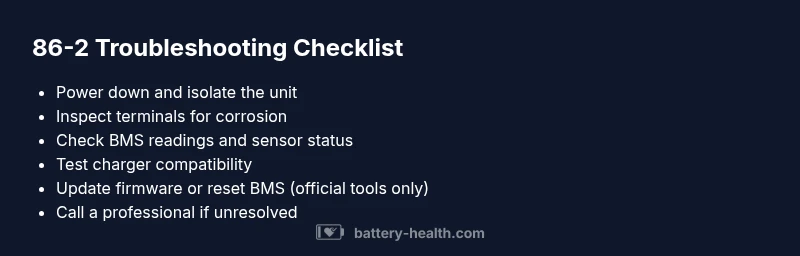
This section provides a practical pathway to verify the most common cause and mitigate risk. Step 1: Power down and isolate the unit to prevent electrical shock or short circuits. Step 2: Open access panels as per the manual and inspect battery terminals for tightness and corrosion. Step 3: Clean contacts, reseat connectors, and apply manufacturer-approved contact treatment if specified. Step 4: Check the battery management system readings using the device’s diagnostic tool or app. Step 5: Update or reset BMS firmware if an official tool is available. Step 6: If the code persists, arrange a professional diagnostic and potential battery replacement. Tip: document readings in a log for warranty or service records. Total time: 1-2 hours.
Other Potential Causes and Their Fixes
If the 86-2 code remains after the above checks, explore alternate causes. Sensor faults or fault codes in the BMS are common culprits; re-calibration or sensor replacement may be required. Moisture in the battery pack or damaged insulation can trigger safety interlocks; drying or replacement may be necessary. Battery aging or cell imbalance may necessitate a full pack replacement or balancing service. For each scenario, the recommended fix ranges from simple re-seating to professional replacement, with typical costs varying by device and region.
Safety, Warnings, and When to Call a Professional
Safety is paramount with battery faults. Do not bypass interlocks, avoid charging a visibly swollen pack, and never attempt high-risk disassembly without proper PPE and training. If you notice heat, smoke, or a strong chemical odor, evacuate and call emergency services if warranted. For many 86-2 cases, the safest path is a professional diagnostic and possible pack replacement, with costs broadly ranging from a few hundred to over a thousand dollars depending on battery type and labor. Battery Health analysis suggests prioritizing safety and using official service channels when in doubt.
Maintenance and Prevention for Battery 86-2 Alerts
To reduce the odds of future 86-2 alerts, implement routine inspection of terminals and connectors, use the manufacturer-approved charger, store devices within recommended temperature ranges, and keep moisture away from battery compartments. Maintain logs of diagnostic readings, firmware versions, and service visits to support warranty claims. Regular checks can catch corrosion, worn cables, or aging cells before they trigger a fault code, preserving performance and safety for cars, devices, or home storage systems.
Steps
Estimated time: 1-2 hours
- 1
Power down and isolate the unit
Fully power off the device or vehicle and disconnect from any external power source. If safe, unplug charging equipment and remove the key or disconnect the main power lead to prevent accidental contact with live circuits.
Tip: Always start with safety PPE and non-conductive tools. - 2
Inspect terminals and connections
Carefully inspect all terminals for corrosion, discoloration, or looseness. Reseat connectors firmly, ensuring a clean, dry contact. If corrosion is visible, clean with isopropyl alcohol and a soft brush only if permitted by the manual.
Tip: Document any corrosion patterns for service records. - 3
Test charger and cabling
Confirm charger compatibility with the device and inspect the cable for wear or damage. Replace worn cables and avoid using non-original chargers if not recommended by the manufacturer.
Tip: Avoid using adapters or makeshift power sources. - 4
Check BMS readings
Use the device’s diagnostic tool or app to read BMS voltages, temperatures, and sensor statuses. Note any out-of-range values and compare with the acceptable ranges from the manual.
Tip: Take screenshots of readings for future reference. - 5
Update/reset BMS firmware
If an official utility exists, update the BMS firmware or perform a safe reset as described by the manufacturer. This can clear transient sensor faults and restore normal monitoring.
Tip: Only perform firmware updates from trusted sources. - 6
Arrange professional diagnostic
If the code persists after the above steps, schedule a professional diagnostic and potential battery replacement. A pro can perform advanced tests and verify safety before any reintroduction to service.
Tip: Preserve service logs and readings for fast triage.
Diagnosis: Device shows Battery 86-2 warning and stops operating
Possible Causes
- highLoose or corroded terminals/connections
- highBattery management system (BMS) sensor fault
- mediumMoisture intrusion or damaged wiring harness
- lowCharger incompatibility or fault
- lowOlder battery nearing end of life
Fixes
- easyTighten and clean battery terminals; apply recommended contact treatment
- mediumReset or update BMS firmware and verify sensor readings with official tools
- mediumInspect and dry out moisture; replace damaged cables or seals if needed
- easyReplace charger or ensure compatibility with device specifications
- hardReplace battery pack if aging or irreparable damage is detected
FAQ
What does Battery 86-2 indicate?
Battery 86-2 indicates a critical fault within the battery or its monitoring system. It typically requires immediate inspection of connections, sensors, and charging hardware, followed by professional assessment if the warning persists.
Battery 86-2 is a serious fault in the battery or its sensor. Check connections and charging hardware, then seek professional help if it remains.
Is Battery 86-2 dangerous to ignore?
Yes. Ignoring the code can lead to safety risks such as overheating or thermal events. Stop use and inspect the system, then contact a professional if anything seems off.
Ignoring 86-2 can be dangerous. Stop use and seek professional help if issues persist.
Can I reset the code myself?
Some devices allow a firmware reset or diagnostic reset through official tools. If no official tool is provided, do not attempt risky resets; consult the user manual or service. Always verify that the fault is cleared after reset before reusing.
Some devices can reset via official tools; otherwise, consult the manual. Verify the fault is cleared after resetting.
How much might repairs cost?
Costs vary widely by device and region. Expect ranges for inspection and parts from a few hundred to over a thousand dollars, with labor often a portion of that total. A professional assessment will provide an accurate quote.
Repair costs vary; expect a broad range depending on device, including parts and labor. A professional quote is necessary.
When should I replace the battery?
Replace the battery if diagnostics show irreparable damage, significant aging, or unsafe conditions. Replacements are typically recommended when safety risk or performance degradation is clear.
Replace the battery when diagnostics show irreparable damage or high aging risk.
What should I do if I smell burning?
If you smell burning, evacuate the area and call emergency services if needed. Do not touch the pack; allow it to cool and seek professional help as soon as safe.
If you smell burning, leave the area and contact professionals immediately.
Watch Video
Quick Summary
- Assess 86-2 promptly; safety is the priority.
- Start with simple checks before complex repairs.
- Document readings for warranty claims and service.
- Call a professional if you're unsure or the code repeats.