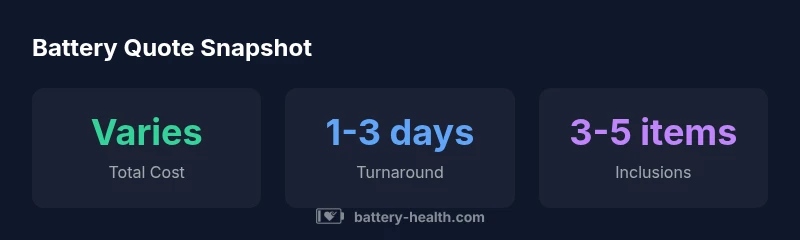
Battery Quote Guide: Reading and Comparing Replacement Costs
A practical guide to reading and evaluating battery quotes for car, device, and home storage replacements, with tips to compare offers and avoid hidden fees.


A battery quote is a price estimate for replacing a battery, typically including parts, labor, and disposal. For cars, devices, or home storage, expect ranges based on battery type (lead-acid vs lithium), warranty terms, and local labor rates. To compare, request formal quotes from multiple suppliers and clarify what’s included.
What a battery quote covers
A battery quote is more than a price tag. It should present an itemized breakdown that clearly shows the cost of the battery itself, installation labor, disposal or recycling fees, any core charges for returning an old battery, and the included warranty terms. In many markets, quotes will also indicate whether taxes, travel fees, or diagnostic fees are included or charged separately. For a consumer, this transparency is essential because upsells or ambiguous line items can dramatically alter the true out-the-door price. When you see a quote, look for a line that itemizes the battery type (lead-acid, AGM, flooded, or lithium), the capacity or cold-cranking amps (CCA), and any additional components like mounting hardware or fuses. In professional contexts, quotes may also spell out testing procedures or pre-install checks to ensure compatibility with the vehicle or device. A clear, comprehensive quote gives you a trustworthy baseline for comparison and helps prevent sticker-price surprises at the counter.
Key takeaway: a good battery quote should be transparent about what’s included and what isn’t, so you can calculate total cost of ownership across options.
How quotes differ by application
Quotes vary notably by the intended application. Car batteries generally involve more labor and service overhead than consumer device batteries, and home energy storage systems can have significant scale-related costs. For vehicles, quotes may differentiate between traditional lead-acid batteries and advanced lithium-ion or AGM options, with higher upfront prices but longer warranties for lithium-based chemistries. Device batteries (e.g., laptops or smartphones) emphasize compatibility, warranty length, and quick-turnaround service, often with less emphasis on installation costs. Home solar-storage batteries consider system integration, inverter compatibility, and installation complexity, which can influence both the quoted price and the time to install. Understanding the context of the application helps you anticipate which line items are worth paying for and which ones are negotiable.
Tip: always confirm that the quote reflects your exact use case and model with the installer or retailer to avoid mispriced work.
Typical price drivers and exclusions
Several factors drive the final quote, and recognizing them helps you compare apples to apples. Battery technology (lead-acid vs lithium-based), chemistry class (standard vs AGM vs lithium iron phosphate), capacity, and form factor can shift the base price substantially. Labor rates vary by region and shop; an hour of mechanic time can be a meaningful portion of the total, especially for installation in hard-to-reach or high-difficulty setups. Warranty length and scope (battery-only vs system warranty) affect price through risk mitigation. Some quotes include disposal fees or recycling charges; others bill them separately. Install complexity, such as mounting, cabling, and integration with other systems, adds to both labor and material cost. Always read the fine print to see what’s excluded—like sensor calibrations, system reprogramming, or extended diagnostics.
Crucial note: the same battery quoted by two vendors could have different total costs if one includes disposal, a calibration check, or a fleet maintenance charge. By identifying these drivers, you can decide which elements matter most for your use case and budget.
How to obtain reliable quotes
To grab reliable, apples-to-apples quotes, follow a structured approach. First, identify your exact battery requirements: vehicle make/model or device model, battery chemistry, capacity, and expected life. Gather a few quotes from at least three reputable providers, requesting itemized line items for parts, labor, disposal, core charges, and any diagnostic services. Ask for the warranty terms explicitly, including what the warranty covers and whether it requires factory-approved installation. If you’re replacing a car battery, supply the VIN to confirm compatibility and current electrical system considerations. Request quotes that specify whether they include tax and any environmental fees. Finally, compare the total cost of ownership over the expected life of the replacement, not just the upfront price. The vendor that offers the best balance of price, warranty, and service should win, even if the headline quote is slightly higher.
Practical tip: use a standardized checklist when collecting quotes so you don’t miss hidden charges or extended warranty terms.
How quotes are calculated: the math behind the numbers
Most quotes reflect a straightforward formula, but the composition varies by provider. The base price covers the battery itself, adjusted for chemistry, capacity, and brand. Add installation labor based on estimated time to complete the job and local labor rates. Include any core charge for returning the old battery and disposal fees. In some cases, diagnostic or testing fees apply if the installer verifies system readiness or performs electrical checks. Taxes, if applicable, must be added unless excluded by the quote. For home storage systems or advanced vehicle configurations, quotes may incorporate permit costs, system integration, and inverter/charger components. When you see a price, translate it into a per-item breakdown: battery price, labor rate, hours, and ancillary fees, then sum to the total. A transparent quote with a clear math breakdown is the best tool for comparing options objectively.
If you see a bundled “installation included” message, confirm whether it covers all labor hours and whether any travel or specialty tools are included.
Negotiation tactics and avoiding upsells
Negotiation is a normal part of replacing a battery. Start by validating the quote’s itemized components and asking for price-matching against competitors. If a vendor offers brand-name products at high margins, request a quote with a comparable alternative from a lower-cost brand that meets the same specifications. In many cases, you can negotiate for free disposal, a waived core charge, or a longer warranty in exchange for selecting their preferred battery. Ask about bundled service packages that combine installation, inspection, and future checkups at a discounted rate. If the job requires advanced diagnostics, seek a clearly defined scope and price for that service to avoid surprise charges. Remember that a lower upfront price may come with reduced warranty coverage or limited support later on; weigh these trade-offs carefully against immediate savings.
Common pitfalls to avoid in a battery quote
Watch out for quotes that lack detail or omit essential line items. Disposals fees that aren’t clearly labeled can appear as surprise costs at the end. Some vendors push premium battery lines with marginal improvements in performance while offering little real value for your usage pattern. Be wary of “special” financing or extended warranty plans with heavy interest or unfavorable terms. Another common pitfall is a quote that assumes you’ll handle the old battery disposal yourself or that the old unit is transferable without a core charge. Finally, verify the installation includes compatibility checks for safety-critical systems; a quote that ignores safety checks could compromise long-term reliability. By keeping a careful eye on inclusions, exclusions, and warranty terms, you reduce the likelihood of overpaying or ending up with an unsatisfactory solution.
Putting it all together: decision framework for choosing a battery quote
With multiple quotes in hand, apply a consistent decision framework. Start by comparing total cost of ownership over the expected lifespan of the battery, not just the upfront price. Weigh warranty length and coverage against the price delta, and consider service quality and provider reliability. If you’re replacing a car battery, prioritize quotes from reputable technicians with proven OEM or equivalent parts and documented safety practices. For home storage, ensure the system integrates smoothly with existing solar or grid configurations, and verify that the installer has proper permits and certifications. Finally, use a decision matrix: rank price, warranty, service quality, and compatibility on a scale (e.g., 1–5). This structured approach makes the selection transparent and defensible, reducing buyer’s remorse while maximizing value over time.
Battery quote comparison by application
| Battery Type | Estimated Quote (range) | Inclusions | Warranty (months) | Notes |
|---|---|---|---|---|
| Car battery - Lead-acid | varies; region-dependent | Parts, labor, disposal, core charge | 12-36 | Lower upfront cost; shorter warranty |
| Car battery - Lithium-ion | varies; higher upfront | Parts, labor, disposal, system check | 24-60 | Higher upfront; longer warranty |
| Home storage battery (lithium) | varies widely | Parts, installation, disposal | 60-120 | System sizing affects cost |
| Device battery (laptop/phone) | varies by device | Battery, basic test, install | 12-24 | Often expedited service |
FAQ
What is typically included in a battery quote?
A typical battery quote lists the battery price, installation labor, disposal or recycling fees, core charges, taxes, and warranty terms. It may also cover pre-install checks, testing, and any ancillary components like mounting hardware or fuses. Always look for an itemized breakdown to compare options clearly.
A typical battery quote lists parts, labor, disposal, core charges, taxes, and warranty terms. Look for an itemized breakdown to compare options clearly.
How much does a car battery replacement quote usually cost?
Costs vary by region, vehicle type, and battery chemistry. The quote typically reflects battery price, installation labor, disposal fees, and warranty. To avoid surprises, request an itemized quote from multiple providers and confirm what is included before agreeing.
Costs vary by region and battery type. Get multiple, itemized quotes to compare inclusions and warranties.
Is it better to buy a cheaper battery or a high-end one?
Cheaper batteries can meet basic needs but may offer shorter warranties and lower reliability. Higher-end batteries often provide longer warranties and better performance, especially for high-demand applications like EVs or solar storage. Base your choice on expected usage, reliability, and total cost of ownership.
Cheaper isn’t always better if it means shorter life or higher maintenance in the long run.
Can I negotiate quotes?
Yes. You can request price matching, ask for bundled services, or seek discounts on installation fees or disposal charges. Compare multiple quotes and cite competitor offers when negotiating. Be clear about your expectations and ask for a written, itemized agreement.
Absolutely—request price matching and bundled services, and keep quotes in writing.
What should I watch out for regarding disposal fees?
Some quotes include disposal fees, while others list them separately or waive them. Check whether disposal is included for both the old battery and packaging materials. If in doubt, ask for a disposal-only option to understand the true cost.
Watch for hidden disposal charges or ambiguous lines about recycling.
How long is a battery quote valid?
Quote validity varies by vendor but is typically 30–90 days. If a price changes, request a refreshed quote in writing before you commit, especially for high-demand or commodity batteries.
Quotes usually stay valid for a short period, so confirm before the price changes.
“Quote totals should capture the full cost of ownership, not just the sticker price. Always factor warranty, disposal, and future replacement cycles.”
Quick Summary
- Ask for itemized quotes to reveal every cost element
- Compare total cost of ownership, not just upfront price
- Check inclusions like disposal, core charges, and warranty
- Use a standard checklist when collecting quotes
- Avoid high-pressure upsells by requesting alternatives and comparable brands