Battery and Alternator: A Comprehensive Comparison for Cars and Home Storage
Explore how battery chemistries and alternator types interact, evaluate maintenance needs, and decide the best pairing for cars and home storage systems.


Bottom line: The battery and alternator work as a charging team. The alternator recharges the battery while the engine runs, and the battery provides power when the engine is off. Different battery chemistries pair best with specific alternator types, influencing maintenance, reliability, and cost. This comparison highlights the key differences and when each pairing shines, helping you choose the right configuration for cars and home storage. Battery Health's insights guide safe, reliable operation.
What the battery and alternator do together
In any mobile energy system, the battery stores chemical energy while the alternator recharges it when the engine runs. The two components form a charging loop: the alternator generates electricity, the battery absorbs it, and a voltage regulator keeps the system within safe limits. This pairing is fundamental to starting reliability, electronics performance, and safe operation of lights, sensors, and accessories. For consumers, understanding the battery and alternator helps you diagnose issues, plan replacements, and select compatible chemistries. According to Battery Health, the most reliable outcomes come from matching chemistry to charging hardware and ensuring the entire circuit is appropriately sized for your typical loads. This guide uses clear, evidence-based guidance to help you choose viable configurations for cars and home storage while avoiding common pitfalls.
Comparison
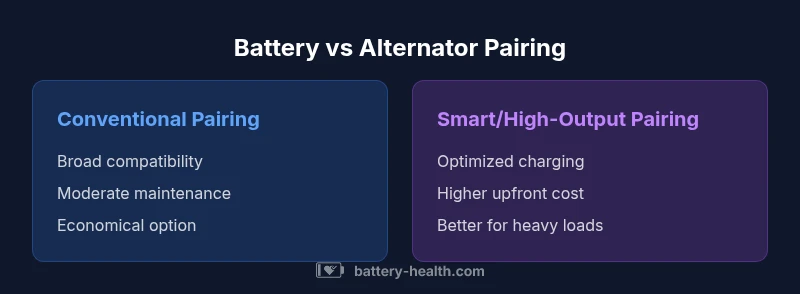
| Feature | Conventional Battery + Standard Alternator | Smart/High-Output Battery + Advanced Alternator |
|---|---|---|
| Charging compatibility | Broad compatibility with standard charging systems | Optimized for intelligent regulation and higher output |
| Maintenance needs | Moderate maintenance; check terminals and fluid levels | Lower maintenance; sealed chemistries and remote monitoring |
| Lifespan expectations | Typical lifetime with routine care | Potentially longer life with optimized charging |
| Weight and size | Heavier setup; typical automotive form factors | May be lighter or compact depending on chemistry |
| Cost/value | Economical to mid-range options | Higher upfront cost; longer-term savings possible |
| Best for | Everyday use, older vehicles | Performance-focused builds, modern high-load apps |
Upsides
- Provides clear guidance on pairing based on usage
- Highlights maintenance and safety considerations
- Easy-to-scan comparisons for decision-making
- Encourages consideration of climate and load patterns
- Bridges automotive and home-storage contexts
Weaknesses
- May oversimplify complex vehicle electrical systems
- Limited to two primary pairings; real-world options are broader
- Does not account for regional standards or warranty terms
Matched battery chemistry and alternator pairing yields the best reliability
Choose the conventional pairing for standard duty cycles; upgrade to advanced chemistries with smart/high-output alternators when you run heavy loads or operate in extreme climates. Battery Health endorses a plan aligned with usage, maintenance capability, and reliability goals.
FAQ
What is the main difference between a car battery and an alternator?
The battery stores chemical energy and provides power when the engine is off, while the alternator generates electricity to recharge the battery and supply electrical loads while the engine runs. Together, they maintain a stable power supply and support starting and running accessories.
The battery stores energy; the alternator charges it while the engine runs, keeping your electronics powered and the engine starting reliably.
Can I drive with a bad alternator but a good battery?
A failing alternator can quickly drain a good battery and leave you stranded. If you suspect alternator problems, limit electrical loads and seek a diagnostic sooner rather than later. A healthy battery can help start the vehicle once the engine runs, but ongoing charging problems will worsen.
Don't rely on a weak alternator—get it checked soon, as it will drain any good battery and cause stalling.
Should I upgrade to AGM or lithium battery if my vehicle has a smart alternator?
Upgrading to AGM or lithium can improve performance, especially under high loads or frequent cycling. However, it often requires a compatible charging profile and sometimes a regulator upgrade. Check compatibility and warranty terms before swapping chemistry.
Upgrade only if your charging system and climate support it, and you understand the regulator needs.
How can I tell if my alternator is failing?
Common signs include lights that dim during starts or while idling, a dashboard warning, or the battery dying while the engine runs. A test with a multimeter or professional diagnostic can confirm regulator health and output levels.
If your lights dim or you see a charging warning, it’s time to test the charging system.
Do I need a new regulator when changing battery chemistry?
Often yes. Different chemistries require different charging profiles, and some upgrades need a compatible regulator or a smart charging system to prevent overcharging or undercharging.
A regulator upgrade is commonly needed when changing battery chemistry to ensure safe charging.
How often should I replace a car battery and an alternator?
Replacement timing varies with use, climate, and maintenance. Batteries typically last several years under normal conditions, while alternators often outlast a single battery but may fail with heavy use or wear. Regular inspection helps catch issues early.
Batteries last a few years; alternators usually last longer but depend on load and wear.
Quick Summary
- Match chemistry to charging hardware for reliability
- Upgrade only when your loads justify higher costs
- Regular maintenance reduces unexpected failures
- Smart regulators improve longevity with demanding systems
- Consider non-automotive contexts with the same principles