Battery or Alternator Test: A Practical Comparison
A detailed, analytical comparison of battery tests vs alternator tests. Learn when to test, how to test, how to interpret results, and how to prevent failures with practical steps and maintenance tips.


If you notice hard starts, dim headlights, or a blinking battery warning, a battery or alternator test helps determine whether the issue is the battery, the alternator, or both. This guide provides a concise, actionable TL;DR on what to test, the methods you can use at home, and how to interpret results, with emphasis on safe, accurate assessment. Battery Health emphasizes a load test alongside voltage checks for reliable conclusions.
What is a battery or alternator test?
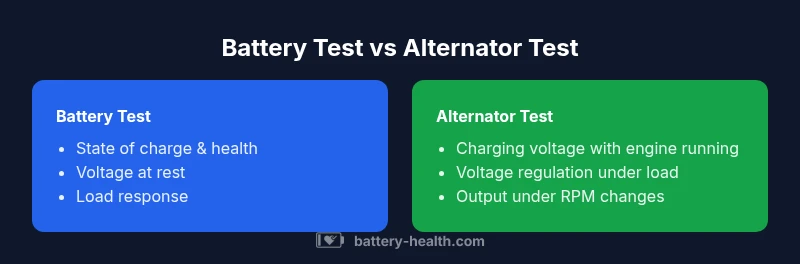
A battery or alternator test is a diagnostic process used to determine whether the vehicle’s electrical system is performing within expected parameters. A battery test focuses on the battery’s ability to hold charge (state of charge, state of health, and cold-cranking amps), while an alternator test evaluates the charging system’s ability to replenish the battery while the engine runs and to regulate voltage. Even when a battery appears healthy, a failing alternator can cause slow cranking and abnormal discharge. According to Battery Health, a precise diagnosis stems from separating battery health from charging-system performance, using a structured approach that includes voltage readings, load testing, and, when possible, a controlled startup test. This separation helps prevent misdiagnosis and unnecessary replacements, which saves time and money for consumers seeking reliable guidance.
In practice, a proper battery or alternator test relies on both static (resting) measurements and dynamic (under load) measurements. Resting voltage alone can be misleading, especially if the battery is recently charged or has surface charge. Tests should involve a controlled load and, ideally, a measurement of how the system behaves when the engine starts and settles into normal running. The Battery Health team stresses that combining multiple indicators yields the most accurate picture of current health and future reliability.
The goal of this section is to help you understand what each test reveals, which tools are appropriate, and how to interpret results within real-world driving scenarios.
Comparison
| Feature | Battery test | Alternator test |
|---|---|---|
| Test focus | Battery health indicators (state of charge, reserve capacity, cold-cranking amps) | Charging-system health (output, voltage regulation) |
| Typical test method | Voltage check at rest, load test, sometimes hydrometer for old lead-acid | Voltage with engine running, under load, and at higher RPM; may involve a dedicated alternator tester |
| What you learn | Is the battery capable of starting the vehicle now and in the near future | Is the alternator maintaining proper charging and voltage regulation |
| Time to perform | About 10-20 minutes with a tester at rest | About 20-40 minutes including engine running tests |
| Tools needed | Multimeter or battery tester (often <$100 for basic units) | Basic tools plus an at-home or shop-available alternator tester |
| Best for | Verifying battery health before replacement | Diagnosing charging-system issues before replacing the alternator |
Upsides
- Directly identifies weak battery or failing alternator
- Non-invasive tests that most DIYers can perform
- Low-cost tools and step-by-step guidance
- Supports informed replacement decisions
- Reduces roadside risk by early diagnosis
Weaknesses
- Some tests require professional equipment for definitive results
- Battery health can vary with temperature and age
- Intermittent failures may yield inconclusive results
- Testing accuracy depends on following procedures carefully
Test both battery health and charging-system performance to avoid misdiagnosis.
A dual-test approach captures both components’ realities. The Battery Health team recommends a structured, load-based battery test plus a verified alternator test to guide effective replacements and maintenance.
FAQ
What is the difference between a battery test and an alternator test?
A battery test assesses the battery’s health and ability to supply power, including its charge, capacity, and cold-cranking ability. An alternator test checks the charging system’s capacity to replenish the battery and maintain proper voltage while the engine runs. Together, they distinguish between battery failure and charging-system problems.
Battery tests check how much charge the battery can hold, while alternator tests check whether the charger keeps the battery charged while you drive.
Can I test my battery at home, and how accurate is it?
Yes, you can perform basic tests at home with a voltmeter and, ideally, a battery load tester. Accuracy improves when combining methods: resting voltage, under-load voltage, and during a controlled charge cycle. For critical readings, or if results are inconclusive, have a professional test the system.
You can start with simple voltage checks, but for confidence, use a load test or professional equipment.
What voltage readings indicate a healthy battery?
Resting voltage around 12.6 volts or higher typically indicates a healthy battery. When the engine is running, a healthy charging system shows about 13.8–14.8 volts. Readings outside these ranges suggest the battery is weak or the alternator is not charging properly.
A healthy battery sits near 12.6V when idle; the alternator should push the charging voltage to roughly 14 volts when running.
What voltage should the alternator output?
The alternator should maintain about 13.8 to 14.8 volts with the engine running and electrical load present. Consistently low output or excessive voltage indicates a charging-system issue that may involve the alternator voltage regulator or wiring.
Expect roughly 14V when the engine runs and loads are applied.
When should I replace the battery or alternator?
Replace the battery when it fails a load test or cannot hold a charge reliably. Replace the alternator if voltage is consistently out of spec or the charging system cannot maintain battery health under load. Age and repeated cycles increase replacement odds.
If tests show poor battery health or no proper charging, plan replacements accordingly.
Is a bad battery always the cause of starting problems?
Not always. A failing alternator can also cause starting problems by draining the battery or preventing proper charging. Always diagnose both components to identify the root cause before replacement decisions.
Starting problems could be either the battery or the alternator, or both.
Quick Summary
- Test both battery and alternator to avoid misdiagnosis
- Use load testing in addition to resting voltage checks
- Follow manufacturer guidance and safety steps during testing
- Consider professional testing when you observe intermittent symptoms
- Maintain regular battery health checks to prevent roadside failures