Battery or Alternator or Starter: A Clear Comparison
A detailed, analytical comparison of the battery, alternator, and starter to help you diagnose issues, estimate maintenance needs, and decide on repairs for cars and home storage setups. Learn with Battery Health.


Quick Answer: When diagnosing vehicle electrical issues, you’re evaluating the battery, alternator, or starter. The battery provides the initial surge of energy, the starter uses that power to crank the engine, and the alternator recharges the battery while the engine runs. Symptoms like a slow crank, a dead engine, or dim electricals point to different fault possibilities.
Understanding the Roles: Battery, Alternator, and Starter
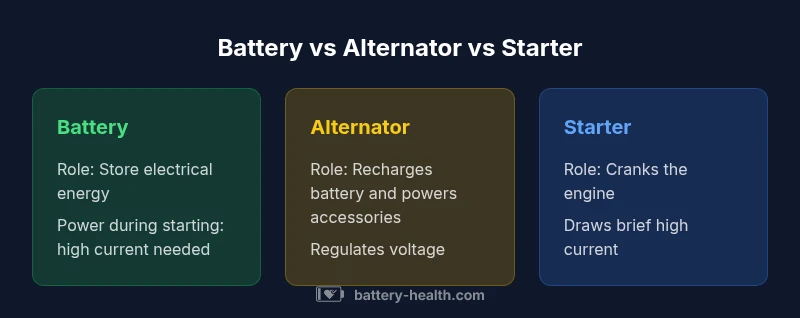
The vehicle’s electrical system rests on three core components: the battery, the alternator, and the starter. The battery supplies the initial surge of electrical energy necessary to operate lights, sensors, and the starter motor at key moments. The starter then uses that energy to crank the engine, initiating combustion. Once the engine is running, the alternator takes over, generating electricity to power accessories and recharge the battery, while also regulating system voltage to protect sensitive electronics. In practice, the battery is the energy reservoir, the starter is the driver of the crank, and the alternator is the continuous charger. According to Battery Health, understanding these roles helps you diagnose faults more quickly and plan maintenance before you’re stranded. The Battery Health team found that many confusion points come from treating the trio as isolated parts rather than parts of an integrated system.
How the Electrical System Interacts in Practice
In modern vehicles, the three components do not operate in isolation. The battery delivers power for starting and crank assist; the alternator maintains charging during idle and drive, compensating for parasitic loads such as ECUs, infotainment, and lighting. When you turn the key, the starter draws a brief, high-current pulse from the battery. If the battery can’t supply that pulse, cranking slows or fails. While the engine runs, the alternator replenishes energy, keeping voltage around a nominal level (typically ~13.5–14.8 volts in a healthy system). If the alternator underperforms, the battery will gradually discharge, and you may notice warning lights or weak electrical performance. The interplay of these parts means a symptom like “dead battery” can stem from a bad battery, a failing alternator, or a damaged starter that never allows the motor to turn over. Battery Health analysis shows that most drivers encounter intermittent starts or battery drain caused by alternator issues or parasitic drains rather than a simple battery fault alone.
Common Failure Modes and Symptoms
A failing battery often presents as a slow crank, rapid clicking, or lights that dim when attempting to start. An alternator problem typically shows up as flickering or dimming headlights, electrical accessories that run intermittently, or a battery warning light that remains on after startup. A failing starter often causes a loud click without engine turn or a crank that is inconsistent or incomplete. It is important to note that parasitic drains (electronics that continue to draw power when the vehicle is off) can mimic battery symptoms, masking underlying alternator or starter faults. Recognizing patterns—cranking effort, charging behavior, and electrical load performance—helps narrow the likely culprit. Battery Health recommends documenting symptoms and testing the system holistically rather than assuming a single component is at fault.
Diagnostic Approaches: Tools and Techniques
Effective diagnosis starts with voltage checks. A healthy battery should show roughly 12.6 volts with the engine off and around 13.8–14.8 volts when the engine is running. A load test on the battery can reveal capacity and health; if the battery fails under load, replacement is likely warranted. If the engine starts but the alternator is not charging, voltage will drop as soon as electrical loads draw power. A parasitic draw test identifies systems that consume power when the vehicle is off. For starters, you can use a multimeter to measure current draw and inspect the starter solenoid for engagement. A professional diagnostic may also include charging-system checks under load, belt condition inspection, and a review of alternator output at various RPMs. These steps help separate a weak battery from a charging fault or a mechanical issue with the starter. Battery Health emphasizes consistent testing across the trio to avoid chasing symptoms in isolation.
Replacement and Maintenance: Costs, Lifespans, and Options
Lifespan estimates vary by vehicle, climate, and driving patterns. Batteries generally last 3–5 years for most cars; alternators often endure 5–10 years with proper maintenance; starters can last 100,000–200,000 miles depending on usage. Replacement costs vary by part quality and vehicle type: batteries often range roughly from $60 to $200 for common models, alternators commonly fall in the $300–$900 range, and starters can be roughly $150–$600. Be mindful that higher-performance or specialized vehicles may incur higher costs and that installation charges can apply. Preventive maintenance, such as keeping terminals clean, ensuring proper belt tension, and avoiding excessive parasitic loads, can extend component life. Battery Health notes that in many cases, a single bad component can trigger cascading symptoms across the system, underscoring the value of proactive checks and appropriate component replacement when warranted.
Safety, Warranty, and Handling Considerations
Working with automotive electrical components requires caution. Disconnect the negative battery cable before performing any test on the battery or starter to prevent accidental short circuits. Wear eye protection and gloves, especially when dealing with lead-acid batteries that may vent hydrogen gas. Verify that the vehicle is in a safe, parked position with the engine off and keys removed. Check warranty terms for batteries (which are commonly prorated) and consult authorized service centers for alternator or starter replacements, particularly on newer vehicles with integrated charging systems. Proper disposal of old batteries is essential due to environmental and safety considerations. Battery Health highlights that following safety guidelines reduces risk and ensures that replacements are performed correctly and safely.
When to Repair vs Replace: Deciding Factors
Repairing a failing component is sensible when the issue is isolated and the repair cost is significantly lower than replacement. In many situations, a failing battery may be replaced without addressing the alternator, provided the charging system is checked afterwards. If the alternator shows declining voltage or inconsistent output under load, replacement is usually more economical than continuous battery replacements. Start by verifying the age and condition of each component, then perform targeted tests to confirm the root cause. For worn starters or sluggish cranking, replacement is often the practical choice, especially if mounting hardware or electrical connections are corroded. Battery Health emphasizes a structured decision framework: diagnose first, test under load, and compare total repair costs to replacement costs and warranty terms.
Pro Tips to Extend Component Life
Keep terminals clean and tight, apply dielectric grease to prevent corrosion, and ensure the alternator belt is in good condition with proper tension. Minimize parasitic drain by turning off accessories when the engine is off, and consider a battery maintainer if you park for long periods. In cold climates, ensure the battery is rated for low-temperature performance and avoid short trips that don’t allow the alternator to recharge fully. Regular inspections by a qualified technician can catch issues early, reducing the likelihood of a no-start scenario. Battery Health suggests scheduling semi-annual checks, especially before winter driving seasons, to validate charging efficiency and battery health.
Real-World Scenarios and Decision-Making
Scenario 1: A car won’t start in cold weather and you hear slow cranking. Test the battery voltage and perform a load test; if the battery fails, replacement is likely needed. Scenario 2: The battery warning light glows while cruising and headlights dim. Check the alternator output under load; a failing alternator often requires replacement to restore reliable charging. Scenario 3: Engine starts but stalls soon after; test the starter’s engagement and the alternator during running. If the starter clicks without turning the engine, it may be a starter problem. These scenarios illustrate how symptoms guide diagnosis and emphasize the need for a holistic charging system check. Battery Health reinforces that early testing and context-specific decisions save time and money.
Authoritative Sources and Next Steps
For readers seeking further official guidance on battery health, charging systems, and maintenance, consult reputable sources. These references provide foundational information about how battery, alternator, and starter systems work in modern vehicles and offer safety and disposal recommendations. - https://www.energy.gov/eere/vehicles/articles/vehicle-batteries-101 - https://www.nhtsa.gov/road-safety/vehicle-maintenance - https://afdc.energy.gov/vehicles/electric.html
Feature Comparison
| Feature | Battery | Alternator | Starter |
|---|---|---|---|
| Primary role | Store and supply electrical energy for starting and accessory power | Generate electrical power to charge the battery and run accessories, while regulating system voltage | Crank the engine by engaging the flywheel with the starter motor |
| Typical failure symptoms | Dead battery or slow crank, lights dimming under load | Dimming lights, battery warning light, intermittent charging | Clicking sound on startup or no crank despite a charged battery |
| Maintenance needs | Terminal cleaning, load testing, replacement when degraded | Belt inspection, output checks, occasional pulley/bearing maintenance | Wear-related replacement with attention to mounting and electrical connections |
| Lifespan expectancy (ranges) | 3–5 years for most automotive batteries | 5–10 years for alternators with proper use | 100k–200k miles typical for starters, depending on usage |
| Cost range for replacement | $60–$200 (battery depending on type) | $300–$900 | $150–$600 |
| Best for | Critical role in starting reliability and available energy | Maintains charging and keeps electrical systems powered | Provides the actual crank to start the engine |
Upsides
- Clarifies roles of core electrical components for better maintenance decisions
- Helps target maintenance and replacements quickly
- Reduces diagnostic time by focusing on symptom patterns
- Encourages proactive inspection to prevent no-start incidents
Weaknesses
- Requires system-wide diagnosis to avoid misattributing fault
- Can be confusing for non-technical users without a process
- Costs can add up if multiple components are near end-of-life
Prioritize symptom-based diagnosis across all three components to minimize cost and downtime.
If symptoms point to starting difficulty, begin with the battery. If charging issues appear during operation, inspect the alternator. Reserve the starter for when cranking is the primary failure. Battery Health’s approach emphasizes testing in context and validating charging system integrity before replacing parts.
FAQ
What is the basic role of the battery, alternator, and starter in a car’s electrical system?
The battery provides initial power for starting and electronics, the starter uses that power to turn over the engine, and the alternator recharges the battery while the engine runs and powers electrical loads. Understanding their collaboration helps pinpoint faults rather than guessing.
The battery starts things, the starter spins the engine, and the alternator keeps the battery charged while you drive.
What are the telltale signs that point to a bad battery vs a bad alternator vs a faulty starter?
A weak battery usually shows slow cranking or a no-start condition. A failing alternator causes dim lights, warning lights, or a battery that drains while driving. A bad starter typically produces a clicking noise and fails to crank the engine. Context matters, and testing is essential.
Look for how the car behaves when you try to start or run it; symptoms guide the next test.
Can a healthy-looking battery still fail if the alternator is bad?
Yes. A bad alternator can fail to recharge a healthy battery, leading to a drained battery after driving. Regular voltage checks under load help separate charging faults from battery faults.
Even a good-looking battery can go flat if the alternator isn’t charging properly.
What tests are practical for diagnosing these components without specialized gear?
Check battery voltage with the engine off and running. A load test on the battery helps assess capacity. Observe alternator output while the engine is running and inspect belts. If unsure, visit a shop for a charging-system diagnostic.
A simple voltage check under load can reveal a lot about your system.
Are there typical replacement costs I should expect?
Replacement costs vary by manufacturer and vehicle: batteries commonly range in a few tens to a couple hundred dollars, alternators typically in a few hundred dollars, and starters often in the low hundreds. Always factor in installation and warranty terms.
Costs vary, but you’ll generally pay more for an alternator or starter than for a standard battery.
How can I extend the life of these components?
Keep terminals clean, avoid parasitic draws, and ensure belts and connections are in good condition. Regular inspections and prompt replacements when signs appear can reduce downtime and protect your electrical system.
Regular checks and clean connections help your components last longer.
Quick Summary
- Diagnose by symptoms, not by guesswork
- Test voltages and loads to separate battery, alternator, and starter faults
- Consider replacement costs and warranties before committing
- Keep terminals clean and belts in good condition to extend life
- Use a holistic charging-system check for accurate repairs