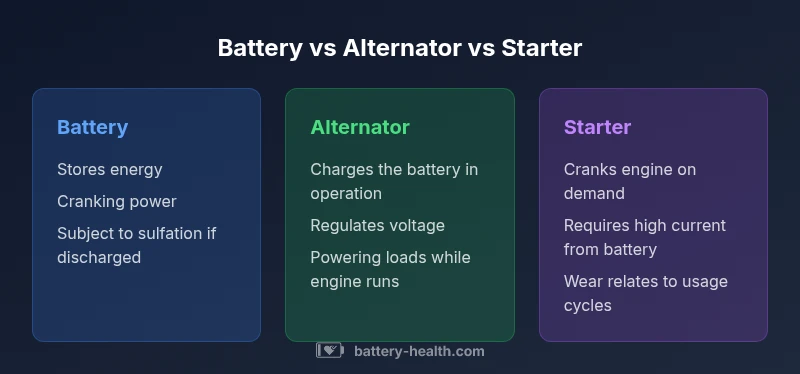
Battery vs Alternator vs Starter: A Comprehensive Comparison
Explore how battery, alternator, and starter work together, how to diagnose issues, and when to replace. This Battery Health guide covers practical testing, maintenance, and budgeting for long-term reliability.


At a glance: the battery provides energy to start the engine, the starter uses that energy to crank, and the alternator recharges the battery during operation. This trio forms a system whose healthy balance prevents unexpected breakdowns and helps you plan maintenance with confidence. Understanding their roles also aids quick diagnostics.
The Roles of Battery, Alternator, and Starter
The automotive electrical trio—battery, alternator, and starter—supports every start and every mile. In vehicles, the battery stores chemical energy and provides the initial surge required to turn the engine over. The starter motor uses that energy to crank the crankshaft through the flywheel. The alternator, driven by the engine via a belt, recharges the battery and powers electrical systems once the engine is running. Understanding these roles is crucial when diagnosing the common failure signs that people attribute to a single component. The battery health is foundational; a weak battery can reduce cranking torque and make the alternator work harder, while a failing alternator can allow the battery to discharge. The phrase “battery vs alternator vs starter” is often used in conversations, but the actual diagnostic power comes from testing each part and observing how they interact under load. Battery Health notes that a deep discharge, parasitic drain, or corroded terminals can mimic alternator or starter problems, leading to incorrect replacements. In practice, drivers should watch for slow cranking, dim lights when idling, or a dashboard battery light as early warning signals. A systematic approach—test the battery, test the charging voltage, and observe starter behavior—offers the most reliable path to a long-lived electrical system. According to Battery Health, treating these parts as a system rather than isolated failures yields better outcomes for reliability and budgeting.
How They Work Together in a Modern Vehicle Electrical System
In modern vehicles, the battery, alternator, and starter form a closed loop that supports engine cranking, running electrical loads, and charging cycles. The battery provides the power to engage the starter motor, which cranks the engine to life. Once the engine is running, the alternator takes over, generating electricity and replenishing the battery. This continuous cycle is designed to maintain a stable 12-14 volt range under typical operation, with variations depending on load and engine speed. The alternator’s regulator keeps voltage within safe limits, protecting sensitive electronics and preventing overcharging. The battery, in turn, must be in good health to accept a full charge when the alternator ramps up. If any element falters—weak battery, slipping belt on the alternator, or a sticking starter—the other two must compensate, which often manifests as reduced performance or warning lights. Regularly inspecting cables, terminals, and belts can help sustain this trio. Battery Health emphasizes a holistic view: a symptom attributed to one component should trigger checks on all three to avoid misdiagnosis and unnecessary replacements.
When diagnosing issues, look for patterns: a hard start that improves after a jump may indicate a battery issue, while a dash light indicating charging problems points to the alternator. A slow crank or grinding noise is more characteristic of a starter fault. By understanding these interactions, you can prioritize tests and avoid premature part replacements. Battery Health recommends combined testing strategies to verify where the fault lies and minimize downtime for your vehicle.
Common Failure Signs by Component
Identifying warning signs early can prevent breakdowns and extend component life. The battery often shows signs of weakness, including slow or intermittent starts, dim headlights at idle, and a battery light on the dash that stays on after engine start. Corroded terminals, a swollen case, or a history of deep discharges are red flags that merit a load test and reconditioning or replacement. The alternator commonly reveals itself through a fluctuating voltage readout, a steady battery light that glows while driving, or abnormal electrical load behavior like flickering lights and fading accessories when the engine is running. Starter symptoms include a grinding sound during ignition, the engine failing to turn over, or an intermittent no-crank condition that can indicate motor wear or a faulty solenoid. In all cases, a qualified technician should perform a controlled test to avoid electrical shocks or other hazards. Battery Health underscores that early detection is most effective when you observe the sequence of events: battery fatigue first, followed by charging instability, and finally starting problems. A methodical approach to symptoms helps you distinguish between worn components and simple maintenance needs.
Common Failure Signs: Alternator Issues
Alternator failures can masquerade as other problems because they affect the charging system rather than the engine start directly. Common signs include a steadily diminishing voltage output, dashboard warning lights flickering on and off, and electrical accessories behaving inconsistently under load. A failing alternator can cause the battery to undercharge, leading to repeated starts and potential short trips that drain the battery. If you notice a battery getting weak after a few miles of driving or a charging system warning, it’s prudent to check the alternator belt for wear or slippage and perform a voltage test with the engine running. Smoke or hot smells near the alternator are unusual and should prompt immediate inspection. Battery Health notes that good charging performance is essential for longevity; an intermittently charging alternator can shorten battery life by forcing repeated deep discharges. Regular belt inspection, clean connections, and testing at a repair shop are wise steps to maintain alternator reliability while extending battery life.
Common Failure Signs: Starter Problems
Starter issues are typically more binary: they either crank smoothly or fail to engage. Signs include a rapid clicking sound when turning the key, a slow or labored crank, or a complete lack of engine turnover with no warning lights. A buzzing or grinding noise can indicate a bent gear or worn starter teeth, while inconsistent starts that improve after a diagnostic jump often point to inadequate battery supply or poor connections rather than the starter itself. If the starter is the culprit, you may notice a hot starter after repeated attempts, which can cause premature wear. Battery Health reminds readers that the starter relies on a healthy battery to deliver the high current needed for cranking; a weak battery can mimic starter failure by preventing the motor from engaging fully. A careful diagnosis should test the starter in coordination with battery voltage and charging conditions to determine whether a replacement is necessary.
Testing and Diagnostic Approaches
Testing the trio requires a structured approach. Start with a healthy battery test: measure resting voltage, perform a load test, and verify terminal cleanliness and tight connections. Next, with the engine off, inspect the alternator belt and battery terminals for corrosion. With the engine running, check the charging voltage at the battery terminals; most systems should register a voltage within a safe range when the alternator is actively charging. If voltage falls under load, the alternator or belt may be slipping. For the starter, perform a cranking test by measuring current draw or listening for cranking speed and starter solenoid engagement. A professional diagnostic approach often includes parasitic draw testing to identify drain sources and a more comprehensive battery condition assessment, such as conductance testing. Battery Health stresses that a holistic test—covering battery, alternator, and starter—yields the most reliable results and minimizes unnecessary parts replacement.
Maintenance, Replacement, and Budgeting
Maintenance planning for battery health, alternator reliability, and starter condition should be proactive rather than reactive. Regular visual inspections of cables, clamps, and insulation help prevent corrosion that impairs all three components. Clean and tight terminals improve performance and extend life, particularly in regions with high humidity or salt exposure. Replacement decisions should consider the age, usage patterns, and climate; while a battery might last several years in mild conditions, the alternator and starter may face wear sooner in aggressive driving or demanding electrical loads. Budgeting for a system-level replacement strategy—replacing the battery first if it shows deep discharge signs, testing the alternator for consistent output, and evaluating the starter's engagement—can reduce the risk of unexpected breakdowns. Battery Health recommends discussing replacement options with a trusted technician to balance cost, reliability, and warranty coverage. If the vehicle is frequently used for short trips, consider a maintenance plan that emphasizes regular battery testing and charging system checks to prevent cumulative damage.
Choosing the Right Configuration for Your Vehicle
The optimal configuration depends on vehicle type, usage patterns, and climate. For most daily drivers, exploring a high-quality battery with a reliable alternator that maintains steady charging is key. In cold climates or high-load scenarios (such as frequent idling with accessories on), ensuring a robust battery and a belt in good condition becomes even more critical. For older vehicles with known wear, a cautious approach may involve replacing the starter alongside the battery and alternator if tests indicate wear or if repeated failures occur under startup. Battery Health emphasizes selecting components from reputable brands and verifying compatibility with OEM specifications. A matched trio reduces stress on wiring and electrical components, helps preserve battery life, and improves overall reliability. Always verify compatibility with the vehicle’s electrical system and service manual, and consider extended warranties if available.
Real-World Scenarios and Decision Framework
In real-world scenarios, the decision framework revolves around diagnostic clarity and expected cost-to-benefit ratio. Start with a baseline test of the battery under load, then confirm charging performance with the engine running. If the battery shows good resting voltage but fails under load, the alternator or connections may be at fault. If the engine struggles to start, but the battery tests well, inspect the starter and its associated wiring and solenoids. In vehicles with complex electrical loads, such as luxury or performance models, a delta test—comparing voltage at multiple points across the system—can reveal subtle charging inefficiencies. Battery Health suggests documenting findings, prioritizing parts by the most probable root cause, and avoiding unnecessary replacements. The goal is to maintain a healthy energy loop that supports starting reliability, steady operation, and long-term battery health.
Feature Comparison
| Feature | Battery | Alternator | Starter |
|---|---|---|---|
| Primary Function | Stores energy and provides initial cranking power | Generates electrical power and charges the battery during operation | Engages the engine by cranking during startup |
| Power Source | Chemical energy stored in cells | Mechanical energy converted to electrical energy by the alternator | Electrical energy drawn from the battery via the starter motor |
| Typical Failure Signs | Slow crank, dim lights, deep discharge symptoms | Wobbly charging voltage, dashboard charging light on while driving | Clicking sound, no crank, or grinding noise during start |
| Location & Access | Typically under hood near battery tray | Mounted on or near the engine with belt drive | Connected directly to the engine’s crank mechanism |
| Maintenance Focus | Terminal cleanliness, state of charge, sulfation risk | Belt tension, electrical connections, regulator health | Starter contacts, solenoid operation, mounting condition |
| Cost/Replacement Guidance | Battery replacement affects reliability and starting power | Alternator replacement affects charging and system health | Starter replacement affects starting reliability |
| Best For | Drivers seeking reliable, ready-to-start power | Owners focusing on long-term charging stability | Users prioritizing immediate starting performance |
Upsides
- Offers a clear, testable framework for diagnosing electrical issues
- Helps prioritize parts replacement to minimize downtime
- Encourages preventive maintenance and system-wide thinking
- Supports budgeting with a holistic view of three components
- Promotes compatibility checks and warranty considerations
Weaknesses
- Requires multiple tests that may need professional equipment
- Can be confusing for beginners without basic electrical knowledge
- May lead to unnecessary replacements if tests are misinterpreted
- Long-term budgeting depends on driving habits and climate
Treat battery, alternator, and starter as a system for reliability
A system-focused maintenance approach minimizes breakdowns and optimizes life span. Regular testing and coordinated replacements offer better value than isolated fixes.
FAQ
What happens if the battery dies while the engine is running?
A dead battery during operation typically causes a loss of electrical power and may stall the engine if the alternator cannot sustain the load. Inspect the charging system and perform a load test on the battery. If the alternator is failing, the battery will discharge faster than it can recharge.
If your battery dies while driving, pull over safely, check the charging system, and get a quick test done. A mechanic can confirm whether the issue is the battery, the alternator, or a wiring problem.
Can a failing alternator damage the battery?
Yes. An alternator that overcharges or undercharges can accelerate battery wear, causing sulfation or poor state-of-charge. Regular charging tests help catch these issues before damage accumulates. If you notice dim lights or odd voltage readings, have the charging system checked promptly.
An alternator that isn’t charging correctly can shorten battery life, so test both together when you see warning signs.
How can I test my car's starter at home?
Home tests are limited but you can observe cranking speed, listen for abnormal noises, and check battery voltage before and during cranking. For definitive results, have a professional conduct a current draw test and a solenoid check.
You can listen for grinding noises and measure voltage, but for a solid diagnosis, a pro test is best.
Should I replace the starter, alternator, and battery at the same time?
Only if tests indicate failures across multiple components or if a system-wide evaluation shows common wear in a given vehicle. Coordinated replacements can reduce downtime and ensure compatibility, but it’s often best to replace only what is faulty.
Only replace all together if tests show multiple faults; otherwise, address the faulty parts first.
What are signs of a failing alternator?
Common signs include a dying battery, dimming headlights, and a warning charging light on the dashboard. You might also hear squealing belts or notice inconsistent voltage when the engine runs. Have the system tested promptly to prevent a no-start condition.
Look for dim lights and a charging light—those usually mean the alternator needs a check.
Can I drive with a bad battery while waiting for replacement?
Driving with a failing battery is risky and can strain the alternator and starter. If you must drive, carry a spare jump-start option and limit electrical loads. Schedule a replacement as soon as possible to avoid being stranded.
If the battery is failing, don’t push your luck—get it checked and replaced soon.
Quick Summary
- Test all three components during routine checks
- Prioritize battery health as the foundation of starting reliability
- Monitor alternator output to prevent over- or undercharging
- Plan replacements together to reduce downtime
- Use a structured diagnostic approach for accurate results