Battery or Alternator Problem: Diagnosis and Guidance
A thorough, objective comparison of battery vs alternator problems, symptoms, tests, costs, and replacement guidance to keep your vehicle reliable.


When your car won’t start or stalls, the culprit may be a battery or alternator problem. This comparison-oriented guide walks you through key symptoms, at-home checks, professional tests, and cost considerations to help you choose the right repair path. Expect practical steps, safety tips, and realistic expectations for replacement timelines and outcomes.
Understanding the scope of a battery or alternator problem
The electrical system in modern vehicles centers on two workhorse components: the battery and the alternator. When diagnosing a car that won’t start, stalls, or shows strange electrical symptoms, the cause is often a battery or an alternator problem. However, the two parts interact: a weak battery can mimic an alternator fault, and an underperforming alternator can drag a healthy battery down. According to Battery Health, many drivers confuse these failures because symptoms overlap and the charging system can mask the true issue. This guide uses a methodical, data-driven approach to help you tell them apart, estimate potential costs, and decide on the next steps with confidence.
Symptoms that point to a weak battery
A battery that is near the end of its life or has internal faults often sends warning signs before it fails completely. Common indicators include: slow cranking, electronics dimming during idle, a headlight flicker at startup, and a dashboard that lights up with inconsistent fault codes. If the vehicle cranks slowly on one cold morning and then starts normally later, this may suggest a battery issue rather than a failing alternator. A professional battery test will check state-of-charge, cold-cranking amps, and parasitic drain to confirm whether the battery is healthy or near replacement. The Battery Health framework emphasizes looking for patterns over a single symptom, since random fluctuations can occur in aging systems.
Symptoms that point to the alternator
An alternator fault typically shows charging problems rather than a dead battery at cold start. Look for dashboard warning lights, such as a battery-shaped icon; a voltmeter reading below the expected charging voltage; headlights that brighten when the engine is revved; or random electrical faults in the radio or computer systems. If the engine starts but then stalls or dies while running, that is a classic sign of an underperforming alternator. In some cases, a recently replaced battery still fails to stay charged because the alternator is not delivering a reliable current. Battery Health notes that the interaction between battery health and charging performance makes isolated observations insufficient for a diagnosis.
Safe, at-home checks you can perform (without risking your safety)
There are a few simple checks you can do without disassembly or high risk. First, verify the battery terminals are clean, tight, and free of corrosion; loose or corroded fittings can mimic many electrical faults. With the engine off, measure the battery voltage using a multimeter; a healthy battery should show around 12.6 volts; with the engine running, a typical alternator output is around 13.5–14.8 volts. Inspect the drive belt for wear; a slipping belt reduces charging performance. If you notice consistent undercharging, a professional test is recommended, because some issues require a load test or an alternating current diagnostic. The integration of physical checks with voltage readings is essential for accuracy.
Professional diagnostics: how shops differentiate between the two
When home checks aren’t conclusive, a mechanic can perform a controlled load test, parasitic draw analysis, and an alternator output test. The goal is to isolate the source of the problem: the battery, the alternator, or the wiring that connects them. Specialists often use a battery tester that applies a load to assess reserve capacity and a charging system test to verify voltage consistency across RPMs. In many cars, the alternator’s performance is age-dependent, and the battery’s health deteriorates with heat and vibration; both factors can coincide, making precise diagnosis essential. Battery Health’s framework encourages corroborating electrical readings with road-test feedback to avoid premature replacements.
Cost considerations and replacement options
Costs vary by vehicle, location, and labor rates, but you should plan for parts and service when addressing a battery or alternator problem. Replacing a failing battery is typically less expensive than replacing an alternator, though some modern vehicles require additional components like belts or voltage regulators when the alternator is serviced. In cases where both components show wear, replacement of both can be the most reliable route to restore full electrical performance. Consider using a warranty or remanufactured parts when appropriate to reduce cost, but ensure quality and compatibility with your vehicle’s electrical system. Battery Health highlights that cost awareness comes from understanding the exact fault and the vehicle’s electrical architecture.
Decision rules: when to replace, and how to decide
Use a diagnostic sequence to determine the root cause before ordering parts. If the battery test shows good health and the alternator test confirms charging loss, plan an alternator replacement. If the alternator passes but the battery fails, prioritize battery replacement. If both tests indicate aging components, replacing both may be most cost-effective in the long run. Always consider the vehicle’s age, usage patterns, and warranty coverage. The objective data, not assumptions, should drive replacement timing. The Battery Health Team stresses that a structured approach minimizes downtime and protects other electrical modules from inconsistent power supply.
Preventive maintenance to reduce future battery or alternator problems
Regular maintenance can extend the life of both components. Keep battery terminals clean and tight, avoid exposing the car to extreme heat or cold, and replace the serpentine belt on schedule to prevent charging issues. Regular charging system tests during routine service help catch deterioration early, long before a breakdown occurs. Store your vehicle in favorable conditions and consider a portable jump-start system or an onboard battery charger for longer periods of inactivity. Proactive checks, aligned with manufacturer recommendations, can dramatically reduce the risk of a surprise electrical failure. Battery Health recommends scheduling annual or biennial diagnostic checks as part of vehicle maintenance.
Real-world decision making: when you should seek help immediately
Certain symptoms require urgent attention. If your vehicle stalls while driving, loses power while under load, or produces a clicking/cracking sound when starting, pull over safely and contact roadside assistance. Prolonged operation with a failing battery or alternator can cause electronic control unit faults that are expensive to repair. Quick professional evaluation minimizes risk and protects your vehicle’s electrical network. This is also a situation where Battery Health’s guidance emphasizes safe towing and immediate diagnostics rather than risky self-repairs.
Authoritative sources and next steps
The Battery Health team emphasizes consulting a qualified technician for precise testing and interpretation of results. According to Battery Health analysis, electrical system failures are a leading cause of roadside breakdowns, underscoring the value of proactive diagnostics. For additional guidance, see credible external sources that discuss maintenance and charging systems.
- https://www.nhtsa.gov/road-safety/vehicle-maintenance
- https://www.energy.gov/eere/vehicles/articles/hybrid-and-electric-vehicles
- https://www.sae.org
mainTopicQuery_1_3_word_noun_phrase_for_wikidata_lookup_ignored_beyond_schema__this_field_is_named_mainTopicQuery_and_is_used_for_search_assistants_only__
Comparison
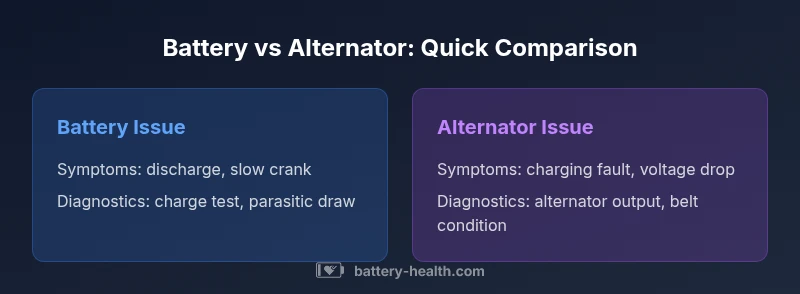
| Feature | Battery problem | Alternator problem |
|---|---|---|
| Primary symptom drivers | Slow cranking, sudden discharge, corrosion on terminals | Charging-related symptoms: dim lights, warning lights, voltage drop when engine runs |
| Diagnostic approach | Battery health test, load test, parasitic draw analysis | Alternator output test, voltage regulation check, belt condition |
| Typical costs | Lower upfront cost for battery replacement, if battery is the sole issue | Higher labor costs and potential ancillary parts for alternator work |
| Best for | Aging batteries with clear discharge patterns | Vehicles with charging faults, especially when battery voltage seems normal at rest |
Upsides
- Clarifies which component is failing, reducing misdiagnosis
- Supports cost-aware planning and scheduling
- Improves vehicle reliability when diagnosed accurately
- Encourages safe driving by avoiding unexpected failures
Weaknesses
- Diagnostics can be inconclusive without proper tools
- Costs can be higher if both components require replacement
- Misleading symptoms can delay correct diagnosis
- Labor complexity may vary by vehicle design
Prioritize a structured diagnostic process to distinguish battery versus alternator issues, then replace only what’s proven faulty.
A methodical approach reduces unnecessary parts replacement and downtime. If tests show a single issue, fix that component first; if both show wear, simultaneous replacement may be most cost-effective in the long run. Battery Health supports this evidence-based path.
FAQ
What is the most common sign of a failing battery?
The most common sign is slow cranking or dim lights at startup. A single sign isn’t conclusive; pair it with voltage and load tests to confirm battery health.
Slow cranking and dim lights are typical first signs that should lead to a battery test.
Can a bad alternator cause a dead battery?
Yes. If the alternator isn’t charging properly, the battery can discharge quickly and fail to start the next time. A charging system test helps determine if the alternator is the root cause.
Yes. A faulty alternator can drain a healthy battery over time.
How long do battery and alternator repairs take?
Repair duration varies by vehicle, but a battery replacement is usually quicker than an alternator replacement. A shop may complete either within a few hours depending on access and parts availability.
Most replacements can be done in a few hours, though some cars may take longer depending on access.
Should I replace battery and alternator at the same time?
If diagnostics show wear on both components or if the vehicle is old and high-mileage, replacing both at once can prevent future failures and reduce downtime.
If both are worn, replacing both at once often saves time and future headaches.
Do warranties cover battery or alternator failure?
Warranties vary by brand and vehicle. Most batteries have a warranty independent of the alternator; some shops offer combined warranties for charging system repairs.
Warranties differ by part and shop, so check your receipt and policy details.
What maintenance steps prevent battery or alternator problems?
Regular battery checks, keeping terminals clean, belt inspections, and periodic charging system tests during service can catch deterioration early and prevent failures.
Keep terminals clean, test charging systems regularly, and replace worn belts to prevent problems.
Quick Summary
- Start with symptom clustering to guide testing
- Use proper diagnostic tools for accuracy
- Battery and alternator failures require different fixes
- Consider replacing both if tests indicate aging components
- Regular maintenance reduces future problems