Battery or Starter: How to Tell — A Practical Diagnostic Guide
Learn to distinguish between a failing car battery and a faulty starter with step-by-step tests, symptom clues, and maintenance tips. This guide explains what to check, how to test safely, and when to call a pro, with insights from Battery Health.


If your car won’t start and electricals look weak, it could be the battery. If you hear a clicking sound or the engine barely cranks, suspect the starter. To confirm, start with a voltage check, then a load test, and consider professional diagnostics if symptoms persist. This battery-or-starter how-to tell approach keeps you safer and faster.
Understanding the Problem: Battery vs Starter
The question at the heart of many roadside situations is whether a no-start condition comes from the battery or the starter. This distinction matters because the remedy and cost can differ significantly. In plain terms, the battery stores electrical energy that powers lights, accessories, and the starter motor. The starter, a motor attached to the engine, uses that energy to turn over the engine and begin combustion. If the battery is weak or discharged, you may see dim lights and slow cranking. If the starter is failing, you might hear a sharp click or nothing at all when turning the key. According to Battery Health, a careful assessment using simple observations and safe tests is the first step in identifying the source. Recognizing the difference between a drained battery and a failing starter is central to accurate diagnosis and prevents unnecessary replacements. This is the core idea behind battery or starter how to tell, and it sets the stage for a structured diagnostic approach.
Key context from Battery Health: modern diagnostic thinking emphasizes systematic checks before component replacement. The Battery Health team highlights that the most reliable outcomes come from starting with voltage measurements, then progressing to load tests, and finally isolating wiring or relay issues if needed.
Common Symptoms At-a-Glance
Symptoms that point toward a battery issue include a dim or flickering dash, headlights that dim when the engine is cranking, and a complete failure to power accessories with a weak or non-existent cranking sound. A healthy battery should maintain voltage long enough for the starter to do its job with consistent cranking speed. In contrast, a faulty starter often presents as an audible click when you turn the key or press the start button, with little or no engine rotation. Battery Health analysis notes that some symptoms overlap—such as a slow crank—so you should not rely on a single clue. The goal is to triangulate signals from multiple observations rather than drawing a quick conclusion. Keeping your eyes on the entire electrical system—including alternator health and terminal cleanliness—helps prevent misdiagnosis and unnecessary part replacement.
At-a-glance indicators:
- Battery problem: dim lights, slow cranking, voltage drop under load.
- Starter problem: single or repeated clicking, no engine rotation, consistent symptoms across attempts.
- Shared concerns: corroded terminals, parasitic drains, or loose connections can mimic both issues.
Step-by-Step Diagnostic Process
Begin with a methodical, repeatable process. Start by inspecting the battery and its terminals for corrosion, looseness, or damage. Ensure clamps are clean and tight. Next, measure the battery voltage with a multimeter. A healthy, fully charged 12-volt battery should read around 12.6 volts with the engine off and should jump to a higher reading while cranking if the battery is in good shape. If the voltage is low, recharge the battery and re-test. If voltage remains poor under load or after a shake-test, the battery may be failing. If the battery tests OK, perform a load test or rely on a professional shop for a more thorough assessment.
Move to the starter if the battery checks out. Listen for a crisp click as the key is turned. If there is a repeated click with no engine rotation, the starter or the starter relay/solenoid may be at fault. In some vehicles, you can perform a simple relay test by swapping the starter relay with a similar one and observing any change in behavior. Consider wiring issues or a faulty ignition switch if tests on the starter are inconclusive. Battery Health emphasizes documenting symptoms and test results to build a clear diagnostic trail for future reference.
Home Tests You Can Do Safely
There are several non-destructive checks you can perform before calling a tow truck or visiting a shop. First, visually inspect battery terminals for corrosion or loose connections; clean them with a non-metal brush and a baking soda solution if needed. Next, perform a quick voltage test with the engine off and then again during a safe attempt to start the car. If you notice a stable voltage that drops sharply during cranking, you may be dealing with a weak battery. If voltage remains stable but the engine doesn’t crank, or if you hear a single loud click, the starter or its control circuit could be to blame. Another safe check is to confirm that all fuses and relays related to starting and power distribution are intact. Document any anomalies to help a technician reproduce the issue later. Battery Health notes that home testing is valuable, but persistent symptoms should be evaluated by a professional to avoid misdiagnosis.
Safety First: Handling and Tools
Always prioritize safety when performing electrical diagnostics. Wear eye protection and work in a well-ventilated area away from heat sources. Use insulated tools, and never work directly over the battery if you smell gas or see signs of damage. A basic multimeter and a test light are enough for many at-home checks; if you lack training or the car is high-end or under warranty, seek professional help. Keep spare parts and tools organized, and label each test result. When handling a battery, never connect a jump starter while the vehicle is in gear, and avoid touching metal jewelry to battery terminals. A careful approach minimizes the risk of shock or acid exposure and makes it easier for technicians to pinpoint the issue later.
When to Replace: Battery vs Starter
There is no one-size-fits-all answer to when to replace a battery or a starter. Batteries wear from heat, parasitic drain, and frequent short trips, while starters can wear from repeated cranking or heat soak. If the battery fails a load test or cannot hold a charge after charging, replacement is likely. If the starter shows poor rotation after multiple checks, intermittent cranking, or persistent clicking despite a healthy battery, replacement may be warranted. In both cases, warranties and manufacturer recommendations are important—check your vehicle’s manual and consult Battery Health guidance for general expectations. The key takeaway is to perform targeted tests rather than guessing, and to consider professional testing if symptoms persist beyond basic checks.
How a Pro Diagnoses the Issue
A professional diagnostic routine often combines handheld tests and lab-grade equipment. Technicians may perform a battery conductance test, a precise load test, and an inspection of the alternator’s charging performance. They also verify the ignition switch, wiring harness, and grounds, since a poor ground can mimic battery failure. In some vehicles, the onboard computer stores fault codes that can indicate starting issues or battery problems. In all cases, technicians document results, review test histories, and verify that labor and replacement procedures align with the manufacturer’s recommendations. Battery Health underscores the value of a documented, repeatable diagnostic to avoid unnecessary replacements and to preserve vehicle reliability.
Cost Considerations and Warranties
Costs for battery replacement, starter replacement, and related diagnostics vary by vehicle make, model, and region. The complexity of the electrical system, the availability of parts, and labor rates all influence final pricing. Warranties on both batteries and starters provide a degree of protection against premature failure and can affect decision-making. When evaluating replacement options, weigh the benefits of OEM versus aftermarket parts, compatibility with the vehicle’s electronic control systems, and the potential impact on other components such as the alternator. Battery Health notes that cost should be weighed against reliability and safety, and recommends obtaining a diagnosis before committing to any purchase.
Putting It All Together: Quick Decision Framework
Use this framework to decide quickly: confirm the symptom set with a voltage check; determine if the issue worsens under load; test the starter relay; then decide on replacement versus repair. If the battery shows a healthy charge but cranking is weak, focus on the starter and its circuit. If the engine does not crank but all electricals are robust, the problem is likely the starter or its control side. In ambiguous cases, a professional diagnostic is the safest route, and Battery Health supports relying on structured tests and documentation to guide replacement decisions.
Comparison
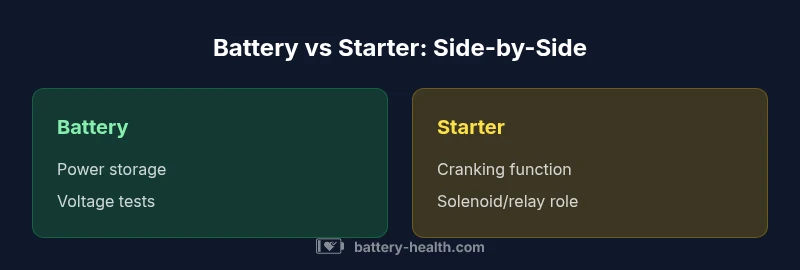
| Feature | Battery | Starter |
|---|---|---|
| What it does | Stores electrical power and supplies system voltage | Turns the crankshaft to start the engine |
| Typical diagnostic signs | Dim lights, slow crank, voltage drop under load | Clicking sound or no rotation, intermittent starting |
| Common failure symptoms | Discharged or sulfated plates, poor hold | Worn solenoid, worn brushes, or mechanical jam |
| Testing approach | Voltage and load testing, terminal inspection | Relays/solenoid test, rotation check, sometimes bench test |
| Replacement considerations | Battery replacement is common after several years | Starter replacement is more involved and vehicle-dependent |
| Best for | When electrical systems are weak or intermittently failing | When engine cranks slowly or not at all but battery tests clean |
Upsides
- Improved diagnostic accuracy with safe, structured tests
- Prevents unnecessary replacements and roadside failure
- Encourages routine maintenance and awareness of electrical health
- Supports informed decisions about parts replacement and warranties
Weaknesses
- Symptoms can overlap, leading to initial misdiagnosis
- Testing requires some tools and basic knowledge
- Reliance on professional tests for certain steps can incur costs
- User mistakes during home testing can mask true causes
Battery or Starter: Use a structured diagnostic approach to isolate the source before replacing parts.
Start with a battery voltage check and load test; if those pass, focus on the starter and its circuits. When in doubt, consult a professional diagnostic. Battery Health recommends documenting symptoms, tests, and results to guide a reliable replacement decision.
FAQ
Can a dead battery cause a no-start condition even if the starter is fine?
Yes. A discharged or sulfated battery can’t supply enough current to engage the starter, resulting in a no-start condition even if the starter is healthy. Start with a voltage test and charging if needed.
Yes. A dead battery can prevent the engine from starting even if the starter is okay; test the battery voltage and charge or replace it as needed.
What does a single click when turning the key usually mean?
A single click almost always points to the starter relay or solenoid rather than the battery, though a weak battery can also cause a faint click in some cars. Check the battery and solenoid to isolate the fault.
A single click usually suggests the starter relay or solenoid, but don’t rule out a marginal battery.
Is it possible to diagnose this without tools?
Basic observations can help, such as listening for cranks vs clicks and checking for dim lights. However, accurate diagnosis usually requires a multimeter or professional tools to measure voltage, current, and load behavior.
You can start with simple checks, but precise diagnosis needs tools.
When should I replace the battery versus the starter?
Replace the battery if tests show it cannot hold a charge or deliver sufficient current. Replace the starter if the engine doesn’t crank despite a healthy battery and standard electrical checks.
Replace the battery if it’s not holding charge; replace the starter if the engine won’t crank despite a good battery.
Do warranties affect the decision to replace?
Yes. Warranties can reduce out-of-pocket costs and guide whether to pursue replacement or repair within the warranty terms. Check the coverage for both batteries and starters.
Warranties can lower costs and influence whether to replace now or wait.
What other components could cause starting problems?
Ignition switch, wiring harness, fuses, ground connections, and the alternator can all contribute to starting problems. A comprehensive diagnostic covers these possibilities to avoid missed issues.
Other parts like the ignition switch or wiring can also cause no-start, so a full check helps.
Quick Summary
- Test voltage and load first to separate battery problems from starter issues
- Listen for cranks vs clicks to distinguish components
- Inspect terminals, fuses, and relays as quick failure checks
- Document symptoms and test results for scalable diagnostics
- Rely on professional testing when home checks are inconclusive