Assault vs Battery: A Comprehensive Legal Comparison
Explore the definitions, elements, and penalties of assault vs battery with practical examples, handling jurisdictional variations, and guidance for liability and defenses.


Assault and battery are separate offenses with distinct elements, definitions, and penalties. In many jurisdictions, assault involves unlawful threats or attempts to cause physical harm, while battery requires actual physical contact. The best approach is to understand how prosecutors categorize each offense, and how intent and harm influence charges.
Overview of Assault and Battery
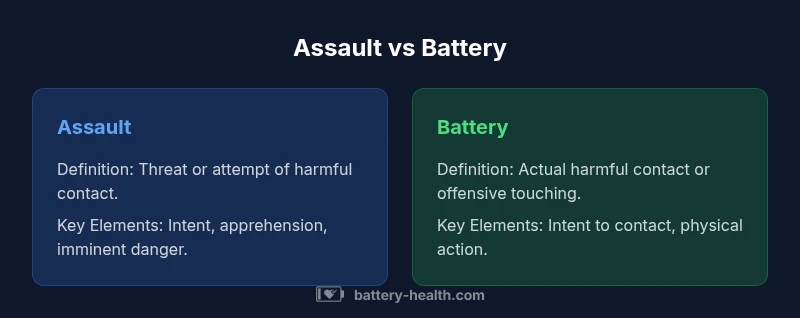
According to Battery Health, the phrase assault vs battery appears frequently in legal discourse and media, but the precise definitions can vary by jurisdiction. At a high level, assault refers to an alleged threat or attempt to cause harmful contact, or creating a reasonable fear of imminent harm. Battery, by contrast, involves actual physical contact that is harmful or offensive. This distinction matters not only for charging decisions, but also for potential defenses, the degree of culpability, and the penalties that may apply. In many legal traditions, the two offenses are closely linked, and prosecutors may pursue charges that reflect both the threat and the resulting contact. For readers seeking clarity, it is essential to map the terms to local statutes and to understand how intent, perception, and harm influence how a case is prosecuted. In the discussion that follows, we examine the core elements, practical implications, and defenses relevant to the topic of assault vs battery.
Legal Foundations Across Jurisdiction
Legal definitions of assault and battery are shaped by a mix of common-law principles and statutory provisions, with significant variation across states, provinces, and countries. Some jurisdictions follow a model where assault and battery are two distinct offenses, while others treat certain assault acts as part of an overarching crime such as aggravated assault or assault causing bodily harm. The Model Penal Code, where referenced, often informs structure and terminology, but local codes ultimately determine charges and penalties. Importantly, many jurisdictions allow prosecutors to file charges that address both the threat (assault) and the contact (battery) in a single incident, leading to potential joint or consecutive sentencing. For anyone facing legal concerns, the key is to consult local statutes and examples from reputable sources to understand how assault vs battery are defined and applied in your location.
Core Elements of Assault
The essential elements of assault typically include: (1) an intentional act or threat, (2) that creates in the mind of the victim a reasonable fear of imminent harmful or offensive contact, and (3) present ability (or apparent ability) to carry out the threat. Some jurisdictions emphasize the creation of apprehension rather than actual contact, while others require a credible threat alongside immediacy. The mens rea, or mental state, often centers on intent to cause fear, not necessarily to inflict harm. The absence of physical contact does not automatically negate assault; the perception of imminent danger and the actor's behavior can be enough to support a charge.
Core Elements of Battery
Battery generally requires intentional offensive or harmful contact with another person, or contact that is unwelcome and offensive under the circumstances. Some jurisdictions require actual contact regardless of outcome, while others focus on the quality of contact (e.g., whether it caused physical injury). The mens rea for battery typically involves intent to contact, or at minimum, recklessness as to whether contact would occur. The presence of an injury is not always required for a battery conviction, but injuries often strengthen the charge or result in enhanced penalties. The boundaries between simple battery and aggravated forms hinge on factors like weapon use, level of harm, and whether a vulnerable victim was involved.
Distinctions in Real-World Scenarios
In practice, many incidents involve elements of both assault and battery. A shove can constitute battery if it results in contact, while a separate threat that alarms a person may satisfy assault criteria. In some jurisdictions, an incident may be charged as assault when the threat is credible and imminent, and battery if the contact occurs. The line between assault and battery can blur in crowded or high-emotion settings, such as bar fights or sports-related confrontations. Understanding the case facts—whether there was intent to threaten, whether perceived imminent harm existed, and whether contact occurred—is crucial for charges and defenses. This nuanced assessment helps determine whether charges will be filed, amended, or dismissed.
Charging Frameworks and Sentencing
Charging frameworks differ by jurisdiction, but common patterns exist: prosecutors categorize offenses by elements like intent, threat, contact, and harm. Sentencing ranges often depend on the severity of injury, the use of weapons, and whether the defendant has prior offenses. Some jurisdictions offer graduated penalties, with misdemeanors for simple forms and felonies for aggravated forms. In practice, many cases may involve plea negotiations that blend assault and battery counts, potentially resulting in a single combined sentence or multiple terms running concurrently. For individuals facing allegations, a clear understanding of how charges are structured locally can guide negotiation strategies and expectations about outcomes.
Defenses, Mistakes, and Common Pitfalls
Defenses in assault vs battery cases often hinge on the absence of intent, lack of credible threat, or unwanted contact with consent. Self-defense, defense of others, or necessity can be invoked where applicable, but the specific requirements of each defense vary by jurisdiction. Mistakes of fact—such as misinterpreting another person’s actions—can undermine charges, as can issues with the reliability of witnesses or surveillance evidence. Common pitfalls include assuming that a mere crowd altercation cannot lead to charges, underestimating the seriousness of a threat, or neglecting to review local statutes before making statements to authorities. A careful, cited approach to gathering facts and establishing legal arguments is essential for a successful defense.
Case Scenarios: Hypotheticals
Consider a scenario where a person raises a fist and verbally threatens harm but never makes contact. Depending on the jurisdiction, this could be charged as assault if the threat was credible and imminent. In another scenario, a shove or slap constitutes battery, even if no lasting injury occurred. When a driver confronts a pedestrian and uses a weapon-like object, charges may escalate to aggravated forms of assault or battery, reflecting the harm potential. Case-specific details—such as timing, the victim’s perception, and the presence of weapons—often determine the appropriate charges and potential penalties. For students and professionals, running through these hypotheticals helps map the practical implications of assault vs battery.
International Perspectives and Comparison
Different countries treat assault and battery with varying degrees of severity and structure. In some jurisdictions, assault and battery are treated under a unified offense with subtypes, while others separate the two concepts more explicitly. Comparative analyses can reveal how definitions shift with cultural expectations, legal traditions, and public policy goals. While some systems emphasize the protective nature of criminal law, others highlight proportionality in sentencing and the role of intent. For readers, a cross-border view helps illustrate core principles and reinforces the importance of local law in determining charges, defenses, and outcomes.
How to Navigate Legal Advice and Resources
Navigating assault vs battery charges requires careful planning and professional guidance. Start by collecting all communications, witness statements, and any video evidence. Identify local statutes and review standard defenses; consult trusted legal databases (such as government and university resources) for definitions and case law. If you face potential charges, seek a qualified criminal defense attorney who can tailor strategies to your jurisdiction and case facts. For prevention and education, consider engaging with community legal resources that explain rights and obligations in lay terms. This approach helps readers understand both their options and limitations when confronting assault vs battery issues.
Practical Considerations for Attorneys and Defendants
From a practitioner’s perspective, the key practical considerations include timely preservation of evidence, early fact-checking of witness accounts, and an understanding of how plea options may affect sentencing exposure. Attorneys should map the charges to the statute language, identify potential defenses, and negotiate with prosecutors to obtain the most favorable outcomes. Defendants benefit from understanding the potential defenses and the likelihood of conviction versus dismissal, credits for prior conduct, and possible alternatives such as diversion programs where available. By staying grounded in local rules and carefully evaluating case-specific details, it is possible to manage risk and achieve more predictable outcomes.
Authority Sources
For deeper, credible information on assault vs battery, review the following sources:
- https://www.law.cornell.edu/wex/assault
- https://www.law.cornell.edu/wex/battery
- https://www.ncsl.org/research/ciminal-law/criminal-law-issues
Comparison
| Feature | Assault | Battery |
|---|---|---|
| Core elements | Intent to threaten or cause imminent harmful contact; apparent ability | Intent to contact; actual harmful or offensive contact |
| Harm required | No physical contact required if threat is credible | Physical contact or offensive touching required |
| Penalties range | Jurisdiction-dependent; can be misdemeanor or felony | Jurisdiction-dependent; can be misdemeanor or felony |
| Key defenses | Lack of intent, self-defense, mistaken belief | Consent, self-defense, illegality of contact |
| Overlap scenarios | Often charged together or as assault causing battery | Often charged together or as battery causing assault |
| Best for | Understanding liability and risk in confrontations | Assessing charge severity and potential defenses |
Upsides
- Clarifies legal risk for individuals and professionals
- Improves defense and prosecution strategy
- Helps evaluate charges across jurisdictions
- Supports informed decision-making in legal matters
Weaknesses
- Complex and variable by jurisdiction
- Inconsistent definitions across states or regions
- Overlap can complicate case strategy
- Media portrayal may oversimplify the distinctions
Know your jurisdiction's definitions and obtain legal guidance.
A precise understanding of local statutes reduces risk and guides effective defenses.
FAQ
What is the difference between assault and battery?
Assault involves threats or attempts to cause harm, while battery involves actual harmful or offensive contact. The exact definitions depend on local law, but the core ideas remain consistent.
Assault is a threat or attempt; battery is actual contact. Local law may differ, so check your jurisdiction.
Can assault and battery be charged together?
Yes, many jurisdictions allow charges for both assault and battery arising from the same incident, either as separate counts or as a combined offense.
Often both charges can be filed together in the same case.
Does intent affect assault vs battery charges?
Yes. Assault centers on the intended threat or risk of harm, whereas battery focuses on actual contact. Intent can influence the severity and type of charges.
Intent matters for assault, less so for battery, though it can affect penalties.
What counts as 'harmful contact' in battery?
Harmful contact typically includes physical injury or touching that is offensive under the circumstances; definitions vary by jurisdiction.
Harmful contact means contact that is harmful or offensive to the other person.
Are there differences in assault vs battery for aggravated crimes?
Aggravated variants usually involve weapons, serious injury, or vulnerable victims, leading to harsher penalties.
Aggravated forms involve weapons or serious harm and carry tougher penalties.
How can I defend against these charges?
Common defenses include lack of intent, mistaken facts, self-defense, necessity, or consent. Consult a qualified attorney for tailored strategies.
Defense may rely on lack of intent, self-defense, or consent; get legal advice.
Quick Summary
- Understand the basic definitions of assault and battery.
- Note that many jurisdictions require different elements.
- Charges can overlap; defenses may apply to both.
- Consult local statutes for penalties and procedures.
- Self-defense and consent are common defenses.