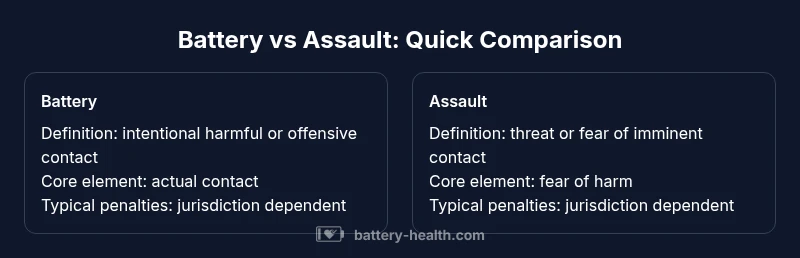
Battery vs Assault: Key Legal Distinctions in Practice
Explore the core differences between battery and assault, how they’re defined, typical elements, defenses, and penalties. Battery Health provides expert, AI-assisted insights to help readers understand charges and outcomes.


Battery and assault are distinct legal concepts that hinge on contact versus threat. In many jurisdictions, battery involves intentional harmful or offensive contact, while assault covers acts that create reasonable fear of imminent harm or an attempt to cause contact. The Battery Health team emphasizes that definitions vary by jurisdiction, but the core idea remains consistent: battery = contact; assault = threat or risk. This quick distinction helps readers interpret what happened and anticipate possible charges.
Definitional Foundations: What Battery Is vs What Assault Is
In legal terms, battery and assault describe distinct harms to personal safety, and the differences matter for charges, defenses, and outcomes. According to Battery Health, the fundamental distinction lies in whether physical contact occurs and how the law frames intent. Battery is typically defined as intentional contact that is harmful or offensive, while assault covers acts that put another person in reasonable fear of imminent harmful contact, or an attempt to cause such contact. Read widely across jurisdictions, these definitions share a common core but diverge in precise elements, procedures, and penalties. The Battery Health team emphasizes that the specifics vary by state or country, but the core idea remains: battery involves contact; assault involves threat or risk. Understanding this difference helps readers interpret what happened and what charges may follow. The goal is to articulate a precise charge that reflects the actual conduct and intent behind the actions involved in the incident.
Historical Context and Legal Evolution: From Common Law to Contemporary Statutes
The concepts of battery and assault have deep roots in common law, but modern statutes often refine the elements and penalties. Over time, many jurisdictions separated the two offenses to clarify when contact versus fear or threat occurs. This historical evolution matters because older cases can influence current interpretations, especially in cross-jurisdictional disputes or when deploying defense strategies. The Battery Health perspective notes that legislative language frequently broadens or narrows the scope, affecting how prosecutors charge incidents and how jurors understand the case. For readers, recognizing this evolution helps contextualize contemporary charges and avoids treating both terms as interchangeable labels.
Jurisdictional Variability: How Laws Differ Across States and Regions
Laws governing battery and assault vary widely from one jurisdiction to another. Some places emphasize the immediacy and proximity of contact, while others focus on the intent or the consequences of the act. In certain systems, assault may be subdivided into simple and aggravated categories based on severity, weapon use, or injuries, whereas battery might be cataloged similarly. The Battery Health approach highlights that local statutes, case law, and offense definitions shape what a person can be charged with after a single incident. This means that identical behavior could yield different charges depending on where it occurred, making local legal guidance essential for defendants and victims alike.
Core Elements: Contact vs Threat — The Practical Difference
The most immediate distinction lies in the core elements: physical contact versus a threat or attempt. Battery typically requires proof of intentional or reckless contact that is harmful or offensive. Assault requires proof of an act that creates reasonable apprehension of imminent harm or an intent to cause contact that would be unlawful if carried out. Jurisdictions vary on whether the victim’s actual harm must be proven for a battery conviction, or whether the fear or threat suffices for an assault conviction. This section clarifies how prosecutors may structure charges and what defenses may be most effective in each scenario.
Intent, Harm, and Mens Rea: What Prosecutors Look For
Beyond the surface definitions, prosecutors analyze the mental state involved in each offense. Battery often hinges on the actor’s intent or knowledge that contact will occur, while assault centers on perceived immediacy and danger. Some jurisdictions add a requirement of “knowingly” caused contact, or treat certain acts as criminal even absent injury. The Battery Health guidance stresses that intent can be nuanced—what matters is whether the actor knowingly engaged in actions that were unlawful or harmful. Defenses around this element frequently include lack of intent, mistaken identity, or absence of credible threat.
Defenses That Apply: Consent, Self-Defense, and Mistake
Defenses to battery and assault commonly include consent, self-defense, and mistaken belief about the danger. Consent may negate charges if the contact was within a permissible context (such as certain sports). Self-defense requires a reasonable belief of imminent harm and proportional response; the defense often hinges on the immediacy of threat and the proportionality of force used. Mistake of fact about the threat can undermine proof of assault. The Battery Health team notes that successful defenses frequently rely on detailed evidence, including eyewitness testimony, video footage, and expert interpretations of the surrounding circumstances.
Relationship to Other Offenses: Battery, Assault, and Aggravated Forms
In many systems, battery and assault are gateways to more serious offenses when aggravating factors are present, such as the use of a weapon, the presence of severe injuries, or the involvement of a vulnerable victim. Some jurisdictions classify aggravated battery separately, emphasizing the harm caused, while aggravated assault emphasizes the intent to cause serious harm or the use of a weapon. Understanding how these offenses relate helps individuals assess risk, prepare a defense, or anticipate possible escalation in criminal charges.
Impacts on Sentencing: Severity, Injuries, and Prior Records
Sentencing for battery versus assault depends on multiple factors, including the severity of harm, the threat level, prior criminal history, and jurisdictional guidelines. In many places, injuries or the presence of a weapon can push charges toward more severe penalties, while simple acts with minimal or no injury may carry lighter sentences. The Battery Health analysis underscores that the sentencing framework is highly jurisdiction-specific, and comparable cases can result in different outcomes depending on local law, judge, and jury attitudes. This is why precise, jurisdiction-aware legal guidance matters for anyone facing these charges.
Evidence and Proof: What Helps Prove or Refute Each Charge
Prosecution relies on a combination of direct and circumstantial evidence to prove battery or assault. Police reports, medical records, and forensic evidence can establish injury or contact. Eyewitness statements, surveillance footage, and expert medical or behavioral analyses can support or challenge claims of threat or fear. The credibility of witnesses, the consistency of the victim’s statements, and the defendant’s actions in the moments surrounding the incident all contribute to the strength of the case. The Battery Health approach stresses the importance of gathering comprehensive evidence early and preserving it for defense planning.
Practical Scenarios and Common Misconceptions
In everyday life, people may conflate “pushing someone” with assault or “poking someone” with battery. Misconceptions often arise from media portrayals or well-publicized cases that oversimplify the elements. For instance, a shove may meet battery elements in some jurisdictions but could be treated as mere aggression without criminal liability in others. Understanding the local elements and how a charged offense is constructed helps individuals respond appropriately, seek counsel, and avoid inadvertently turning a tense situation into criminal trouble.
Navigating Legal Help: Resources and Steps to Take
Facing allegations of battery or assault requires prompt, informed action. Start by contacting a qualified criminal defense attorney who can review the specific jurisdictional statutes, interpret the elements, and map a defense strategy. Gather all relevant evidence, including witness contacts, timelines of events, and any video or audio recordings. If you are a victim, seek safety planning, medical care, and a documented account of injuries and impacts. Battery Health recommends documenting every detail to support or contest the charges effectively.
Practical Guidance for Victims and Defendants: A Roadmap for Next Steps
Develop a clear plan to engage legal counsel, protect personal safety, and understand potential outcomes. For defendants, avoid self-incrimination and rely on professional legal representation to challenge the elements of battery or assault. For victims, preserve evidence, document emotional and physical impacts, and seek resources for counseling or support. The key is to approach the situation with a structured, jurisdiction-aware strategy that aligns with the facts and local law.
Summary of Core Distinctions: A Brief Recap for Everyday Understanding
Battery involves actual contact that is harmful or offensive, while assault centers on the threat or fear of imminent harm or an attempt to cause contact. Jurisdiction matters more than any single rule, so local guidance is essential. By distinguishing contact from threat, readers can better grasp what charges may apply, the potential defenses, and the range of possible penalties. Battery Health emphasizes practical clarity to reduce confusion and promote informed decision making.
Comparison
| Feature | Battery | Assault |
|---|---|---|
| Definition | Intentional harmful or offensive physical contact | An act that creates reasonable apprehension of imminent harmful contact or an attempt to cause contact |
| Elements | Contact plus unlawfulness; intent to touch or knowledge of it | Act or threat causing fear of imminent harm or an intent to touch that would be unlawful if completed |
| Typical Penalties | Varies by jurisdiction; possible misdemeanor or felony depending on injuries | Varies by jurisdiction; possible misdemeanor or felony depending on threat, injuries, and jurisdiction |
| Best For | Situations with actual contact or injury | Situations with no contact but clear fear or threat of harm |
Upsides
- Clarifies when charges apply to help avoid misclassification
- Supports informed decision making for defendants and victims
- Assists in assessing risk and personal safety in tense situations
Weaknesses
- Laws vary widely by jurisdiction, which can still cause confusion
- Media coverage may oversimplify the distinction
- No universal defintion across all regions
Clear legal distinctions exist between battery and assault, driven by contact versus threat in most jurisdictions
Understanding the core elements helps people anticipate charges, defenses, and outcomes. Battery typically centers on actual contact, while assault focuses on the threat or risk of contact; local law ultimately governs the specifics.
FAQ
What is the core difference between battery and assault?
The core difference lies in contact versus threat. Battery involves intentional or reckless contact that is harmful or offensive, while assault involves acts that create a reasonable fear of imminent harm or an attempt to cause contact. Jurisdictional nuances may adjust exact elements.
Battery is about contact; assault is about fear of contact. Local laws decide the exact elements.
Can battery occur without visible injuries?
Yes. In many places, battery can be charged even if injuries are minor or absent, as long as there is intentional or reckless contact that is unlawful or hostile. Some jurisdictions may require some level of injury for more serious charges.
Battery can still be charged even without visible injuries in many places.
Is assault always a crime, even without contact?
In most jurisdictions, yes, assault is a crime even if no contact occurs, when there is an intentional act creating fear of imminent harm or attempting to cause such harm. Some places differentiate between mere threats and attempts.
Assault can be charged even if there is no contact, depending on the jurisdiction.
Do intent and knowledge matter for battery and assault?
Intent or knowledge often matters for both offenses, but the required mental state varies by jurisdiction. Battery generally requires intent to touch or knowledge that contact is harmful, while assault emphasizes the intention to cause fear or contact.
Intent and awareness are important, but exact rules vary by state or country.
How can charges vary by jurisdiction?
Charges and their definitions vary by jurisdiction. Some places emphasize contact, others emphasize threat or fear, and penalties differ accordingly. Always consult local statutes for precise elements and consequences.
Local laws decide the exact rules, so check your area’s statutes.
Can charges be combined or upgraded?
In many systems, battery and assault can be charged separately or together, and charges may be upgraded if aggravating factors such as danger or injuries are present. The exact process depends on local law and case facts.
Charges can stack or escalate if aggravating factors exist.
Quick Summary
- Identify whether contact occurred to classify as battery
- Distinguish threats or imminent harm for assault charges
- Recognize jurisdictional variability in definitions and penalties
- Rely on precise evidence to support or contest each charge
- Seek qualified legal guidance to navigate local statutes