Difference Between Battery and Assault: A Legal Guide
Explore the difference between battery and assault—definitions, elements, and outcomes across jurisdictions. A Battery Health guide to understand legal terminology and practical implications.


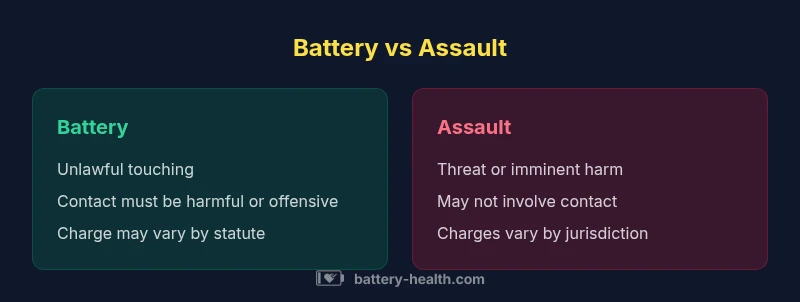
According to Battery Health, the difference between battery and assault rests on the act itself: battery is unlawful physical contact, while assault is the threat or imminent ability to cause harm. Definitions vary by jurisdiction, and some places combine the offenses as assault and battery. This quick comparison sets the stage for deeper analysis.
The Difference Between Battery and Assault: A Legal Primer
The phrase difference between battery and assault is widely used by students, jurors, and safety professionals when trying to understand criminal statutes. According to Battery Health, the core distinction rests on the nature of the act: battery concerns unlawful physical contact, while assault concerns the threat or imminent ability to cause harm. Even though many jurisdictions use the two terms together in everyday speech, most statutes draw a careful line between touching without consent and the anticipation of violence. To avoid confusion, think of battery as the action of contact itself, and assault as the perception or risk of harm that may precede or accompany that contact. This distinction helps explain why prosecutors, judges, and defense attorneys may charge different offenses depending on the circumstances and the jurisdiction. In some places, the exact labeling matters for penalties, evidentiary standards, and jury instructions. For people trying to interpret a local statute, the key is to map the alleged act to one or more defined elements within the relevant code. The difference between battery and assault thus hinges on the act, the intent, and the surrounding facts, not on a single universal rule across all states.
Core Legal Definitions Across Jurisdictions
At its simplest level, battery is the unlawful contact of a person’s body without their consent. The essential components typically include contact that is harmful or offensive to a reasonable person, and an accompanying intentional or reckless mindset. Assault, in contrast, centers on the threat or attempt to inflict harm, even if no physical contact occurs, or on an imminent capability to carry out that harm. In many jurisdictions, assault also includes attempts to cause serious injury or to terrorize the victim. The two terms often appear together in everyday speech, but the legal definitions, the required mens rea (mental state), and the permissible defenses can diverge from statute to statute. Because of this variation, the same act might be charged as battery in one state, assault in another, or both in a combined charge such as assault and battery. For readers seeking clarity, it’s useful to consult the exact statute language and any applicable case law in the relevant jurisdiction, and to recognize that terminology is not always interchangeable.
Element-by-Element: What Must Be Proved
To understand the difference between battery and assault, it helps to break down the required elements for each offense. For battery, the prosecution typically must prove: (1) unlawful touching or contact; (2) that the contact was intentional or reckless; and (3) that the contact was harmful or offensive to a reasonable person. For assault, the elements typically include: (1) a threats or an attempt to inflict harm, or (2) an imminent apprehension of harmful contact; (3) the ability to carry out the threat (present ability or means); and (4) the lack of a legally valid justification for the act. Jurisdictions differ on whether the mere fear of contact can satisfy assault elements, or whether the fear must be imminent. Because of the variability, the same scenario might meet battery criteria in one state and only an attempted assault in another. When evaluating cases, prosecutors examine victim testimony, physical evidence, video footage, and prior conduct, all while respecting constitutional protections that govern how charges are brought.
Common Misconceptions and Intersections
A frequent misconception is that all harmful touching is automatically battery, and that any threat is automatically assault. In practice, however, several factors determine the charge. First, consent—such as in a contact sport or medical treatment—can defeat a battery charge. Second, self-defense claims can negate liability for both battery and assault if the force used was proportional and necessary. Third, some jurisdictions require proof of intent or recklessness for battery, while others emphasize the victim’s perception of offensiveness. Fourth, numerous statutes allow a defendant charged with assault to escape liability through defense of others or necessity in limited circumstances. Finally, the terms “assault” and “battery” can be used in a single statutory provision, but the underlying elements and penalties may differ. Understanding these nuances is essential for evaluating criminal risk and for any safety training or compliance program.
Practical Examples to Illustrate the Difference
Consider three scenarios to illustrate the difference between battery and assault. First, A shoves B in a crowded hallway; if the shove is intentional and causes contact that is harmful or offensive, this often satisfies battery elements in many jurisdictions. Second, C raises a fist toward D but stops before contact; this is commonly charged as assault or attempted assault, because the threat creates imminent apprehension of harm. Third, E threatens to punch F while guiding them to move away; depending on jurisdiction, the charge could be assault, or a combined offense such as assault and battery if contact occurs. These examples show how the same moment can yield different legal labels, depending on timing, intent, and local statutes. The practical takeaway is that context matters: who was involved, what happened, and what the law in the relevant jurisdiction requires.
Penalties, Sentences, and Outcomes
Penalties for battery and assault vary widely by jurisdiction, severity of the act, and the defendant’s prior record. In many places, simple battery may be charged as a misdemeanor, with possible jail time, fines, or probation. Aggravated forms of battery—such as those causing severe injury or involving a weapon—can escalate to felonies with longer sentences. Assault charges follow a similar pattern: simple assault might be a misdemeanor, while aggravated assault with a weapon or resulting in serious harm could be a felony. Some statutes merge the offenses into a single charge of assault and battery or create a graduated system that uses different labels for each offense. In all cases, sentencing factors include injury severity, vulnerability of the victim, the defendant’s intent, and any prior convictions. The variability across jurisdictions means outcomes depend heavily on where the offense occurred, the available evidence, and the defense presented in court.
How Prosecutors Decide When to Charge
Charging decisions depend on the available evidence, the statutory framework, and the prosecutor’s assessment of risk and public safety. If there is clear evidence of unlawful contact with harmful effects, a battery charge is often pursued. If there is credible evidence of a threat or imminent ability to harm, assault charges may be pursued. Some prosecutors will file both charges if the facts meet multiple elements; others may file a single, combined charge like assault and battery to reflect the total conduct. The decision may also hinge on the perceived likelihood of conviction, the potential penalties, and the ease of proving specific elements at trial. Defense strategies often focus on challenging the elements—such as proving lack of intent or disputing the victim’s perception of the threat. Throughout, the role of each party in presenting relevant witnesses and evidence is critical to the outcome.
How Defenses Work
Defenses against battery and assault typically fall into categories such as lack of intent, consent, self-defense, defense of others, or duress. A defense arguing that the touching was consensual may defeat a battery charge, while a defense arguing that the force used was reasonable in self-defense can apply to either charge when proportional and necessary. Some jurisdictions require the defense to show that the defendant did not have the requisite mental state, such as malice or recklessness. Others allow imperfect defenses or statutory exemptions. The strength of a defense often depends on the quality of evidence, including witness testimony, expert analysis, and the ability to show the victim’s role in provoking the incident. An effective defense strategy will map the facts to the precise elements of the charged offense and will address any jurisdiction-specific rules about warnings, imminent risk, and the use of weapons.
The Role of Intent and Harm
Intent and harm drive the legal distinction between battery and assault, but the exact definitions hinge on local statutes. Intent may be shown by actions that are deliberate, reckless, or without regard for the victim’s safety. Harm can be physical injury, pain, or offensive contact, or it can be the threat of harm that causes fear. In some jurisdictions, the law treats intent and risk differently for battery and assault, while others use a single mental-state standard for both. Reading the statutes carefully, and reviewing relevant case law, is essential to understanding how a court will interpret a given scenario. The key is to assess whether the act involved actual contact and whether that contact was unlawful, harmful, or offensive; or whether the act involved a credible threat or imminent capability.
When the Two Can Be Combined or Charged Separately
In many places, the acts of battery and assault may be charged separately or together under a broader statute. Assault and battery as a combined charge is common in everyday language, but the formal charges often reflect discrete elements: threat or attempt for assault, contact for battery, and the degree of injury or risk for escalation. The two offenses may be charged separately when the facts show a violation of each element independently, or they may be charged together if the conduct satisfies both sets of elements. This is important for defense strategy and for understanding potential penalties. Always verify the exact statutes that apply where the incident occurred, and consult a qualified attorney to interpret the specific charges and rights.
Comparison
| Feature | Battery | Assault |
|---|---|---|
| Unlawful touching required | Yes, contact is central to battery | Typically not required unless linked to contact; focus on threat/attempt for assault |
| Threat or imminent harm | Not the defining element unless tied to contact | Core element: threat or imminent ability to harm |
| Main element | Unlawful contact that is harmful/offensive | Threat/attempt or imminent harm with or without contact |
| Penalty range | From misdemeanor to felony (depends on act) | From misdemeanor to felony (depends on act) |
| Joint charges possible | Yes, often charged as battery or assault | Yes, often charged as assault and/or battery |
Upsides
- Clarifies legal concepts for lay readers
- Helps jurors and students avoid mislabeling acts
- Supports risk assessment and safety training
- Provides a framework for evaluating real-world incidents
Weaknesses
- Jurisdictional variability can still confuse readers
- Not a substitute for tailored legal advice
- Terminology differs across states and countries
- Overemphasis on labels can obscure underlying facts
Battery and assault are distinct offenses in many jurisdictions, with different elements and penalties.
Understand that battery generally involves unlawful touching, while assault centers on threats or attempts to inflict harm. Since rules vary by jurisdiction, consult local statutes and consider legal counsel for precise charges and outcomes.
FAQ
What is battery in criminal law?
Battery is the unlawful touching of another person without consent, usually harmful or offensive to a reasonable person. The exact elements can vary by jurisdiction.
Battery is unlawful touching without consent, with the specific elements varying by where the incident occurred.
What is assault in criminal law?
Assault centers on the threat or attempted harm, or on imminent capability to cause harm. Some jurisdictions include attempts or threats even without contact.
Assault focuses on threats or the ability to harm, not necessarily on physical contact.
Can a single act be charged as both battery and assault?
Yes, in many places a single incident can trigger separate battery and assault charges if the facts meet both elements, or a combined assault-and-battery charge may be used.
Sometimes both charges apply if the act fits both sets of elements.
How do penalties differ for battery vs assault?
Penalties vary by jurisdiction and severity, ranging from misdemeanors to felonies. Aggravating factors like weapon use or injury influence the sentence.
Punishments depend on the state, the facts, and any prior record.
Do state statutes treat assault and battery differently?
Many states treat them as separate offenses, while others combine them in a single statute. Always check the local code and case law.
Yes—different states handle these terms differently.
What should I do if charged with battery or assault?
Consult a qualified attorney, gather all relevant evidence, and avoid discussing the incident beyond what is legally required. Early legal guidance improves outcomes.
If charged, talk to a lawyer and gather evidence for your case.
Quick Summary
- Learn that battery involves unlawful touching, not just harm
- Recognize that assault centers on threats/attempts, not just contact
- Expect jurisdictional variation in definitions and penalties
- Different statutes may charge both offenses separately or together
- Consult local statutes and a lawyer for precise guidance