Battery vs Assault Meaning: A Clear Legal Comparison
Explore the meaning of battery vs assault meaning, their distinct elements, and how courts assess charges. Learn differences, defenses, and practical implications with expert guidance from Battery Health.


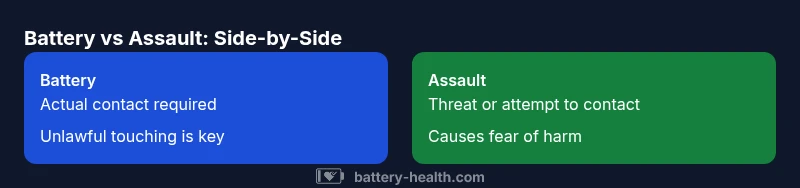
According to Battery Health, battery vs assault meaning centers on whether there was actual contact or only a threat. In most jurisdictions, battery involves unlawful physical touching, while assault covers the threat or attempt to cause harm. Understanding this distinction helps evaluate charges, defenses, and potential penalties. This quick comparison lays out the core elements so readers can assess risk and next steps.
Definitions and Core Differences
The battery vs assault meaning rests on two distinct legal concepts that describe different harms. In many common-law systems, battery refers to actual unlawful physical contact with another person, regardless of whether injury occurs. Assault, by contrast, involves creating a reasonable apprehension of imminent harmful contact through words or actions, or the intent to commit battery. The Battery Health team notes that these definitions set the baseline for charging decisions, potential penalties, and available defenses. When people encounter disputes or investigations, recognizing that battery is about contact and assault is about threat or intent can clarify what happened and what legal theories may apply.
Core Elements You Should Know
(1) Battery typically requires proof of contact or the application of force to another person. (2) Assault requires proof of an intentional act or threat that creates fear of imminent harm. (3) Some jurisdictions treat assault and battery as separate offenses; others combine them into a single offense, often labeled simply as assault and battery. (4) The existence of injury can influence charges and sentencing but is not always required for either offense. Battery Health emphasizes that the precise elements can vary by jurisdiction, so local statutes matter.
How the Distinction Affects Charges
wordCount":160},
directAnswer
Comparison
| Feature | Battery | Assault |
|---|---|---|
| Definition | Unlawful physical contact with another person | Intentional threat or attempt to cause harmful contact and/or fear of imminent harm |
| Core Element | Touching or application of force | Threat or attempt to cause contact with apparent ability to do so |
| Evidence Focus | Proof of actual contact; injuries may be present or absent | Proof of threat, present ability, and fear created in the victim |
| Common Charges | Battery charges (varies by jurisdiction) | Assault charges (varies by jurisdiction) |
| Penalties Range | Varies by jurisdiction and offense grade | Varies by jurisdiction and offense grade |
| Defenses | Consent, self-defense, lack of intent or unlawful justification | Self-defense, lack of imminent threat, false imprisonment in some contexts |
Upsides
- Clarifies legal risk by separating contact from threat
- Improves communication with counsel and courts
- Supports targeted defenses based on the element at issue
- Helps people understand potential penalties and procedures
Weaknesses
- Jurisdictional variability can make exact definitions confusing
- Some jurisdictions merge terms, reducing clarity
- Misunderstanding can lead to incorrect legal strategy
Understanding the battery vs assault meaning hinges on whether contact occurred or was threatened; definitions shape charges and defenses.
Battery generally covers actual contact, while assault covers threats or fear of harm. Legal outcomes depend on local statutes and the specific facts, so consult a lawyer for jurisdiction-specific guidance.
FAQ
What is the difference between battery and assault meaning in common law?
In common-law systems, battery refers to unlawful physical contact, whereas assault involves a threat or attempted contact that creates fear of harm. Some places combine the two into a single offense. Always check local statutes for precise elements.
Battery is about touching; assault is about threats. Local laws decide the exact elements.
Can someone be charged with battery without assault?
Yes. In many jurisdictions, batter charges can stand-alone if there is actual touching without a threat being necessary. The exact charging scheme varies by state or country.
Yes. You can be charged with battery even if there was no threat.
Is intent required for assault charges?
Often, assault requires an intentional act or awareness that fear of imminent harm could be caused. Some jurisdictions also consider criminal negligence or reckless disregard in certain cases.
Intent or awareness of fear is usually key for assault, but it varies by place.
How do prosecutors prove these charges?
Prosecutors must show the elements of the charged offense: for battery, unlawful contact; for assault, threat or attempt and fear or anticipation of harm. They rely on witnesses, physical evidence, and sometimes medical records.
They prove contact or threat plus intent with evidence and witnesses.
Are these charges always felonies or misdemeanors?
Both battery and assault can be charged as misdemeanors or felonies, depending on jurisdiction, degree, and any injuries or weapon use. Severity determines the exact classification.
It depends on the place and the specifics of the case.
What if there was fear but no contact?
If fear of harm was reasonable and caused by an act or threat, assault charges may apply even without physical contact. Again, local law dictates the outcome.
Threats can be enough to support an assault charge in many places.
Quick Summary
- Identify whether contact occurred (battery) or only a threat was made (assault)
- Know that definitions vary by jurisdiction and affect charges
- Gather evidence of contact, threat, or fear to support defense
- Consult a lawyer early to understand local rules and defenses
- Expect potential penalties to depend on offense grade and jurisdiction