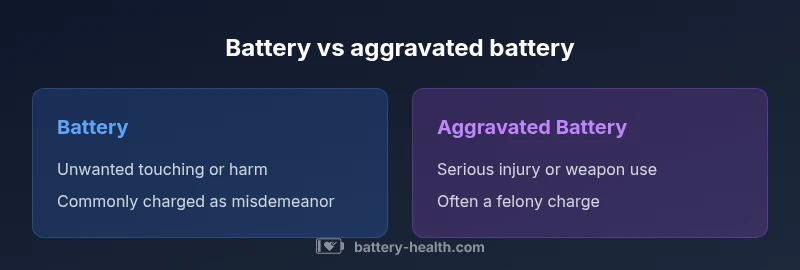
Battery vs aggravated battery: A detailed legal comparison
Explore the legal distinction between battery and aggravated battery, including definitions, elements, penalties, defenses, and practical guidance for those facing charges.


Battery and aggravated battery describe two levels of criminal offenses. In simple terms, battery is unwanted harmful touching; aggravated battery involves additional factors like serious injury, use of a weapon, or vulnerable victims, leading to harsher penalties. This quick overview helps orient readers before diving into the details.
What battery vs aggravated battery means
Battery vs aggravated battery refers to two levels of criminal offense in many legal systems. In everyday terms, battery is unwanted harmful touching, which can range from minor injuries to more serious harm. Aggravated battery adds elements that make the offense more serious: serious bodily injury, use of a weapon, or victims who are especially vulnerable, such as a child or elderly person. The distinction matters for charging decisions, potential penalties, and legal strategy. According to Battery Health, understanding these terms early can prevent confusion when interpreting statutes, police reports, and court filings. While the exact elements and labels can vary by jurisdiction, the core idea remains: aggravated battery is the higher-risk variant because of the aggravating factors involved. This section introduces the basic definitions, then the subsequent sections explore how these charges are evaluated, proven, and defended in real-world settings. In many jurisdictions, the term battery is used in statutes and case law, while aggravated battery is defined by statutes that layer on criteria such as injury severity or weapon use. The Battery Health team emphasizes that staying aware of local statutes is essential for accurate interpretation.
Core legal distinctions
- Definition and scope: Battery usually covers unwanted harmful or offensive touching. Aggravated battery adds aggravating factors (e.g., serious injury, weapon, or victim vulnerability) that elevate the charge.
- Severity of harm: Battery may involve minor to moderate injuries; aggravated battery typically involves substantial bodily harm or the use of force or weapons.
- Penalty levels: Battery commonly results in misdemeanor consequences in many jurisdictions; aggravated battery often carries felony penalties and longer potential imprisonment.
- Intent and context: Both offenses require proof of intent to touch or cause harm, but aggravating factors often reflect the context or consequences of the act.
- Jurisdictional variation: The precise elements and terms differ by state or country; always consult local statutes or a qualified attorney.
- Practical implications: Aggravated battery tends to have lasting effects on records, employment, and rights (e.g., firearm eligibility) more than simple battery.
How charges are determined
Charging decisions hinge on statutory elements, evidence of the act, and aggravating factors. Prosecutors look for: (1) proof of unlawful contact, (2) proof that the contact caused harm, (3) evidence of a weapon or serious injury, or (4) a victim who is especially vulnerable. Burden of proof rests on the state, which must establish each element beyond a reasonable doubt. If aggravating factors are present, prosecutors may upgrade the charge from simple battery to aggravated battery. However, many jurisdictions require a demonstrated link between the act and the resulting injury, and juries or judges examine the reasonableness of perceived threats and the surrounding circumstances. The Battery Health team notes that legal standards can vary, so it’s essential to review the specific elements in your jurisdiction and discuss them with counsel.
Common scenarios and examples
- Simple battery in a bar fight with minor injuries may be charged as battery rather than aggravated battery, depending on the injury level and context.
- An assault involving a weapon (like a blunt object) that causes serious injury often qualifies as aggravated battery.
- A battery against a vulnerable person (such as a child or elderly individual) can elevate charges due to vulnerability factors.
- In domestic violence cases, aggravating factors such as repeated offenses or serious harm can push the charge to aggravated battery. These scenarios illustrate how facts translate into different charges under varying statutes. The Battery Health analysis highlights that prosecutors will weigh the likelihood of proving each element when deciding on charges and plea offers.
Penalties and consequences
Penalties for battery and aggravated battery vary widely by jurisdiction, but general themes apply. Battery commonly carries misdemeanor penalties, potential fines, and short-term confinement in some systems. Aggravated battery tends to carry felony charges with longer prison terms and higher fines, and it often triggers collateral consequences such as loss of firearm rights or mandatory sentencing enhancements. The exact range depends on local laws, prior criminal history, and the presence of any aggravating factors. Battery Health emphasizes the importance of understanding local statutes to assess risk accurately, as even the same name can map to different elements across states or countries.
Defenses and alternatives
Common defenses to battery charges include self-defense, lack of intent, mistaken identity, or insufficient evidence to prove the necessary elements beyond a reasonable doubt. For aggravated battery, defenses can be similar but must also challenge the presence or applicability of aggravating factors (e.g., disputed severity of injury or disputed weapon use). Jurisdictions may require that reasonable belief of imminent harm be evaluated in light of the circumstances. Defendants should seek experienced counsel to examine the facts, violations of statute, and potential pretrial motions. Battery Health reminds readers that solid legal defense hinges on evidence, witness credibility, and precise statutory interpretation.
Impact on records and future implications
A battery conviction typically results in a misdemeanor record, which can affect employment, housing, and background checks depending on the jurisdiction and the job type. Aggravated battery can create a felony record, with more severe, long-lasting effects including higher barriers to certain employment, loss of professional licenses, and limitations on civil rights. In some places, a felony conviction may restrict firearm ownership and eligibility for public assistance. Because the long-term impact varies by jurisdiction and individual circumstances, it is crucial to consult a qualified attorney to understand how a charge could affect future opportunities. The Battery Health team highlights that early, proactive legal planning can influence outcomes and options.
Jurisdictional variations and international perspectives
Legal definitions of battery and aggravated battery differ not only among states but also between countries. In some jurisdictions, the term 'aggravated' is reserved for injuries above a certain threshold or specific weapons, while in others, statutory schemes hinge on the victim’s vulnerability or the offender’s intent. International comparisons show that many common-law systems use similar frameworks with local modifications, whereas civil-law jurisdictions may describe similar offenses under different catalogues of crimes and penalties. For readers outside the United States, the core concept remains: aggravated circumstances amplify liability and penalties. Always consult local statutes and seek counsel to navigate cross-border concerns. The Battery Health team urges careful attention to jurisdiction-specific rules when evaluating any battery-related charges.
Comparison
| Feature | Battery | Aggravated Battery |
|---|---|---|
| Definition | Unwanted harmful or offensive physical contact | Battery with aggravating factors (e.g., serious injury, weapon, or vulnerability) |
| Elements of Offense | Unlawful contact; lack of consent; harm caused | All battery elements plus one or more aggravating factors |
| Typical Penalties | Misdemeanor penalties; probation possible; fines | Felony penalties; longer imprisonment; higher fines |
| Jurisdictional Classification | Often misdemeanor where defined | Often felony; varies by statute |
| Impact on Record | Usually misdemeanor record; varies by job field | Felony record with broader long-term consequences |
| Defenses | Self-defense, lack of intent, mistaken identity | Self-defense with heightened scrutiny; proportionality; proof of aggravating factors |
Upsides
- Clarifies legal risk for readers and practitioners
- Helps map out potential charges and defenses
- Aids in planning legal strategy or negotiation
- Supports informed decision-making for outcomes
Weaknesses
- Jurisdictional differences limit generalization
- Legal terminology can be complex for lay readers
- No substitute for personalized legal advice
Understanding battery vs aggravated battery helps align expectations with likely charges and penalties
Aggravated battery generally carries stiffer penalties due to aggravating factors. Accurate classification hinges on jurisdiction-specific statutes and factual elements, so consulting a lawyer is essential for a precise assessment.
FAQ
What is the basic definition of battery in criminal law?
Battery generally means intentional or reckless harmful or offensive physical contact. The exact elements depend on local statutes, but unlawful contact with harm or offensive contact is central to the charge.
Battery means intentional touching that harms or offends someone, but the details depend on where you are.
How does aggravated battery differ from battery?
Aggravated battery includes additional factors such as serious injury, use of a weapon, or victim vulnerability. This typically results in a more serious charge and harsher penalties than standard battery.
Aggravated battery adds factors like serious injury or weapons, making it more serious than regular battery.
Is aggravated battery always a felony?
In most jurisdictions, aggravated battery is charged as a felony, but the exact classification can vary. Some places may have enhanced misdemeanors under certain circumstances.
Usually, aggravated battery is a felony, but it depends on local laws.
What injuries count as 'serious' for aggravated battery?
Serious injuries typically include those causing significant harm, lasting disability, or life-threatening conditions. The precise definition varies by statute, so check local law for the exact standard.
Serious injuries usually involve lasting harm or life-threatening conditions, but check your local statute.
Can self-defense be a defense to battery charges?
Self-defense can be a defense if the force used was reasonable and necessary to prevent imminent harm. The reasonableness of the response is evaluated against the circumstances.
Self-defense can work if the force was reasonable and necessary to stop an imminent threat.
What should I do if charged with battery or aggravated battery?
Contact a qualified criminal defense attorney promptly, avoid discussing the case with others, and gather any available evidence or witnesses. An attorney can evaluate defenses and potential plea options.
If charged, get a lawyer quickly and collect evidence and witnesses.
Quick Summary
- Identify the offense elements early in the case
- Elevating factors determine if a charge is aggravated
- Penalties vary by jurisdiction and facts
- Consult local statutes and a qualified attorney for clarity