Battery or Assault Worse? A Thorough Comparison Guide
Explore when battery or assault worse lies in practice, with clear definitions, examples, and risk factors. This analytical comparison helps readers understand charges, evidence, and consequences across common scenarios.


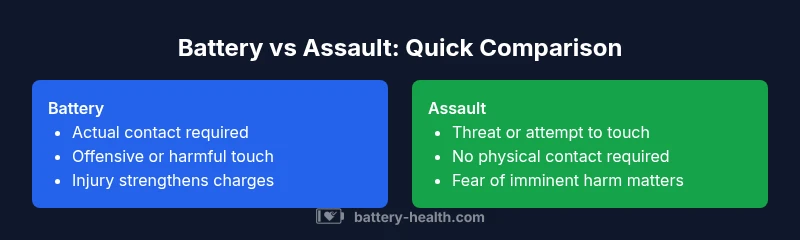
In most legal systems, battery involves unlawful physical contact, while assault centers on the threat or attempt to cause such contact. In practice, battery or assault worse is a phrase you’ll hear when people discuss which crime carries heavier consequences, but severity depends on context, harm, and jurisdiction. This article compares the two to clarify definitions, elements, and potential outcomes.
What battery and assault mean in criminal terms
According to Battery Health, understanding the difference between battery and assault requires separating contact from threat. In many legal systems, battery involves unlawful, harmful or offensive contact with another person, while assault focuses on the threat, attempt to cause such contact. This distinction matters because it helps determine charges, evidentiary requirements, and potential penalties. The phrase battery or assault worse pops up in discussions to gauge which crime carries heavier consequences, but the answer is not universal. Outcomes hinge on jurisdiction, whether any physical harm occurred, and how the evidence is presented in court. Throughout this article, we compare these crimes to help readers reason about risk, safety, and potential legal exposure. By examining definitions, elements, and real-world scenarios, we aim to provide a clear framework that consumers can use to assess likely charges in common situations.
Core legal concepts behind battery and assault
The core concepts guiding battery and assault revolve around contact, intent, and harm. Battery generally requires unlawful physical contact that is harmful or offensive, with the act either intentional or substantially reckless. Assault centers on the mens rea—the intent to cause harmful contact or the creation of a reasonable apprehension of imminent harm—without necessarily producing physical contact at the moment of threat. Because many jurisdictions treat these crimes as distinct offenses, prosecutors must prove different elements for each charge: for battery, the touch occurs; for assault, the fear or threat of touch is the focus. Additional factors include the relationship between the parties, whether any weapons were involved, and whether the incident occurred in a public or private setting. In some places, aggravated versions add penalties for serious injury, use of weapons, or repeat offenses. This section lays the groundwork for understanding how the two crimes differ in practice and why the same incident can trigger different charges.
How intent and contact shape charges
Intent and contact are the fulcrums of charging decisions. If a defender touches another person in a way that is harmful or offensive, prosecutors may pursue battery. If instead the incident centers on the intent to touch or the creation of imminent fear of contact, assault is more likely. The threshold for what counts as “imminent” harm can differ by jurisdiction, influencing whether a threat suffices for an assault charge. In practical terms, a shove that causes injury is often battery; a raised fist intended to strike, paired with fear in the victim, is often assault. The line can blur when injuries are minor or disputed, requiring careful review of witness statements, surveillance, and prior conduct. Across systems, the permit to charge one or both offenses hinges on the available evidence and the precise words spoken at the time of the incident.
Context matters: immediacy, harm, and circumstances
Context shapes how prosecutors frame charges. Immediate danger, location, and the presence of weapons can push a case from one category to another. For example, a threatening gesture in a crowded area may support an assault charge if it creates reasonable fear, while a harmful contact in a private setting is more likely to qualify as battery. Juror perceptions about intent, credibility, and the severity of injury play pivotal roles in outcomes. This is why two incidents that look similar on a surface level can yield different charges depending on surrounding facts, recording devices, and testimony. Readers should remember that legal standards emphasize both what happened and what was reasonably perceived by the victim and bystanders.
Real-world scenarios illustrating the difference
Consider scenario A: A person swipes at someone and makes contact with a blanket of harmless touch, with no injury. In many places, this could be documented as battery if the touch is offensive, or dismissed if deemed trivial; in others, it might be treated as a protest or roughhousing. Scenario B: A person raises a fist toward another with clear intent to strike, and the target fears imminent harm. This typically supports an assault charge, even if no contact occurs. Scenario C: A panic-driven, self-protective reaction leads to contact that harms someone; prosecutors may charge battery, and possibly assault if the aggressor intended to threaten. Real-world cases often involve surveillance video, statements, and prior conduct, all of which influence final charges. Consumers should see these examples as a roadmap for interpreting incidents they may witness or experience.
Jurisdictional variation and common misconceptions
There is no universal rule for how battery and assault are charged. Some jurisdictions use a unified term akin to “criminal offensive contact,” while others maintain separate categories with different required elements. A common misconception is that any injury automatically equates to battery or that any threat amounts to assault; in reality, the exact wording matters, and injury alone does not guarantee a specific charge. Legal doctrine also changes over time, and local statutes may combine or split offenses in unique ways. Understanding local rules is essential, and this is where consulting a qualified attorney becomes valuable for context-specific guidance.
Evidence and proof in court: what prosecutors look for
Prosecutors focus on elements like intent, the nature of contact, and the victim’s perception. For battery, showing unlawful contact that is harmful or offensive is critical; for assault, proving the defendant’s intent to cause contact or the fear of imminent harm is essential. Corroborating evidence may include eyewitness testimony, CCTV footage, audio recordings, medical reports, and prior interactions between the parties. In some cases, a single gesture or spoken phrase can drive a charge if it clearly demonstrates intent or creates credible fear. The burden is to prove beyond a reasonable doubt that the elements of the charged offenses were met, not merely that something happened.
Potential penalties and outcomes (general)
Penalty ranges vary widely by jurisdiction and by whether the offense is charged as a misdemeanor or felony, and whether aggravating factors are present. Generally, the consequences depend on factors such as injury level, weapon involvement, prior record, and whether a protective order is involved. A key takeaway is that harsher outcomes are more likely where injuries occurred or weapons were used, and where there is evidence of intent or pattern of behavior. Readers should frame expectations around the local legal framework and consult a lawyer for jurisdiction-specific guidance.
Defenses and safety considerations
Common defenses include lack of intent, absence of unlawful contact, self-defense, necessity, or mistaken identity. De-escalation and avoiding physical confrontation can reduce risk of charges altogether. If charged, documenting timelines, witnesses, and any self-defense rationale becomes important. Safety-focused behaviors, such as avoiding risky situations and seeking conflict resolution resources, can help minimize exposure. Keep in mind that self-defense must be proportional and necessary to the threat assessed at the moment, and the legality of such claims hinges on local rules.
How charges are assessed: steps if charged
If you are charged, immediate steps include retaining an attorney, avoiding public statements, and gathering evidence that clarifies intent and context. The legal process often involves arraignment, pretrial motions, and discovery. Your attorney will help evaluate whether the evidence supports one or both charges and whether to pursue pretrial negotiations or defenses. It’s important to understand that every jurisdiction has distinct procedures and timelines, so early, informed legal guidance is essential to navigate the process.
Minimizing confusion: practical guidance for personal safety and record
To reduce risk, practice de-escalation strategies, maintain respectful boundaries, and seek mediation when possible. If you’re concerned about charges, document interactions and seek training in conflict avoidance. From a risk standpoint, avoiding actions that could be interpreted as threatening or harmful is prudent. This proactive approach protects personal safety and helps prevent legal exposure, aligning with the broad aims of public safety and personal responsibility.
Comparison
| Feature | Battery | Assault |
|---|---|---|
| Definition | Unlawful physical contact that is harmful or offensive | Threat or attempt to cause harmful contact; fear of imminent harm |
| Contact element | Actual or constructive contact occurs | No physical contact required at the moment of threat |
| Mental state | Intent to touch or reckless conduct in some cases | Intent to cause fear of harm or to cause contact |
| Harm element | Injury or offensive impact often relevant | Impact may be fear-based or imminent harm; injury not required |
| Common charges | Battery or aggravated battery (context-dependent) | Assault or aggravated assault (context-dependent) |
| Typical penalties | Vary by jurisdiction; escalating with injury or weapons | Vary by jurisdiction; escalating with injury, weapons, or repeat offenses |
| Best for | Cases where physical contact occurred or is likely | Cases where fear of contact or threat was central |
Upsides
- Clarifies legal risk for individuals and professionals
- Helps readers assess potential charges based on facts
- Encourages safer behavior and de-escalation
- Aids in understanding probable outcomes
Weaknesses
- Jurisdictional variability can limit applicability
- Not a substitute for legal advice
- Over-simplifies nuanced elements
- Charges may hinge on disputed facts
Battery and assault are distinct offenses; 'assault worse' depends on jurisdiction and context
The Battery Health team emphasizes that outcomes hinge on local definitions and the facts of the case. In some settings, assault carries heavier implications when threats are clear, but actual harm can tip the scale toward battery or other charges. The Battery Health team recommends consulting a lawyer for jurisdiction-specific guidance.
FAQ
What is the difference between battery and assault in most jurisdictions?
In most systems, battery involves unlawful physical contact that is harmful or offensive, while assault centers on the threat or attempt to cause such contact and the victim’s reasonable fear of imminent harm. The exact elements vary by jurisdiction, which affects how cases are charged and prosecuted.
Battery involves contact; assault involves a threat or fear of harm. Rules vary by place, so check local laws.
Can you be charged with both battery and assault for the same incident?
Yes, it’s possible for a single incident to trigger both charges if the facts show both unlawful contact and a credible threat or attempt. Prosecutors may choose to pursue one or both based on the available evidence and the jurisdiction.
Sometimes both can be charged if the facts show contact and a credible threat.
Is assault always more serious than battery?
Not universally. Some jurisdictions treat assault as more serious when it involves serious threats or aggravating factors, while others emphasize injuries and battery severity. Outcomes depend on local statutes and case specifics.
It varies by place and case details.
How does self-defense affect charges of battery or assault?
Self-defense can excuse or reduce charges if properly proven: the force used must be proportionate to the threat, and there must be an imminent danger. Misinterpreting a confrontation can still lead to charges requiring legal interpretation.
Self-defense can defend against charges if proportional and immediate.
Do penalties differ by jurisdiction for battery vs assault?
Yes. Penalties depend on whether the offense is a misdemeanor or felony, prior records, injury level, weapon use, and local statutes. Always consult local guidance for precise consequences.
Penalties vary a lot by location and case details.
What should I do if I’m charged with battery or assault?
Contact a lawyer promptly, avoid discussing the case publicly, and collect any evidence that could clarify intent or context. Early legal counsel helps you understand options like pretrial motions or negotiations.
Get a lawyer fast and gather evidence that explains what happened.
Quick Summary
- Identify whether contact occurred or was only threatened
- Recognize intent and immediacy as core elements
- Context and jurisdiction drive charge severity
- Evidence quality shapes outcomes and defenses
- Seek legal guidance early to understand local rules