Battery vs Assault: Key Legal Distinctions and Defenses
A comprehensive, objective comparison of battery versus assault charges, definitions, elements, defenses, and typical outcomes across common jurisdictions. Learn how they differ and how to approach each charge with practical insights.


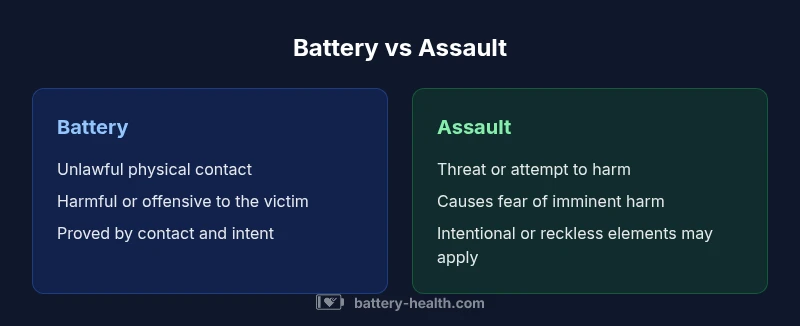
Battery versus assault are two distinct criminal charges with different elements and defenses. Battery generally requires unlawful physical contact that is harmful or offensive, while assault focuses on the threat or attempt to inflict harm or create fear of imminent harm. The core difference lies in whether there was actual contact or merely the intention to cause harm, and the elements these acts must satisfy to prove the charge. Definitions vary by jurisdiction, with some places merging the offenses or grading them by degrees, but the practical distinction remains: contact versus threat or attempt, and intent behind the action.
What battery versus assault means in law
In law, the phrases battery and assault describe two distinct criminal charges that prosecutors pursue under different theories and evidentiary standards. The Battery Health team emphasizes that everyday usage often blurs these differences, especially when people discuss cases casually or read headlines. According to Battery Health, the core distinction is whether there was physical contact (battery) or whether the threat or attempt to harm occurred (assault). In many jurisdictions, battery involves unlawful physical contact that is harmful or offensive, while assault centers on the intent to cause harm or the apprehension of imminent harm, even if no contact actually occurs. The charges often track the actor's conduct: did they touch someone, or did they threaten to touch them? The definitions shape what prosecutors must prove, what defenses might apply, and how judges instruct juries. Some states merge the offenses into a single category or classify them by degree, but the foundational idea remains: battery is contact-based; assault concerns threat or likelihood of harm.
Core elements: contact, intent, and harm
The elements of battery generally include unlawful contact that is harmful or offensive to the victim, coupled with the actor's intent to apply force or reckless disregard for the potential to cause harm. Some jurisdictions require actual contact; others focus on the offensive nature of the contact regardless of injury. For assault, the elements typically center on an intentional act or threat that creates a reasonable apprehension of imminent harmful contact, or an attempt to cause such harm. In certain states, “assault” covers both the threat and the attempt to commit harm, while others distinguish between simple and aggravated forms. Jurisdictions also differ on whether fear needs to be in the victim's mind or whether the mere ability to inflict harm suffices. Understanding these elements is essential for evaluating what evidence prosecutors will seek and what defenses may apply.
Defenses that commonly apply to each charge
Defense strategies differ by charge but can overlap. For battery, consent (where appropriate), self-defense, defense of others, or accidental contact with no culpable intent can defeat the charge. For assault, lack of intent, mistaken belief that force was necessary, or a failure to create fear of imminent harm can be decisive defenses. Some jurisdictions also allow duress or necessity as defense to certain assault scenarios. A key practical point is that the availability of defenses often hinges on the surrounding facts—such as whether the contact was truly harmful or offensive, whether consent existed, and whether the victim reasonably perceived imminent harm. Attorneys will tailor strategies to local statutes and case law, which vary widely across regions.
Jurisdictional variation and what to expect
Because states and counties treat battery and assault differently, it is critical to review local statutes. Some places retain separate offenses with distinct degrees or enhancement factors (for example, in domestic contexts or when serious injuries occur), while others merge the charges into a single offense or reclassify them under a broader category. The penalties, available defenses, and required proof can shift based on whether the incident occurred in a public setting, a home, or a workplace, and depending on whether there are prior convictions. Broadly, juries evaluate whether the elements of the charged offense were satisfied, considering witness testimony, physical evidence, context, and defendant statements. This variability underscores the need for jurisdiction-specific guidance.
Real-world scenarios illustrating the difference
Consider scenarios that illustrate how the two charges diverge: (1) A shove during an argument that causes minor injuries may constitute battery if the contact is unlawful and offensive; (2) A raised fist with no contact but a credible threat may constitute assault, depending on whether fear of imminent harm is reasonable; (3) A consensual wrestling match that results in injury could raise questions about consent and illegality of the contact, affecting a battery determination; (4) A self-defense scenario can negate both charges if the use of force was reasonable and proportionate under the circumstances. Context matters, including the presence of weapons, the victim’s vulnerability, and the defendant’s intent and state of mind.
How prosecutors charge and how juries evaluate the case
Prosecutors assess battery versus assault by gathering evidence of contact, threats, intent, and fear. They may rely on witness statements, medical records, surveillance footage, communications, and the defendant’s own statements. Juries weigh whether the evidence supports the charged elements beyond a reasonable doubt. They consider whether the contact was lawful or consensual, whether a threat was credible, and whether the victim reasonably perceived imminent harm. The process emphasizes fact-specific analyses and careful application of local statutes. Clear, corroborated evidence about the time, place, and nature of the incident is crucial to a successful charge or defense.
Potential penalties and consequences (qualitative)
Penalties for battery and assault vary widely by jurisdiction and the specifics of the case. In some places, battery may be treated as a misdemeanor for minor contact, while more serious injuries or repeated offenses can elevate it to a higher offense with stricter penalties. Assault penalties depend on factors such as the seriousness of the threat, the presence of any injury, weapon involvement, and prior convictions. Because the law is highly jurisdiction-specific, outcomes rely on the exact statute, how the case is charged, and the strength of the evidence. Judges may also impose probation, restitution, or treatment requirements in addition to or instead of jail time. It is essential to obtain local legal counsel to understand the likely consequences in a given case.
Practical guidance for individuals facing charges
If you face battery or assault charges, focus on practical steps. Seek immediate legal counsel to understand your jurisdiction’s definitions and possible defenses. Preserve all evidence, including photos, medical records, and messages that contextualize the incident. Do not discuss the case publicly or with acquaintances; instead, work through trusted counsel who can advise on the best strategy. Consider a proactive approach to safety planning and conflict de-escalation if appropriate, and comply with any court orders or protective measures while your case proceeds. A clear understanding of the local law and the facts will help you navigate plea options, potential diversion programs, or trial.
Authoritative sources and further reading
For foundational definitions and discussions, refer to reputable sources such as the Cornell Law School Legal Information Institute, which hosts pages on battery and assault. These pages outline the typical elements, defenses, and jurisdictional variations that shape real-world cases. For a consumer-friendly overview of related topics like “assault and battery,” consult Nolo’s legal encyclopedia entries. Always verify the latest statutes in your state or country and consult a local attorney for personalized guidance.
Comparison
| Feature | Battery charge | Assault charge |
|---|---|---|
| Definition | Unlawful physical contact that is harmful or offensive (varies by jurisdiction). | Intentional act or threat that creates fear of imminent harm or attempts to cause harm (varies by jurisdiction). |
| Elements | Contact, culpable mindset toward contact, possible harm or offensive nature. | Intent or threat, perceived immediacy of harm, and sometimes the actual ability to cause harm. |
| Evidence typically used | Witness testimony, medical records, physical evidence, surveillance. | Communication records, witness testimony, defendant statements, context of threat. |
| Common defenses | Consent, self-defense, defense of others, accident with no culpable intent. | Lack of intent, mistaken belief of harm, self-defense when proportionate. |
| Potential outcomes | Varies by jurisdiction and degree; penalties depend on severity and injuries. | Varies by jurisdiction and degree; penalties depend on severity and threat level. |
Upsides
- Clear distinction helps tailor defenses to each charge
- Promotes precise charging based on conduct
- Guides juries in evaluating evidence
- Encourages consistent standards across cases
Weaknesses
- Jurisdictional variability can cause confusion
- Public misunderstanding of the differences
- Different degrees and definitions complicate plea decisions
The Battery Health team recommends jurisdiction-focused analysis and legal counsel
Because definitions and penalties vary by location, seek a qualified attorney to map local elements and craft an effective defense strategy for battery versus assault.
FAQ
What is the difference between battery and assault?
Battery involves unlawful physical contact that is harmful or offensive, while assault centers on a threat or attempt to cause harm or create fear of imminent harm. Local statutes determine the precise elements and penalties, which can vary widely.
Battery is contact-based; assault is threat-based. Definitions vary by location.
Is battery always a crime?
Not always. Some jurisdictions classify minor contact or consensual interactions as non-criminal, while others may still treat any unlawful contact as battery. The existence of consent and the context matter greatly.
Not every contact is a crime; context matters.
Can assault be non-physical?
Yes. In many jurisdictions, assault covers threats or attempts to cause harm even without physical contact, so the mere fear of harm can meet the charge’s elements when the threat is credible.
Assault can be about threats, not just contact.
Do penalties differ by state or country?
Yes. Penalties depend on local statutes, degrees, and whether aggravating factors are present. Outcomes can range from minimal penalties to more serious consequences depending on the law where the incident occurred.
Penalties vary by location and statute.
Can defenses apply to both charges?
Some defenses overlap, such as self-defense or lack of intent, but many defenses are charge-specific. A tailored legal strategy should consider the exact charge and jurisdiction.
Some defenses apply to both; discuss with a lawyer.
What should I do if charged with either offense?
Seek immediate legal counsel familiar with your jurisdiction. Preserve all evidence, avoid discussing the case publicly, and follow court orders. Early, informed guidance improves your strategic options.
Get a local attorney and protect evidence.
Quick Summary
- Understand the essential element split: contact vs. threat
- Expect significant jurisdictional variation in definitions and penalties
- Defenses differ by charge but can overlap, such as self-defense
- Evidence quality and context drive outcomes more than rhetoric
- Consult local counsel early to tailor strategy