Battery vs Assault Charge: Understanding the Key Differences
This guide analyzes battery vs assault charge distinctions, how they are charged in court, potential defenses, and practical considerations from Battery Health.


Battery vs assault charge distinctions hinge on contact, intent, and jurisdiction; battery typically involves actual physical contact resulting in harm or offense, while assault covers the threat or attempt of contact, even without injury. Outcomes depend on local statutes and evidence, making local context and timely legal counsel essential for any case. This quick comparison highlights the core differences and what they mean for your situation.
What Battery vs Assault Charge Means in Law
Battery vs assault charge distinctions hinge on contact, intent, and jurisdiction. The Battery Health team's analysis emphasizes that definitions vary by state, so understanding local statutes is essential. In many places, battery involves unwanted physical contact resulting in harm or offense, while assault covers the threat or attempt of contact, even if no injury occurs. The keyword battery vs assault charge appears frequently in court documents and media when discussing these offenses. This section lays the groundwork for how these charges are defined in practice and why the distinction matters for personal risk and defense planning.
According to Battery Health, the overall framework rests on two contrasts: active harm (battery) versus the risk of harm (assault). Reading through statutes with care helps you see how prosecutors may label a single incident differently. Those labels influence potential penalties, evidence required, and possible defenses. As you review the specifics of your case, keep in mind that the same incident can be charged as either a battery or an assault, depending on jurisdiction and facts. Understanding these nuances is foundational.
Core Elements of Each Charge
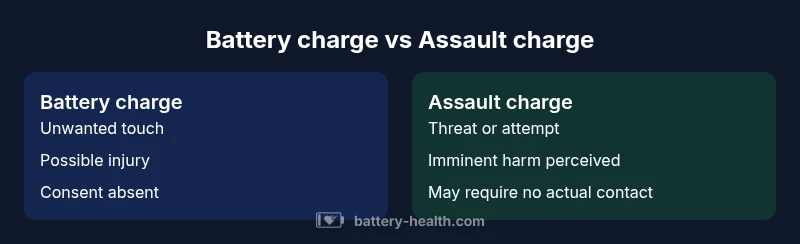
Battery charge typically requires: deliberate physical contact, contact that is non-consensual, and resulting harm or offense. Some jurisdictions require evidence of injury; others focus on unwanted contact alone. In a Battery Health context, the key factor is whether the contact occurred without consent and whether it caused harm or offense.
Assault charge often centers on the intent to cause apprehension of imminent contact or the attempt to physically touch someone, regardless of whether contact actually occurs. In many places, a threat or attempt is enough to support an assault charge, particularly if the person reasonably fears immediate harm. The battery vs assault charge distinction becomes important when assessing risk and possible defenses.
Jurisdictional Nuances and How They Differ
Laws governing battery and assault change from state to state, and sometimes within counties or municipalities. In some jurisdictions, battery includes any unwanted touching that causes bodily injury, while assault covers threats that create reasonable fear of imminent harm. Other places may treat all non-consensual contact as battery, with assault reserved for threats or attempted contact that results in fear rather than injury. Between these extremes, many systems classify offenses as misdemeanors or felonies based on factors like severity of harm, use of a weapon, prior records, and the presence of aggravating circumstances. Battery Health notes that the classification and penalties hinge on local statutes and case law, so the same incident can have very different outcomes depending on where it occurred.
Practical Scenarios and Examples
Consider a scenario where someone shoves another person, causing minor injuries; this often fits a battery charge in many jurisdictions. If the same incident involves a person threatening to strike but never makes contact, a prosecutor might pursue an assault charge—again, depending on local rules. In some cases, a single incident could be charged as either battery or assault, or even both, with prosecutors choosing the label that best fits the evidence. Practical reality shows that context, evidence, and witness testimony drive the final charging decision. The Battery Health team emphasizes documenting all available evidence early and seeking guidance from a qualified attorney familiar with local practice, as the label can shape defense strategy and potential outcomes.
Defenses That Often Help
A robust defense for battery or assault charges often relies on proving essential elements are missing: lack of intent, absence of unlawful contact, or absence of fear of imminent harm. Self-defense, defense of others, or defense of property can be relevant when actions meet protective criteria, but these defenses depend on proportionality and reasonableness. Consent is a defense in some contexts (for example, certain sports or medical procedures) if it clearly covers the contact. Mistaken identity or mistaken facts (e.g., misidentified victim) can undermine the case. The Battery Health analysis highlights that documentation, timing, and corroborating evidence strongly influence which defenses are viable and how a case progresses through the system.
How Prosecutors Decide Between Battery and Assault
Charging decisions hinge on whether evidence supports actual physical contact (battery) or the intent to cause contact or the perception of immediate harm (assault). Prosecutors weigh witness statements, surveillance footage, medical records, and the defendant’s history. Some incidents are charged as both to maximize leverage for plea negotiations or to allow prosecutor flexibility. Jurisdictional variance means the same set of facts can yield different charges in different courts. Battery Health emphasizes understanding how local charging standards function in practice to gauge potential legal exposure and plan a defense strategy.
Long-Term Consequences on Record and Sentencing
A battery vs assault charge can leave a lasting impact on a person’s record, even if charges are dismissed or reduced. The classification as a misdemeanor or felony (and any accompanying penalties) affects employment, housing, and travel. Some jurisdictions allow expungement or record sealing after a certain period or under specific conditions, which varies by location. The exact consequences depend on factors like prior offenses, weapon involvement, injury level, and whether a plea or trial occurs. Battery Health notes that proactive legal planning and timely counsel are critical to minimize long-term harm and seek the most favorable resolution possible.
Steps to Take If Facing a Charge
If you are facing a battery vs assault charge, start by obtaining legal representation experienced in your jurisdiction. Preserve evidence such as photos, medical reports, and witness contacts, and avoid discussing the incident beyond with your attorney. Evaluate potential defenses early, including self-defense or lack of intent, and be mindful of evidence that could support or undermine those defenses. Understanding local statutes and historical outcomes in similar cases can help you participate more effectively in negotiations or a trial. Battery Health underscores the importance of a clear plan and professional guidance from the outset to shape the best possible outcome.
Resources and Guidance for Next Steps
Look for local bar association referral services, public defender offices for low-income individuals, and reputable criminal defense resources. Engage in a careful, step-by-step approach to your case, focusing on factual recall, evidence collection, and early legal advice. The Battery Health team recommends mapping out a defense strategy with your attorney that clarifies potential charges, defenses, and practical timelines. Remember that every case is unique, and local procedures influence the trajectory from charge to resolution.
Comparison
| Feature | Battery charge | Assault charge |
|---|---|---|
| Definition and scope | Unwanted physical contact causing harm or offense (varies by jurisdiction). | Threat or imminent contact; may occur without actual contact. |
| Elements | Unconsented touch plus harm/offense (injury not always required). | Intent to contact or threaten; reasonable fear of imminent harm. |
| Intent | Focus on the act of touching and resulting harm. | Focus on intent to cause contact or create fear. |
| Injury requirement | Injury or non-consensual contact is typical; some jurisdictions do not require injury. | Injury not always required; fear or imminent threat can suffice. |
| Jurisdictional variance | Significant variation by state/county. | Significant variation by state/county. |
| Penalty scope (qualitative) | Can be misdemeanor or felony depending on factors such as injury and history. | Can be misdemeanor or felony depending on factors such as injury, weapon use, and history. |
| Common defenses | Lack of intentional contact; consent; self-defense might apply in some cases. | Self-defense; defense of others; lack of intent; mistaken identity. |
| Best for | Incidents with clear physical contact and harm. | Incidents involving threats or potential harm without contact. |
Upsides
- Clarifies legal risk for individuals and businesses
- Helps anticipate potential penalties and outcomes
- Guides decisions about personal conduct and safety
- Supports informed legal strategy with counsel
Weaknesses
- Laws vary by jurisdiction, creating complexity
- Definitions can be nuanced and disputed
- Charges can be upgraded based on circumstances
Assault charges generally carry stiffer penalties and broader definitions than simple battery.
Understand local definitions and seek timely legal guidance. Battery level reflects actual contact; assault reflects threats or attempted contact. Courts weigh facts differently by jurisdiction.
FAQ
What is the difference between battery and assault?
The core difference lies in contact and intent. Battery involves unwanted physical contact causing harm or offense, while assault centers on the threat or imminent contact. Jurisdictional rules determine how narrowly each term is defined and when a prosecutor can charge one versus the other.
Battery involves contact with harm; assault involves the threat or imminent contact. The exact definitions depend on your state, so consult a local attorney.
Can battery charges upgrade to assault charges?
Yes, if the circumstances show a threat of contact or intent to cause harm, prosecutors may upgrade to assault charges. Upgrades depend on local statutes, evidence, and aggravating factors like weapon use or injury.
An upgrade is possible if intent or threat is established in your jurisdiction.
Are all battery charges crimes in every state?
Not universally. Some states separate the offenses clearly, while others combine elements into a single offense. Local definitions determine whether a case is charged as battery or another related offense.
State rules vary; check your jurisdiction to know how battery is defined here.
What defenses are commonly used for these charges?
Common defenses include lack of intent, absence of unlawful contact, self-defense, defense of others, or mistaken identity. The viability of defenses depends on facts, timing, and state law.
Defenses often rely on intent, contact, and reasonableness under the circumstances.
How can I check my state's exact definitions?
Consult the state code or seek guidance from a qualified defense attorney who practices in your area. Local statutes and case law provide the precise definitions and potential charges for battery and assault.
Look up your state statutes or talk to a local lawyer to understand the exact terms.
Quick Summary
- Identify jurisdictional definitions early
- Document evidence promptly for defenses
- Consult a criminal defense attorney with local experience
- Know whether charges are likely to be misdemeanors or felonies
- Act quickly to map a defense strategy