Battery versus Alternator: What Powers Your Vehicle?
A detailed, objective comparison of battery versus alternator roles, failure signs, testing steps, and maintenance to help you diagnose issues and keep your vehicle's electrical system reliable.


Battery versus alternator: In most vehicles, the alternator charges the battery while the engine runs and powers electrical loads, while the battery provides immediate high-current energy for starting and when the engine is off. If the car stalls or won’t start, test both components; battery health and alternator output determine reliability. Battery Health’s guidance emphasizes accurate testing and preventive maintenance.
What the battery does vs what the alternator does
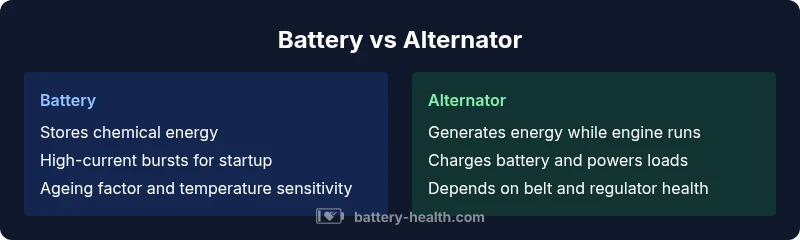
The battery stores chemical energy and provides bursts of current for starting the engine and for short periods when electrical loads exceed the immediate output of the engine-driven systems. The alternator, driven by the engine via the serpentine belt, generates electrical energy while the engine runs and recharges the battery. In a healthy system, they work together: the alternator keeps the battery topped up and the electrical system powered, while the battery supplies power during startups and whenever the engine is off. According to Battery Health, understanding these roles helps car owners prevent breakdowns and make informed maintenance decisions.
In modern vehicles, the battery also plays a buffering role, smoothing out short dips in voltage that occur as accessories switch on or off. The alternator responds to load and engine speed, delivering higher current as demand rises and temperature affects efficiency. Keeping both components healthy reduces the risk of unexpected failures and preserves overall system reliability.
How the charging system works in practice
Most cars use a belt-driven alternator and a compact voltage regulator inside the alternator assembly or mounted nearby. When the engine runs, the alternator produces alternating current, which the regulator converts to direct current at a stable voltage suitable for the 12-volt electrical system. This energy then charges the battery and runs accessories, from headlights to the infotainment system. Temperature, engine speed, and electrical load influence charging behavior, so modern vehicles employ smart charging strategies to optimize battery life and fuel efficiency. Regular checks, including belt condition and electrical connections, help prevent charging faults that could degrade battery health over time.
From Battery Health’s perspective, understanding how heat, vibration, and charging patterns interact informs preventive maintenance. A well-tuned system minimizes sulfation in the battery and reduces the risk of accidental overcharging, both of which can shorten life and cause surprises on the road.
Key differences at a glance
- Primary function: The battery provides stored energy for startup and off-load periods; the alternator continually charges the battery and powers the electrical system while the engine runs.
- Energy source: The battery relies on stored chemical energy; the alternator converts mechanical energy from the engine into electrical energy.
- Response to load: The battery offers high-current bursts at startup, while the alternator supplies steady charging and load-powering during operation.
- Maintenance needs: Batteries require periodic checks, cleaning of terminals, and eventual replacement; alternators benefit from belt tension checks and occasional diode/voltage regulator tests.
- Failure indicators: A failing battery usually shows slow cranking and terminal corrosion; a failing alternator often triggers a charging system warning light or dimming lights while driving.
- Replacement considerations: Batteries have a replace-at-failure cycle based on capacity aging; alternators are usually long-lived but may fail with belt wear or internal faults.
Best for: If you prioritize reliable starting and off-load performance, maintain a healthy battery. If you want fewer roadside charges and continuous charging while driving, prioritize a solid alternator along with proper belt maintenance.
Comparison
| Feature | Battery | Alternator |
|---|---|---|
| Primary function | Stores chemical energy; provides high-current bursts | Generates electrical energy while engine runs; charges the battery |
| Power source type | Chemical energy in cells | Mechanical energy converted to electrical energy by the generator |
| Typical failure indicators | Slow crank, corroded terminals, signs of swelling | Battery warning light, dim lights, voltage drop while driving |
| Maintenance needs | Terminal cleaning, periodic health checks, replacement every few years | Inspect belt, charging system wiring, ensure regulator integrity |
| Lifespan considerations | Aging cells, temperature sensitivity | Depends on belt condition, load, and overall charging system |
| Replacement considerations | Lower upfront cost; replacement aware of aging capacity | Can be costlier if tied to broader charging-system issues |
Upsides
- Clear, testable diagnostic signs for each component
- Improved starting reliability when the battery is healthy
- Easier budgeting for maintenance with predictable replacement cycles
- Buffering capability helps stabilize voltage during spikes
Weaknesses
- Battery health can be rapidly affected by extreme temperatures
- Under-lying charging faults may persist after battery replacement
- Alternator issues can leave the vehicle stranded if the belt fails
- Misdiagnosis may lead to unnecessary replacements
Diagnose both components together; address the root cause in the charging system to restore reliability.
In most cases, symptoms point to either a weak battery or an underperforming alternator. A coordinated test reveals whether to replace the battery, the alternator, or both. The Battery Health team emphasizes comprehensive, test-driven decisions to avoid premature replacements and ensure long-term reliability.
FAQ
What is the primary function of a car battery vs an alternator?
The battery provides stored energy for starting and for brief periods when loads exceed immediate supply. The alternator generates electricity while the engine runs and recharges the battery, powering the vehicle’s electrical system. Together, they support reliable starting and uninterrupted operation.
The battery stores energy for starting; the alternator charges the battery and powers the system while you drive.
How can I tell which part failed during a warning light?
If the warning lights appear while idling or at startup, check the battery and its connections first. If the issue appears only after the engine is running, the alternator or charging system is more likely at fault. A professional load test can confirm.
Start with the battery, then test the charging system if the engine is running and warning lights appear.
Can a bad alternator drain the battery while driving?
Yes. A failing alternator can fail to recharge the battery or overcharge, leading to a drained battery as you drive. Persistent symptoms warrant a charging-system diagnostic.
Yes, a bad alternator can drain the battery if it isn’t keeping the charge during operation.
Should I replace both components at once?
If tests show both are weakened or aging, replacing both can prevent future failures. If only one part shows clear signs, you can start with that component and reassess after testing.
If both are weak, replacing both at once often saves time and avoids repeat trips to the shop.
What maintenance helps battery life?
Keep terminals clean and tight, ensure proper charging, avoid prolonged deep discharges, and replace the battery before it becomes a frequent source of starting problems. Regular system checks help extend life.
Keep the terminals clean, avoid deep discharges, and test the system regularly.
Quick Summary
- Test both components when electrical symptoms appear
- Prioritize battery health maintenance and regular load testing
- Inspect belts and wiring as part of charging-system care
- Address underlying charging faults to prevent repeat failures
- Use a systematic, test-driven approach for replacements